
by Cynthia McKinney
With General Motors and Chrysler at death’s door, the incoming Obama administration had an opportunity to perform a transformative bailout, to invest billions in public dollars to leapfrog U.S. automakers into the green future. Instead, Obama’s men spent $50 billion to maintain the industrial status quo and further weaken unions.
Obama Blows Chance to Remake U.S. Transportation
by Cynthia McKinney
“Government policy-makers had a tremendous opportunity to set transportation policy for the 21st century and beyond.”
Since 2008, both the Bush and Obama Administrations spent hundreds of billions – by some estimates, up to TRILLIONS – of dollars bailing out Wall Street investors, banks and industrial firms. Much was said about the need to provide a stimulus to the economy, with the public understanding that job creation would follow the infusion of cash into these sectors. But thus far, there has been little impact on unemployment, and there is no light at the end of the tunnel for the unemployed.
With the infusion of so much public money into these sectors came the possibility of structural change. The government was in the driver's seat, the public was heavily invested in finance and industry, and policy in those sectors – i.e., policy in such critical areas as transportation – could now be set by the people.
Butt that hasn't happened, as we all know. And this past week, the possibility of real change in the transportation sector faded into the background.
In 2009, President Obama began a takeover of GM that ended in the auto giant filing bankruptcy, its collapse the result of management's long-running failure to adapt to consumers' demand for reliable fuel-efficient cars. Upon taking ownership, government policy-makers had a tremendous – perhaps unprecedented – opportunity to set transportation policy for the 21st century and beyond. This past week's announcement of the sale of a majority stake in GM was essentially an announcement of a failure to take advantage of that opportunity.
“There is no light at the end of the tunnel for the unemployed.”
The magnitude of this failure cannot be understated, and the reasons for it reveal a lot about this Administration and its priorities.
First, a comparison of the Administration's handling of the GM takeover with the operation of private firms in company takeovers is in order. One common corporate takeover model over the past decades has been the leveraged buy-out ("LBO"), where the buyer uses a very small sum of its own money, leverages it with borrowed funds and other debt, and attains control of the company. These buyers, despite their typically very small stake, are not shy about taking direct control of policy-making and operations at the targeted company from the start.
Here, the government infused some $50 Billion in the first three months alone, laid off workers, reduced pensions and other benefits in the process, and essentially set the company "back on its feet" to be reacquired by the same forces and with the same basic mission that led it to disaster in the first place.
Gordon Gekko couldn't have done a better job – for Wall Street investors. But American workers and taxpayers, as well as those concerned about the health of Planet Earth, didn't fare well at all.
“We will again watch a steady stream of gasoline-addicted automobiles issue forth, produced by fewer and fewer union workers.”
Lost is the chance to turn GM – the company that killed the electric car – into a world-class innovator of non-fossil fuel transportation vehicles; lost also are the jobs that would have followed. And instead of following Michael Moore's suggestion "to build the future: bullet trains, light rail and electric buses," we will again watch a steady stream of gasoline-addicted automobiles issue forth, produced by fewer and fewer union workers.
Interestingly, on the same day that GM stock went back on the market, Japanese automaker Nissan introduced an all-electric vehicle to the US market place. If the prior success of the Toyota Prius is any measure, the Nissan Leaf will likely draw a huge response from American consumers – at the expense, of course, of US automakers and, more importantly, US auto workers.
During my 2008 Presidential campaign, I called for a government takeover of GM, but with the specific purpose of using it as a vehicle to redefine transportation. I specifically called for the development and manufacture of fossil fuel-free cars, trains and buses, which would put the US back in the forefront of the global transportation industry. Instead, President Obama said he hopes to put 1 million electric cars on the road by 2015, a laudable goal compared to the record of the last four administrations, but palpably insufficient as a response to the urgent crises facing our climate, our workers and our competitive industrial position in the world.
We bought and paid for the chance to change the world – and we paid top dollar for it. But instead, we received another shipping container full of more-of-the-same. What a waste...
Cynthia McKinney is a former Democratic congresswoman from Georgia and a Green Party presidential candidate.

 Brazil's indigenous people struggle against an entrenched oligarchy determined to drive them from their lands and a right wing president who is supported by the U.S.
 The United States has cut off channels for sending remittances to the island, leaving families who rely on the help – especially during the pandemic – without desperately needed resources.
 Economic recovery is uneven, with Black workers least likely to be employed in the wake of the covid pandemic.
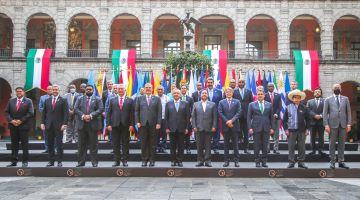 The heads of state of the regional block agreed on a 44-point declaration which addressed the strategy against COVID-19 and climate change and took a stand against the blockade on Cuba.
 The memorial gathering for Glen Ford was held on Saturday, September 18, 2021 in New York City at the Riverside Church.



