 by Kim Ives
When the most popular political party is barred from the election, what's the point of voting? Such was the simple logic of Haiti's recent farcical senatorial run-off election, boycotted by supporters of Lavalas Family, exiled President Jean-Bertrand Aristide's party. “Streets around the capital were eerily devoid of pedestrians and traffic despite the fact that the government allowed the operation of public transportation.” Some estimate only about one percent of eligible voters turned out.
Haiti's Non-Election
by Kim Ives
“The people have shunned the two attempts at authoritarian elections by the government in power.”
What if they held an election and nobody came?
For Haiti’s Provisional Electoral Council (CEP), that is no longer a hypothetical question. It is exactly what happened on Sunday, June 21, when the CEP tried to hold run-offs for 12 of 30 Haitian Senate seats.
Polling stations around Haiti had even fewer voters than they had on April 19, when Haitians massively boycotted the election’s first round by respecting the Lavalas Family party’s call for “Operation Closed Doors, Empty Streets.” The CEP had disqualified the party, Haiti’s largest, on arbitrary and unjustified technicalities (see Haïti Liberté, Vol. 2, No. 40, 4/22/2009).
The CEP claimed there was 11 percent participation in the April 19 vote. Most Haitians scoff at that figure, estimating participation at closer to 1 percent.
The latest boycott, again initiated by the Lavalas Family party, was called “Operation Doors Nailed Shut.”
Foreseeing the abstention, most candidates campaigned very little or not at all. John Joel, a ruling party (Lespwa) candidate for the West Department, which comprises the capital, had to put his fancy color posters higher up on lampposts to avoid the derisive graffiti which was quick to cover them.
One of the capital’s largest voting stations, located at the “Airport Intersection,” at the corner of the normally bustling Delmas and Nazon roads, was completely devoid of any voters when visited by Haïti Liberté reporters shortly after noon. The 14 clear ballot boxes each contained fewer than five ballots. The poll worker assigned to the entrance gate said that practically no voters had shown up, suggesting that primarily poll workers had voted there.
“Most candidates campaigned very little or not at all.”
Streets around the capital were eerily devoid of pedestrians and traffic despite the fact that the government allowed the operation of public transportation, which had been banned during the first round. Only motorcycles, the vehicle of choice for gunmen, were prohibited.
One right-wing journal said the “elections were the quietest and most relaxing” the country has had. But the Lavalas Family made a different assessment in a June 22 press conference.
“The ‘permanent’ electoral council, the president and his government know better than we do the difference between reduced participation and the complete abstention of an entire nation,” a party spokesman declared. “The people have shunned the two attempts at authoritarian elections by the government in powerbecause they were denied any representation. They had no other choice but to stay home because they had no candidates.”
The party asked the Senate to “formally investigate the results of these elections, including the participation rate and the exclusion of Lavalas, as elements for non-validation of the so-called elected representatives of the second round of elections on June 21, 2009.” Senators “cannot miss this opportunity to prove to the Haitian people that they are on their side and therefore will not condone this conspiracy that is a national disgrace to Haiti,” the party concluded.
“They had no other choice but to stay home because they had no candidates.”
On June 2, over 30 directors of human rights and solidarity groups, academics and prominent individuals from Haiti, the U.S., France and the U.K. sent an open letter to Organization of American States Secretary-General José Miguel Insulza and United Nations Secretary-General Ban Ki-moon urging them to acknowledge the grave problems with Haiti’s April 19 senatorial elections, principally the Lavalas Family’s exclusion.
The signers, including professors Noam Chomsky and William Robinson, writer Claude Ribbé and Bishop Thomas Gumbleton, told the OAS and U.N. leaders that they “are concerned by the unqualified statements of support for Haiti’s flawed April 19, 2009, Senate elections by you and your organizations.” Noting the massive April 19 boycott due to the Lavalas Family’s “unjustified exclusion,” the signers “call on the OAS to revise its line on the April 19, 2009, Senate elections in Haiti, and instead support the holding of new elections.”
The letter concludes by saying that “rather than endorse runoff elections currently scheduled for June 21, and the eventual seating of Senate candidates resulting from an irregular and unrepresentative election, the OAS and the U.N. should support free and fair elections with all candidates represented on the ballot – including those from the most popular political party.”
.

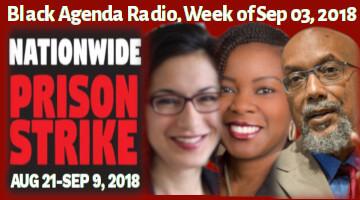 Natl Prison Strike Aug 21 -Sep 9; Ajamu Baraka: 2018 candidates must oppose militarism; Sentencing Project: prison cell phones reveal conditions; Robyn Spencer: BPP stood for solidarity
 The tactics of imprisoned activists have evolved since the prison strike of 2016, which was brutally repressed, especially in Georgia, said Bruce Terpstra, of the Incarcerated Work
 Prison officials across the country are apoplectic over inmate access to cell phones, partly because “it allows people that are incarcerated to serve as reporters, to broadcast firsthand what they
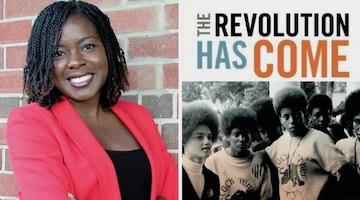 The Black Panther Party “saw the world through a lens of global justice,” said Robyn Spencer, author of the new book, The Revolution Has Come: Black Power, Gender and the Black
 The Women’s March on the Pentagon, scheduled for October 20 and 21, “is an important part of ‘Anti-war Autumn’” activities, said Ajamu Baraka, director of the Black Alliance for Pe



