Barack Obama and Black American Ethnicity
by Marian Douglas-Ungaro
"United States of America will still never yet have elected a Black president who is the descendant of my people's ancestors who were enslaved in the USA."
Speaking for myself, one of the two most disturbing facts about the U.S. presidential election of November 2008 is that so many folks - even folks who've never set foot in the United States, are not U.S. citizens, and have never suffered as 3rd, 4th & 5th class Americans on U.S. soil - are so geared up to "elect themselves a black president." Yet they either have no clue or absolutely do not care that the person who's been put forth is not a descendant of any of the millions of OUR Black American families whose ancestors were physically and genetically bred (as prized "slaves"), and lived and died in this "fair land of milk, honey and money," all the while sharing the same legal status as horses and cows. That long history has marked this country, and it forged the Black American people, as slavery did the entire Afrodescendant population of the Americas, three hundred million-strong today. And yet in 2008, to the best of my knowledge, in any non-majority-Black country of the Americas, and in spite of our history which pre-dates the countries established and built up around us, not one of these descendants will be elected president of her or his land.
Some likely would find such facts sobering, if only they were discussed in the institutions of society, including the media; yet the mere discussion or questioning of all this, apparently, is taboo, verboten, deemed "mean-spirited" and "unnecessary."
The next question to be raised, or more like ignored, is the one of family, history, ethnicity, and who is a Black American. As a Black American myself, I grew up among family, friends and community thinking I knew. In 2008 I've been told (by others who actually have ethnicity, such as "Kenyan" and, more precisely, "Swahili") how "mistaken" I am. I've also been very concerned when the issue is insulted down to the level of whether someone is - quote - "black enough." This is not about race, color, citizenship or nationality. Ethnicity is not solely race, nor vice versa.
"Ethnicity is not solely race, nor vice versa."
I know I'm not the first person (especially among Black Americans, but other Americans and non-Americans, too) to have noticed that the Rev. Jeremiah Wright quite probably has more White ancestry than the Democrats current "last man standing." But every day U.S. society lets Rev. Wright and all Black Americans know how little it cares about how and why many of us, like Rev. Wrigh, came - mostly through rape and slavery - to be so "high yellow." Instead many observers have determined to be totally obsessed with the one-generation "mixed-race background" of the Democrats' presumed presidential candidate from Illinois.
No, all this ain't about race or color. It is about the right of the Black American people, after three hundred years of being muzzled and tongues being cut out for uttering the truth, it's about our right to sorting out our history; not only how we "came to be" - our ethnic heritage - but also our true relationship to the Native Americans and White Americans in our own family trees.
I know of no ethnicity, including Black American, that is reduced to a sort of "club" and which confers "membership" on others who are not from that background.
I'm certainly not saying that persons of other origins are not U.S. citizens. And I am not saying a person is not black, part-black or whatever. But in the same way my parents, siblings and I are not Jamaican, Guyanese, Honduran, Garifuna, Afro-Uruguayan, Afro-Argentinian, Brazilian, or Afro-Mexican; in the same way I am not Nigerian, Kenyan or Somali, nor Ibo, Yoruba or Luo (as was Barack Obama's absent father), I am a Black American - a descendant of Africa and the slave trade, a descendant, too, of Europe and of Native people of North America; bred, born and raised in the Americas, specifically the USA.
"It's about our right to sorting out our history."
I would never attempt to distort or manipulate any of those other groups' identities. They own and have the right to their histories, stories, legends and bloodlines. Apart from the (several) societies and peoples where I, legitimately, can work to trace my ancestry outside what is now the USA, what those countries and histories owe to their people is not due to me - and certainly, in the framework of a long history, not as the first recipient in line. In my entire life alI I have expected was the same respect back for Black Americans.
Today, in no uncertain terms, I'm being told even this (not to mention reparations) is too much to ask.
Black people of different backgrounds - indeed, human beings from any group - can and should work together. But in a real, ethnic group sense, and particularly for a people who've been told we have neither the right to the fruits of our labor nor to our own existence, it is a central fact that others cannot be, are not, me, nor am I them. Attempts to do - and then to tell me I'm supposed to say it's wonderful - will not be well-received.
No matter which man ascends to the U.S. presidential throne in November 2008, the day after that election the United States of America will still never yet have elected a Black president who is the descendant of my people's ancestors who were enslaved in the USA. Until that day finally arrives, if ever it is allowed to happen, I and others like myself, and not only Blacks, shall still be waiting to exhale.
Marian Douglas-Ungaro lives in Washington, DC. Her professional experience includes having served as press secretary and aide on Haiti to former New York congressman Major Owens, and working in international human rights and elections missions in Latin America and the Caribbean, and in the Balkans. She has also lived and worked in East and Central Africa, and visited Somalia and Somaliland. Ms. Douglas-Ungaro can be contacted through her blog at http://marian.typepad.com/, or by email at marian.typepad@gmail.com.

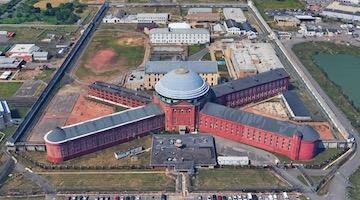 In 1990, Lawrence Bell was 14, orphaned and living in an abandoned house when three Camden cops pressured him to sign a confession of murder.
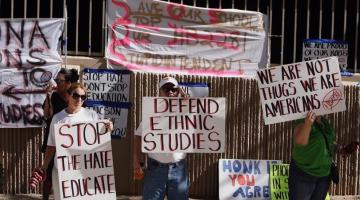 The US university is marked by the dominance of intellectual white liberalism in tension and complicity with conservative nationalism and neoliberalism.
 Alabama Communists helped lay the foundation for the organized civil rights movement that emerged in the late 1940s and early ’50s.
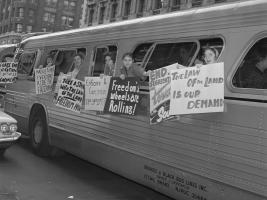 Prison and police abolition were key to the thinking of many midcentury civil rights activists.
 If there’s ever a time when a Reconstruction might actually lead to democratization and the end of American imperialism, this is the opportunity, says Robin D.G. Kelley.



