The Kerner Commission at 40: A Real Program for "Change"
that is Still Being Ignored
by Dedrick Muhammad
This article previously appeared in Inequality.org.
"Too many Americans naively see the mere fact of Obama's
candidacy as evidence of the resolution of the black/white race divide."
In February of 1968 President Lyndon B. Johnson's Kerner Commission Report
was released. The Kerner Commission was created in response to the 1967 urban
Black rebellions in Detroit and Newark. The report famously stated: "Our nation
is moving toward two societies, one black, one white, separate and unequal."
Forty years later, I sat down in front of my laptop to
examine the current presidential candidate's plans to deal with the still
prevailing black/white economic divide. In examining the four leading
presidential candidates websites and the dozen or so issues each highlight, only
once did I find an issue that incorporated the black/white racial divide.
Ironically enough it was the "post-racial" presidential candidate Barack Obama
who saw civil rights as a worthy enough topic for his website. Obama highlights
the issue by mentioning income inequality, a rise in hate crimes, the
suppression of minority voters, and racial disparities in the criminal justice
system. Obama recognizes that the racial divide still challenges this nation.
The problem is that too many Americans naively see the mere fact of Obama's
candidacy as evidence of the resolution of the black/white race divide.
The Kerner Commission report recognized that the
black/white race divide was largely an economic divide and proposed economic
policies to meet this social problem. This policy prescription included:
creating two million jobs, in both the public and private sector; fully
subsidizing on-the-job training for the chronically unemployed; providing
federal assistance to all schools that worked to end de facto segregation;
offering federal funding for year-round compensatory education programs serving
disadvantaged children; developing a uniform national welfare standard to bring
everyone's income up to the poverty line; and building six million new and
renovated units of housing for low and moderate income families.
"Congress passed antiriot legislation rather than the
kinds of social programs advocated in the Kerner Report."

Though the Kerner report was widely discussed at the time of
its release with over two million copies sold, the recommendations were at best
ignored. As the African American Encyclopedia notes Congress passed antiriot
legislation rather than the kinds of social programs advocated in the Kerner
Report.
Obama's civil rights plan is much more modest than that of
the Kerner Commission. Obama advocates strengthening civil rights enforcement,
combating employment discrimination, ending racial profiling and deceptive
voting practices, as well as some criminal justice reforms such as providing
ex-offender support and eliminating sentence disparities. All of these are well
and good but Obama's plan fails to make the necessary investment that could
economically lift African Americans who currently earn about 57 cents on every
dollar that white Americans earn and only have about a fifteenth of the wealth
of white America.
Today America still stands as a nation marked by segregated
black and white societies that remain separate and unequal. A 2002 US Census
Bureau report titled Beyond
Black and White states that African Americans are still the most segregated
racial group in the United States. It also highlights that whites have the
strongest own-race preference when it comes to buying a home. The report
further states that holding other factors constant, while Asian and Hispanic
composition does not matter to Whites buying a home, black neighborhood
composition does.
White Americans dislike of living in communities comprised
of more than 10% African Americans causes a substantial decrease in demand for
African Americans homes which correspondingly causes an erosion in home value.
At the same time, it artificially increases the demand and value of homes located
in overwhelmingly white neighborhoods. With homeownership as the primary source
of wealth for most Americans, the prejudice of white Americans serves to
maintain the current racial wealth divide.
"None of the presidential candidates advocate an economic
development plan that will heal the nations centuries-old black/white divide."

In 1968 there was an understanding that ending the
black/white race divide was an important challenge to the nation as a whole and
that it would require massive federal investment. Today none of the
presidential candidates advocate an economic development plan that will heal
the nations centuries-old black/white divide and only Barack Obama even
highlights that the area of civil rights as one of current national priority.
The report State of the Dream 2008,
which I helped write, found that upper-income African-Americans are almost
twice as likely as low income whites to have taken a subprime loan and that a
third of black children or born into poverty. The candidates apparently don't
deem these issues as important enough to focus on during a presidential
election. But they should.
This year holds much promise. Our country may well elect for
the first time a woman or an African-American to the presidency. Either
scenario would mark a major milestone. Yet there's no such promise in bridging
the continued racial divide. It would help all the presidential candidates and
the nation as a whole to look back at the 40-year-old Kerner Commission report
and see a plan that could truly bring forth the change we all could believe in.
Dedrick Muhammad is a senior organizer and
research associate at the Institute for Policy
Studies in Washington.

 If international law and justice are buried in the rubble of Gaza, the global community will ultimately be digging its own grave.
 Three years into Israel's genocide in Gaza, the consequences of a decision driven by siege, settlement expansion, and assaults on Al-Aqsa are still unfolding.
 In this week’s segment we hear about the right-wing politics of the anti-migrant movement in South Africa, ANC failures, and upcoming elections in that country. But we begin with the first and only…
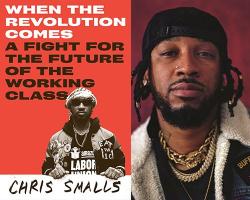 Chris Smalls discusses his memoir, "When the Revolution Comes: A Fight for the Future of the Working Class," published by Penguin Random House. He is the first and only union leader to successfully…
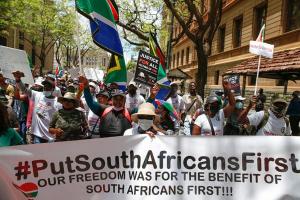 Our guest is Nairobi based political writer and strategist Clinton Nzala. He joins us to provide an update and an analysis of the South African anti-migrant March and March movement, which is…


