A Black Agenda Radio Commentary by Glen Ford
Black voters have still not reversed their 75-year record of rejecting Black Republican candidates for majority Black congressional districts. The two new Black Tea Partyers are from mostly white districts, and will have little reason to become involved in Black Caucus affairs. Besides, Black corporate Democrats are fully capable of doing great damage to Black interests, without GOP help.
Tea Partyers in the Black Caucus?
A Black Agenda Radio Commentary by Glen Ford
“Incoming congressmen Tim Scott of South Carolina and Allen West of Florida will have no influence on the Congressional Black Caucus.”
Congressional Black Caucus chairperson Barbara Lee has announced that the two Black Tea Party supporters elected to Congress from South Carolina and Florida are welcome to join the Black Caucus. That’s no surprise. In its 41-year history, the Black Caucus has always had an official open door policy to non-Democrats. But the CBC has been fortunate that the three Black Republicans elected to the House of Representatives in the last two generations have opted not to complicate the lives of Black Caucus Democrats. Former Oklahoma congressman J.C. Watts declined to join. Connecticut’s Gary Franks, who served from 1991 to 1997, was a nominal Black Caucus member, but totally inactive. And Melvin Evans, a non-voting congressional delegate from the U.S. Virgin Islands, made hardly a ripple in House of Representatives, serving only one term between 1979 and 1981. Senator Edward Brook, of Massachusetts, never joined the Caucus.
Except for the non-voting Melvin Evans, the Virgin Islander, all three of the Black Republicans elected to Congress since the 1930s have represented majority white constituencies. Black voters on the U.S. mainland have not elected a Black Republican to the House since Oscar De Priest lost his seat from Chicago in 1934.
In other words: Republicanism is dead in Black America. Even Republicans no longer believe they can hope to win office by running Black candidates in Black majority districts. In the mid-Nineties corporate strategists decided their best shot at directly influencing Black politics was through the Democratic Party. Rather than beat the dead horse of Black Republicanism, they would finance the careers of a new breed of corporate Black Democrats – like Newark, New Jersey mayor Cory Booker, and outgoing Washington, DC mayor Adrian Fenty, and – the most prominent Black corporate Democrat of all, Barack Obama.
“Black voters on the U.S. mainland have not elected a Black Republican to the House since Oscar De Priest lost his seat from Chicago in 1934.”
The corporate shift to financing and nurturing Black Democrats friendly to big business was hugely successful. By 2005, there were enough right-leaning, corporate-friendly members of the Congressional Black Caucus to comprise a mini-caucus of their own. Ten of them voted with Republicans on personal bankruptcy, 8 sided with the enemy on repeal of the Estate Tax, and 11 made common cause with big business on energy issues. Not long afterward, two-thirds of the Black Caucus voted to allow the telecom companies free rein in cable television and the Internet.
With a Democratic Black Caucus like that, who needs Black Republicans?
The Republican Party cannot make significant inroads among Black Americans because the GOP has thrived by being the White Man's Party. It's a winning formula at the ballot box. The Tea Party phenomenon is an even more virulent strain of the same racist disease. Incoming congressmen Tim Scott of South Carolina and Allen West of Florida will have no influence on the Congressional Black Caucus, and if either of them do join, will probably fail to show up for any serious business. The problem with the Congressional Black Caucus is corporate-bought Democrats, who already infest the place.
For Black Agenda Radio, I’m Glen Ford. On the web, go to www.BlackAgendaReport.com.
BAR executive editor Glen Ford can be contacted at Glen.Ford@BlackAgendaReport.com.

 Keisha Lindsay: Questions about black all male schools; Chris Duran & Concerned 44 demand reform of African Studies at Seton Hal; Zayid Muhammad of Newark Concerned Communites on documenting po
 US presidents may seem different from one another, in terms of rhetoric, “but they all have in common being committed to empire,” said Anthony DiMaggio,a political scientist a
 Zayid Muhammad, of Newark Communities for Accountable Policing, was pleasantly surprised at the scope of a NJ Advanced Media report on police use of force in every city and town in
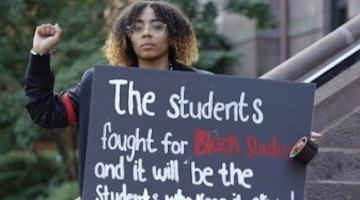 Students with the Concerned 44 movement, representing the 44 percent of students that are ethnic or gender minorities, plan to renew their protests after the holidays at Seton Hall University, said
 The movement for all-male Black schools is both “good and bad,” said Keisha Lindsay, author of In a Classroom of Their Own.



