Papua and West Papua are subjected to violence and habitual repression from the Indonesian central authorities.
“A policy of transmigration has been practiced, tantamount to genocide.”
Like Timor-Leste, West Papua, commonly subsuming both Papua and West Papua, remains a separate ethnic entity, acknowledged as such by previous colonial powers. Its Dutch colonial masters, in preparing to leave the region in the 1950s, left the ground fertile for a declaration of independence in 1961. Such a move did not sit well with the Indonesian desire to claim control over all Dutch Asia Pacific colonies on departure. There were resources to be had, economic gains to be made. The military duly moved in.
The New York Agreement between Indonesia and the Netherlands, brokered in 1962 with the assistance of the United States, saw West Papua fall under United Nations control for the duration of one year. Once passing into Indonesian control, Jakarta would govern the territory “consistent with the rights and freedoms guaranteed to the inhabitants under the terms of the present agreement.” Education would be a priority; illiteracy would be targeted, and efforts made “to accelerate participation of the people in local government through periodic elections.”
One article stood out: “Indonesia will make arrangements, with the assistance and participation of the United Nation Representative and his staff, to give the people of the territory the opportunity to exercise freedom of choice.” In 1969, a ballot was conducted in line with the provision, though hardly in any true, representative sense. In the rich traditions of doctored representation and selective enfranchisement, 1,026 individuals were selected by Indonesian authorities to participate. Indonesia’s military kept an intimidating watch: the vote could not be left to chance. The result for Indonesian control was unanimous; the UN signed off.
“In the rich traditions of doctored representation and selective enfranchisement, 1,026 individuals were selected by Indonesian authorities to participate.”
Unlike Timor-Leste, the historically Melanesian [dark-skinned] territories of Papua and West Papua remains under thumb and screw, an entity that continues to exist under periodic acts of violence and habitual repression from the Indonesian central authorities. A policy of transmigration has been practiced, a point argued by scholars to be tantamount to genocide. This has entailed moving residents from Java and Sulawesi to West Papua, assisted by Jakarta’s hearty sponsorship.
The Indonesian argument here has been ethnic and political: to confect a national identity through assimilation. Under President Joko Widodo (“Jokowi”), one keen to push the idea of “Indonesia Maju” (“Advanced Indonesia”), renewed stress is being placed on infrastructure investment, economic growth and natural resources, of which Papua features heavily.
The indigenous populace has had to, in turn, surrender land to those transmigrants and appropriating authorities. “The rights of traditional law communities,” notes Clause 17 of Indonesia’s Basic Forestry Act of 1967, “may not be allowed to stand in the way of transmigration sites.”
Appropriations of land, the relocation of residents, and the odd massacre by Indonesian security forces, tend to fly low on the international radar of human rights abuses. West Papua lacks the cinematic appeal or political heft that would encourage around the clock coverage from media networks. Bureaucratic plodders in the various foreign ministries of the world prefer to render such matters benign and of little interest. Geopolitics and natural resources tend to do most of the talking.
“The rights of traditional law communities may not be allowed to stand in the way of transmigration sites.”
In late 2015, for instance, Scott Busby, US deputy assistant secretary of the Bureau of Democracy, Human Rights, and Labor, and James Carouso, acting deputy assistant secretary for Maritime and Mainland Southeast Asian affairs, ducked and evaded anything too compromising in their testimony before the Senate Foreign Relations Committee on East Asia, the Pacific, and International Cybersecurity Policy. The consequences of demographic policies directed by Jakarta were assiduously ignored. Massacres and institutional accountability in the territory were bypassed, as were Indonesian efforts to prevent scrutiny on the part of human rights monitors, the UN Special rapporteur and journalists.
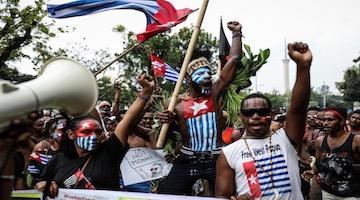
This year, more instances of violence have managed to leach out and gurgle in media circles. It took a few ugly incidents in the Javanese city of Surabaya to engender a new wave of protests which have had a rattling effect on the security forces. Last month, pro-Indonesian nationalist groups, with reported encouragement from security forces, taunted Papuan students with an array of crude insults in East Java. (“Dogs,” “monkeys” and “pigs” were part of the bitter mix.) The fuse was lit, notably as arrests were made of the Papuans themselves. “Papuans are not monkeys”, proclaimed banners being held at a rally in Central Jakarta on August 22.
Government buildings have been torched in Jayapura. Additional forces have been deployed, and internet access cut. There are claims that white phosphorous has been used on civilians; prisons are being filled. There have even been protests in Indonesia’s capital, with the banned Morning Star flag being flown defiantly in front of the state palace. (Doing so is no mild matter: activist Filep Karma spentover a decade of his life in prison for doing so.)
“There are claims that white phosphorous has been used on civilians; prisons are being filled.”
The struggle for independence, at least in the international eye, has been left to such figures as Benny Wenda, who lobbies governments and groups to back the “Free Papua” campaign. He is particularly keen to take the matter of the Free Choice vote of 1969, that nasty instrument that formalized Indonesian control, to the United Nations General Assembly. Last month, he had to settle for taking the matter to the Pacific Islands Forum as a representative of Vanuatu’s delegation. In January, he gifted the UN Human Rights Chief Michelle Bachelet a petition with 1.8 million signatures seeking a new referendum for the territory.
The response from an Indonesian government spokesman was emphatic, curt, and conventional. “Developments in Papua and West Papua province are purely Indonesia’s internal affairs. No other country, organization or individual has the right to interfere in them. We firmly oppose the intervention of Indonesia’s internal affairs in whatever form.”
The hope for Jokowi and the Indonesian authorities will be simple: ride out the storm, conduct a low-level suppression of protests, and place any talks of secession on the backburner. In this, they can count on regional, if hypocritical support. In the words of a spokesman for the Australian Department of Foreign Affairs and Trade, “Australia recognizes Indonesia’s territorial integrity and sovereignty over the Papua provinces. Our position is clearly defined by the Lombok Treaty between Indonesia and Australia.”
Dr. Binoy Kampmark was a Commonwealth Scholar at Selwyn College, Cambridge. He lectures at RMIT University, Melbourne. He is a frequent contributor to Global Research and Asia-Pacific Research. Email: bkampmark@gmail.com
This article previously appeared in Asia-Pacific Research.
COMMENTS?
Please join the conversation on Black Agenda Report's Facebook page at http://facebook.com/blackagendareport
Or, you can comment by emailing us at comments@blackagendareport.com

 A Third Takeover of Lima is the next action planned in the mobilization against the coup government in Peru.
 The author asks CARICOM member states to support the Haitian people in their struggle for sovereignty.
 Colombia's new president is popular with the people but beset by enemies. It is a common situation where the popular vote is not indicative of who really holds political power.
 At least 16 people were killed after protests broke out in Senegal following the sentencing of leading opposition figure Ousmane Sonko to two years in prison. Mass public unrest has grown against…
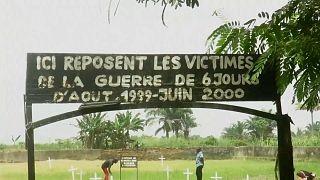 Uganda and Rwanda began their incursions into the Democratic Republic of Congo 23 years ago. Full reparations to victims have not been paid and the two invader countries still act with impunity.


