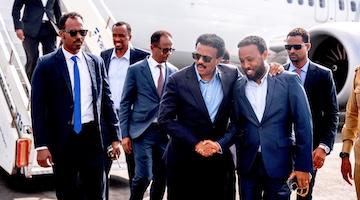
Somali President Mohamed Abdullahi Mohamed, aka Farmaajo, Eritrean President Isaias Afwerki, and Ethiopian President Abiy Ahmed
Cold War and War on Terror destabilize Somalia and cause great suffering for its people.
Mohamed Abdullahi Mohamed, aka Farmaajo, is currently the Interim President of Somalia, pending parliamentary elections that have been repeatedly postponed since February. He first became the president of Somalia in 2017 after winning 184 of 329 votes in Somalia’s parliament.
Seven years earlier, in 2010, Farmaajo was a civil servant in Buffalo, New York, an equal opportunity compliance officer at the New York Department of Transportation. As a Somali refugee who arrived in the US in 1988, he had put himself through school, earning first a BA in history, then an MA in political science, both at the University of New York-Buffalo. The title of his master’s thesis is “U.S. STRATEGIC INTEREST IN SOMALIA: From Cold War Era to War on Terror."
That might sound like an imperialist argument, but he was actually quite critical of US history in the country and the region. In 2009, he was still hopeful that the US might do better.
Farmaajo is currently Somalia’s interim president, but with the states of Puntland and Jubaland refusing to recognize his authority. Elections have been repeatedly planned but postponed due to disagreements between parties and lack of election infrastructure. In addition, the Islamist Al Shabaab continues to oppose the existence of a secular Somali state. Meanwhile, the US is still bombing to, they say, counter Al Shabaab.
Somalia is among the nations most often said to be a “failed state.” Farmaajo himself repeatedly referred to it as such in his Master’s thesis, in which he also described attempts at nation building, a project he still seems committed to. In his brief time as prime minister—from November 2010 until June 2011—and then as president, he has been known for fighting corruption, opposing clan conflict and Islamic extremism, and trying to make the Somali state function by, for example, ensuring that soldiers and civil servants got paid.
Whatever one thinks of Farmaajo and/or the Somali Tayo Party he founded in 2012, his thesis is a thought-provoking account of the chaos that Somalia has yet to overcome.
Clan structure in a harsh desert environment
When he wrote his thesis, in 2009, Farmaajo said that 70 percent of the Somali population were pastoral nomads, 20 percent farmers, and 10 percent fisherman. One of his story lines is about how some of the population came to seek political power in government rather than clans but without abandoning clan alliances. This is his description of nomadic clan alliances and how European colonists suddenly forced central government and some semblance of constitutional democracy on a culture alien to it:
Not only did they introduce one central, federal authority to the nomadic people in Somalia; they promoted a system of government based on the multi-party democratic system. This was totally foreign to the Somali pastoralist society; furthermore, the colonial epoch was not nearly long enough for them to learn it. The new "one size fits all" political system never matched Somalis’ anarchist culture. With new borders drawn, however, and the old system compromised, it was the only way for Somalia to function.
Somalia was branded with a political philosophy. It never had a chance to develop a brand of democracy that supports different political views and reflects clan-family values and beliefs. There were no competing ideas and views in Somali nomadic society because clan families had much in common. The main differences were in lineage and location. They shared the same culture, language and religion, and lived with perpetual conflict, which sometimes caused irrefutable disruption.
War is part of Somali culture; so too is working together. The harsh Somali environment in which Somalis live requires clan alliance as a rule of existence. The political maneuvering of any tribe depends not on how well they compromise, but what kind of coalition they put together in order to keep and retake territory and camels.
The Cold War
During the Cold War, Somalia was, like so many African nations, constantly torn between competing systems, neither of which were natural to it, and the competition between East and West became more about competition than anything else. Farmaajo writes:
Rather than help to stabilize East Africa, the United States and Soviet Union compromised their supposedly egalitarian and humane value systems in enabling its degeneration into war, chaos, and murder. The moral compass pointed nowhere when there was an opportunity to thwart the other's strategic ambitions. The tension between the two countries, [Ethiopia and Somalia], intensified when Somalia failed and warlords replaced the central government. Clan leaders competed against each other for Ethiopian support, running the country and its people into the ground over fiefdoms and bits of land.
At one point, Somalia and Ethiopia were both allied with the Soviet Union, with some semblance of a Marxist Leninist political structure. However, when longstanding rivalries between Ethiopia and Somalia over the Somali Ogaden region led to outright war between the two, the Soviet Union chose to back Ethiopia, the more populous and powerful nation. In response, the US backed Somalia until 1991, when the Soviet Union collapsed. At that point the US no longer felt it had any strategic interests in Somalia and as soon as it withdrew financial support for the central government of Siad Barre, the government collapsed into a state of war between competing clans. At the same time the Tigrayan People’s Liberation Front (TPLF) seized power in Ethiopia under cover of a multi-ethnic alliance, then became the USA’s “anchor state” in the Horn, providing troops in service to US goals in the region and on the African continent.
The brief US and UN intervention in the early 1990s, during the last years of the first Bush regime, which included the “Blackhawk Down” debacle, was actually undertaken with the humanitarian intent of feeding Somalis suffering from famine caused by incessant civil war. However, it quickly turned into a costly hunt for warlord General Mohamed Farah Aideed. In October 1993, the Washington Post published an op-ed by Eritrean President Asaias Afwerki, in which he wrote:
The military emphasis, which has derailed the Somali intervention and turned the U.N. into a party to the conflict, must change. An inordinate $1.5 billion has been spent on the military effort in Somalia as compared to just $160 million for relief and rehabilitation. The U.N.'s priorities must be reversed; humanitarian and political efforts must come first.
Despite his urging, the US and UN simply withdrew after the Black Hawk Down incident, during which jubilant Somalis dragged a dead US soldier through the dust of Mogadishu. Somalia subsequently descended deeper into anarchy and rule by warlords for the rest of the 1990s, and the US has been unwilling to commit US combat troops in Africa since. It has not, however, hesitated to commit special operatives, arms, and military advisors to various proxy forces and covert operations.
War on Terror
After 9/11, the US began to take interest in Somalia again, claiming to fear that its anarchic state had become a safe harbor for terrorists.
Farmaajo is well aware that US support for the mujahideen in Afghanistan fostered the Islamist terrorism that came back to haunt it. However, he did, at least in 2009, believe that the US returned to Somalia to fight it. Of course the US use of Islamic terrorists as proxy warriors, particularly in Syria, has reshaped the War on Terror narrative, but in 2009, he accepted the US’s stated goals.
Farmaajo writes that, without relation to Al Qaeda, a Somali Islamist movement arose to fill the power vacuum that had followed the Siad Barre government’s collapse into clan warfare. It eventually came to be the Islamic Courts Union (ICU), which, despite its strict Islamic fundamentalism, seemed to be Somalia’s best hope of peace until 2006. At that point, when the US was lumping all Islamist movements together and calling them all Al Qaeda, it organized an Ethiopian invasion of Somalia to overthrow the ICU. This exacerbated the longstanding rivalry between the two nations, and once again collapsed the fragile Somali state. The result was chaos, return to competition between competing clans and warlords, and the rise of Al Shabaab, a more extreme Islamist formation.
This is what gives Somalia the “failed state” label today. It is the condition that Farmaajo has tried to overcome. His platform is that a modern, secular, central government must supersede both clan rivalry and Islamic terrorism, but without the staggering ignorance and insensitivity to Somali history and social structure that the US and other foreign powers have shown.
An Independent Alliance Emerges in the Horn
On September 5, 2018, Farmaajo joined Ethiopian Prime Minister Abiy Ahmed and Eritrean President Isaias Afwerki in Asmara, the capital of Eritrea, to sign the Joint Declaration on Comprehensive Cooperation Between Ethiopia, Somalia and Eritrea.
At first this regional peace agreement among three nations long at war was heralded internationally. In 2019, the Nobel Committee presented PM Abiy Ahmed with the Nobel Peace Prize, and the UN General Assembly presented all three heads of state with the Concordia Leadership Award for promoting peace and economic integration in the Horn of Africa.
However, in November 2020, the US’s longstanding puppet, the Tigrayan People’s Liberation Front, attacked a federal army base in Ethiopia’s Tigray Province, instigating a civil war. The TPLF and the US have both faulted Eritrea and Somalia, but most of all Eritrea, for sending troops to help Prime Minister Abiy Ahmed defeat the TPLF insurrectionists.
The US, missing its “anchor state,” backed the TPLF and made the usual unsubstantiated claims of genocide and state blockage of “humanitarian corridors” to deliver aid.
Can Somalia overcome tribalism and Islamic fundamentalism to establish a modern secular state? Can Ethiopia overcome tribalism to do the same? Will the alliance between the three nations, Ethiopia, Eritrea, and Somalia, withstand the US attempt to create chaos and undermine government in the Horn, or in any nation or region attempting to escape its domination? How aggressive will the US be to overcome this challenge to its global hegemony?
Those are certainly not the only questions in the Horn, whose people have to overcome the challenges of their own history and current geopolitical situation on their own. They are the questions that we in the West should keep in mind as we challenge the narrative promoted by our propaganda press.
Ann Garrison is a Black Agenda Report Contributing Editor based in the San Francisco Bay Area. In 2014, she received the Victoire Ingabire Umuhoza Democracy and Peace Prize for promoting peace through her reporting on conflict in the African Great Lakes Region. She can be reached on Twitter @AnnGarrison and at ann(at)anngarrison(dot)com.




 Our guest is attorney Jaribu Hill, executive director of the Mississippi Workers Center for Human Rights. She reports on the police killing of 1-year old Kohen Wiley in Senatobia, Mississippi and on…
 On January 3, 2026, the U.S. conducted a military attack against Venezuela and kidnapped president Nicolas Maduro and his wife, First Combatant Cilia Flores. Since that time interim president Delcy…
 The democrats’ backtracking on what they dismissively refer to as “wokeness” is the newest iteration of their political trickery as once again they give the appearance of supporting what they…
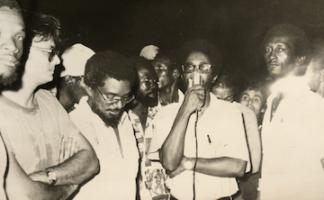 “The Burnham dictatorship crept up upon Guyanese people like a thief in the night.”
 The late Dr. Johanna Fernández left an awesome intellectual and activist legacy that includes her 2010 documentary film “Justice on Trial: The Case of Mumia Abu-Jamal.”


