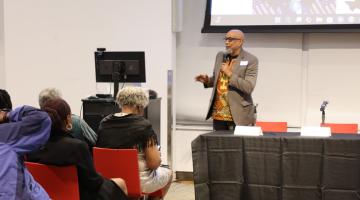
We reprint Dr. Gerald Horne's keynote speech at Black Agenda Report's 20th anniversary celebration.
I am honored to be invited to speak at this 20th anniversary celebration of Black Agenda Report (BAR).
BAR is walking in the gigantic footsteps of ‘Freedom’s Journal,’ initiated in Black America in 1827. Obviously, BAR should consider various editions next year focused on this profound 200th anniversary. The antebellum era featured a plethora of Black press organs, including a number by Frederick Douglass and others in major cities. Like BAR, these organs were internationally minded, with Douglass spending considerable time in London at a time when his homeland and Britain were often at swords’ point, at a time when the nations had fought a war in 1812, which included the Redcoats torching Washington, DC in August 1814 with the immense assistance of the enslaved population, sending President James Madison and his garrulous spouse, Dolly, fleeing into the streets, one step ahead of the posse. The enslaved then proceeded to flee on British boats to freedom in Trinidad and Tobago, where their descendants continue to reside.
In other words, just like BAR, the Black Press of this bygone era was globally minded—unlike many of today’s Black intellectuals, leaders and organizations.
The Black Press of that era was aware of its constituency, aware that a good deal of African Americans had fled to reside in revolutionary Hayti. The Black press of that era knew, for example, that as the U.S. expanded into what had been Spanish Florida circa 1820, the free Negro population, especially of St. Augustine and the northeast corner of what became the Sunshine State, fled to Cuba. The Black press knew that the remaining Black folk in Florida united with the Indigenous population, especially those we dub the Seminoles, to fight some of the bloodiest wars that ensnared the U.S. military. Then in the late 1850s, the Free Negro population fled en masse to Mexico. In some ways, the Black Press then was more akin to BAR than many of today’s organs in covering global events.
BAR and, notably, Margaret Kimberley are also walking in the footsteps of Ida B. Wells-Barnett, who not only publicized the news against bestial lynching but also took her crusade abroad in tacit recognition of the need for global solidarity, not least because of the persistence of class collaboration within the settler descendant working class and middle class.
The Black Press of an earlier era campaigned vigorously against the bloody U.S. war in the Philippines at the end of the 19th century, which—along with the Hawaii coup of 1893 marked a new stage in the genocidal trajectory of U.S. imperialism.
BAR also has walked in the footsteps of W.E.B. Du Bois, who initiated the still-existing NAACP journal ‘The Crisis’ circa 1910. BAR also followed in the footsteps of Marcus Garvey’s journal, ‘the Negro World,’ insofar as it too covered global events assiduously, notably in Africa and the Caribbean.
Going forward, BAR should seek to emulate the Associated Negro Press (ANP), which came into existence during the World War I era and yet, despite what we would see as the primitive telecommunications of that era, managed to have correspondents in every corner of this far-flung planet, once again bringing more global news to their audience than many of today’s Black Press organs. I strongly urge BAR to expand its already formidable network of correspondents, not least in the Caribbean, Africa and Asia. Perhaps more doable, BAR should take advantage of the infinite capacity of its website to develop correspondents in U.S. cities, large and small. For example, we desperately need a fine-grained analysis of the recent mayoral race in Los Angeles.
As I noted in my book on the ANP, if you visit their archive in Chicago, you will find a dispatch written on the stationery of Adolf Hitler himself in May 1945, as this monster was going down in flames and an ANP correspondent had grabbed stationery from his desk in order to scribble an on-the-scene dispatch.
1945 and the end of the anti fascist war also marks a watershed moment globally, domestically, and for Black Americans more generally. After collaborating with Moscow in order to bring Berlin and Tokyo to their knees, U.S. imperialism resumed the Cold War, which had begun in October 1917.
This featured a crackdown on the organs of communication to force them to toe the line, not unlike what is happening today with the current occupant of the White House, who has twisted the arms of ABC News in particular, compelling parent company Disney to fork over a multi-million-dollar settlement.
In 1945, the crackdown’s prime target was Hollywood, as left wing screenwriters in particular were targeted.
Concerning the Black community, Du Bois was put on trial and faced the prospect of an extended tenure in prison on the spurious grounds that he was the agent of a foreign power—meaning Moscow--because he campaigned for banning nuclear weapons.
This was part of a larger process of battering the Black Left, then making agonizing anti-Jim Crow concessions through the aegis of Black Liberals, led by the NAACP. The passport of the tallest tree in our forest, Paul Robeson, was taken as his income plummeted from the six figures to the low four figures, hampering his ability to make contributions to allied Black Left organizations, including the Civil Rights Congress, led by his comrade William L. Patterson, who, as Du Bois was being indicted, had filed a petition at the United Nations charging U.S. imperialism with genocide against Black folk. It is not too late for BAR to mark the 75th anniversary of this precedent-setting gambit with the aim of once again taking our plight to the United Nations, to the Caribbean Community (CARICOM), to the African Union, to the Economic Community of West African States (ECOWAS), to the Southern Africa Development Community (SADC). Patterson too was jailed during this tempestuous era. Also behind bars was Black Communist leader Ben Davis Jr., elected to the New York City Council from Harlem in 1943, during the height of the anti-fascist moment, re-elected in 1945, then ousted unceremoniously, perhaps illegally, in 1949 and jailed by 1950. Imprisoned alongside him was his attorney, George Crockett, who in the following decades was elected to Congress from Detroit, where he was a tribune for the anti apartheid cause, culminating in the Comprehensive Anti Apartheid Act, passed over President Reagan’s veto, which led directly to South African independence in 1994.
Also persecuted was Jamaica-born Ferdinand Smith, who helped to organize the once-militant National Maritime Union, which organized sailors who helped to deliver exports and imports by sea. By 1950, he was deported to his homeland.
Still, this Red Scare/Cold War offensive destabilized the Black Community ideologically, a process that has yet to dissipate to this very day. Thus, in early 1961, when Congolese patriot Patrice Lumumba was murdered with the complicity of U.S. imperialism, with a rationale for this crime being his supposed ties to Moscow, the activists who marched in militant protest to the UN on 42nd Street entered the building and engaged in fistfights with security personnel—a startling demonstration captured in the documentary ‘Soundtrack to a Coup d’Etat’. Yet similarly startling was the protesters’ decision to bar from their ranks Ben Davis, Jr., presumably because of his Communist and Moscow ties.
This blunder was consistent with the ideological missteps of Black Liberals, led by the NAACP and continued to this very day by many of our intellectuals, who have failed to speak out on most global matters in return for anti-Jim Crow concessions—a bargain that has expired, though many in our community still act as if it remains intact.
This blunder was part of the ideological warping that has handicapped the Black Liberation Movement and lingers to this very day. I would also recommend that, going forward in this century, BAR should not just—in the words of the late Glen Ford—castigate the ‘Black Misleadership Class’ but explore their roots and the objective conditions that lead to right opportunism, which I would argue inheres in this settler colonial society.
For example, today we must grapple with the disturbing rise of various forms of opportunism, embedded in the phenomenon known as ‘Foundational Black Americans’ and ‘American Descendants of Slaves.’ Yes, such formations ooze opportunism and xenophobia, not least toward our brothers and sisters with roots in the Caribbean and Africa itself. And, yes, we must be unsparing in our critique of these formations. But as was once said by one wiser than myself, it is not enough to just judge and condemn; we must also explain. And explaining FBA requires that we acknowledge that in the U.S., there has been a special persecution of those of us with roots in this land, since—after all—we have been going toe to toe with these settlers and their descendants for centuries, absorbing blows—and as Nat Turner and Gabriel and the heroes and heroines of the ‘Negro Fort’ in Spanish Florida in 1816 and the Black Panther Party—have demonstrated, doling out punishing blows at the same time. But what we must point out to these brothers and sisters is that because of the adverse circumstances we have faced in this land, we have had to rely upon global solidarity, be it the Haitian Revolution or assistance from 19th-century Mexico or assistance from the socialist camp and allied African liberation movements.
Yet as we analyze FBA and ADOS, we would be blind to ignore the climate that produced them. For example, our friends on the U.S. left have invented nebulous concepts like ‘identity politics’ which are routinely used to defame the Black Liberation Movement, without recognizing that the Black unity and solidarity to which they object is not only a barrier against fascism but is also a reflection of the class politics to which they supposedly pay homage insofar as this reflects the class unity bred over the centuries by the unpaid sector of the working class. More troubling, the U.S. left does not apply the term ‘identity politics’ to the most disturbing aspect of this phenomenon, i.e., Zionism or Zionist Israel, where rights and responsibilities are doled out on the basis of a narrow ethno-religious identity and has played a huge role in plunging the US into a devastating war in Iran.
How can we have confidence in a U.S. left that routinely engages in constructing racist double standards? How can we critique FBA and ADOS without critiquing the climate that helped to produce them?
In addition to marking the 200th anniversary of the Black Press; marking the 75th anniversary of the Genocide Petition and seeking to emulate same in 2027; developing correspondents globally and domestically, BAR should also provide a mature analysis of the recently concluded midterm elections, preliminarily with the theme that we may have dodged a fascist bullet but if the Democratic Party operates true to form they will pave the way for the resurgence of fascism in 2028 or 2030, not least by pursuing “double containment” of Russia and China simultaneously, a must to avoid.
In addition to marking the 200th anniversary of the Black Press; marking the 75th anniversary of the Genocide Petition and seeking to emulate the same in 2027; developing correspondents globally and domestically, BAR should also provide a mature analysis of the ongoing balance of forces globally, critical understanding of which is essential to domestic advance. As of now, it appears that China is in the passing lane, but we cannot exclude the possibility that factionalism in the Chinese Communist Party combined with the toxicity of a revenge-seeking US imperialism could combine to change this equation—which would likely lead to an ascendancy of the Tokyo-Delhi condominium, which, like most projections, portends good news for the Caribbean and Africa. As for the recently concluded midterm elections, we should point out that the elections in Los Angeles and the South hold immense importance for our constituency. As for the former, the defeat of Black woman incumbent Karen Bass (coupled with the retreat of Gotham’s Eric Adams) may mark the demise of the post-1954 epoch which involved, inter alia, a New Deal coalition that for the most part did not focus on global affairs, except for Israel and intermittently Africa. Both Bass and Adams were defeated by Social Democratic aligned candidates with immigrant roots, generally running to their left—although the Black community had been to the left of the rapidly fading New Deal coalition. This alignment led to Black mayors like Tom Bradley of Los Angeles and David Dinkins of Gotham making painful compromises on Palestinian rights, ultimately undermining our own struggle here at home, especially with regard to the bogus issue of purported persecution of Soviet Jewry, which not only helped Israel resolve its demographic crisis by bringing in more of this group but also placed us cross-wise with Africa, which even today stands alongside Moscow on the Ukraine crisis. Of course, all this was consistent with the stance of our Black Liberal friends who even today generally ignore issues beyond these shores.
What will be complicating for Black Politics is that for some time to come the old New Deal coalition will prevail in Dixie, as the recent results in Georgia, Mississippi, and Texas show, but as Social Democracy arises north of the old Mason-Dixon line, the Black community as the left of the New Deal coalition will be supplanted by Social Democrats and Communists and radicals of various stripes, as Mayor Bass’ attempt to outflank Nithya Raman on the right by not terming Gaza a ‘genocide’ suggests, not helpful to her or her forces in today’s political climate. BAR can explain this geographic difference and forestall the Black South and Non-South talking past each other. Given the weaknesses of the U.S. left—ideological and otherwise—BAR must step into the void by addressing issues that settler descendants even of the left generally ignore, such as the composition of whiteness itself, the bedrock of the settler colonial project, e.g. the journalist Stephen Kinzer implicitly challenging the construction of ‘whiteness’ itself in his book on Washington’s disastrous Ukraine policy and his blaming this catastrophe on the undue influence of those with roots in Eastern Europe’s Russo-phobia and anticommunism, e.g. Zbigniew Brzezinski and Victoria Nuland in shaping this disaster or JD Vance implicitly blaming the Iranian quagmire on Zionism, which goes to the heart of how ‘whiteness’ was constructed in this Protestant dominated colony by admitting the Jewish minority into the hallowed halls of whiteness as opposed to Spanish Catholicism, for example.
For in the long run I think the results of Tuesday’s election suggest something that has been apparent since the 19th century—socialism is the wave of the future, including Medicare for all, confiscatory taxes on billionaires, justice to the dispossessed Indigenous and Chicanos, and reparations for descendants of enslaved Africans, etc., and we fully expect BAR to explain why this is so.
Gerald Horne is the John Jay and Rebecca Moors Chair of History and African American Studies at the University of Houston. He is the author of 50 books, including The BitterSweet Science: Racism, Racketeering, and the Political Economy of Boxing. His latest book, The Counter-Revolution of 1893: The Hawaii Coup and the Roots of U.S. Imperialism in the Asia-Pacific Basin, is out now.

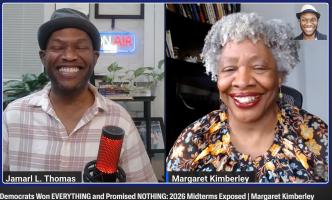 BAR Executive Editor and Senior Columnist, Margaret Kimberley, analyzes the 2026 midterm election with Jamarl Thomas.
 The recent midterm elections have brought more Black people to high elected office, but for 20 years, Black Agenda Report has warned about the dangers of the Black misleadership class.
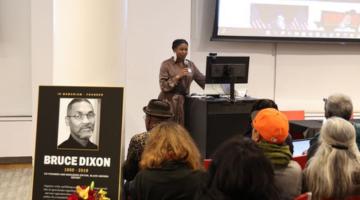 We reprint Dr. Jemima Pierre’s remarks at the 20th anniversary celebration for Black Agenda Report, New York City, November 7, 2026.
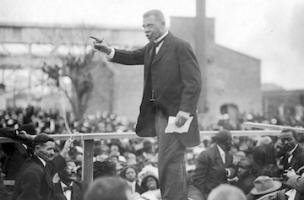 “Mr. Washington represents in Negro thought the old attitude of adjustment and submission…Mr. Washington’s programme practically accepts the alleged inferiority of the Negro races.”



