Black Agenda Report
Black Agenda Report
News, commentary and analysis from the black left.

  • Home
  • Africa
  • African America
  • Education
  • Environment
  • International
  • Media and Culture
  • Political Economy
  • Radio
  • US Politics
  • War and Empire

Why Several Latin American Countries Abstained at UN Vote on US Blockade Against Cuba
Orinoco Tribune
04 Nov 2026
🖨️ Print Article
 silhouette of Donald Trump
A silhouette of Donald Trump's profile against a backdrop of the Cuban flag. Photo: AI-generated image.

The collapse in support for the UN resolution against the U.S. blockade of Cuba reflects Washington's aggressive diplomatic pressure and blackmail on Latin American governments rather than any genuine change in regional sentiment.

Originally published in Orinoco Tribune.

Since the 1990s, the United Nations General Assembly has voted overwhelmingly against the US blockade on Cuba, with unanimous support from Latin America. Just two years into the second Trump administration, this situation has changed drastically.

In October 2024, the resolution received 187 votes in favor, one abstention (Moldova), and the usual two against from the US and Israel. Two years later, the results stand at 130 votes in favor, 25 abstentions, and 17 against.

The Latin American countries that voted against the resolution are Argentina, Colombia, Costa Rica, Ecuador, and Paraguay. Meanwhile, Chile, Guyana, Haiti, Honduras, Jamaica, Peru, and the Dominican Republic abstained. Additionally, Bolivia, El Salvador, Guatemala, and Venezuela did not participate in the voting.

In this way, several Latin American nations reversed their historical positions. Chile, for example, supported the initiative for 33 years, a position similar to the rest except for Argentina and Paraguay, which had already expressed their opposition in 2025.

As for Venezuela, it could not vote because it has not been able to pay its UN membership fees due to the US blockade. The unilateral and illegal coercive measures imposed on Venezuela since 2015 have excluded the country from the international financial system. As a result, it cannot pay its membership dues, and its right to vote has been suspended despite being a founding member of the United Nations.

What is behind this result?
As soon as the result was known, US Ambassador to the UN Mike Waltz expressed satisfaction. “Today, almost three times as many countries voted against, abstained, or simply chose not to vote,” he summarized.

“There’s still a lot to be done,” stated Waltz, one of the visible faces of Washington’s diplomatic offensive to weaken the traditional support Latin America and the Caribbean had had for Havana’s resolution.

The week before, Cuban Foreign Minister Bruno Rodríguez had warned that the UN General Assembly vote would take place in “unusual circumstances.” He denounced a series of “pressure methods” and directly accused US Secretary of State Marco Rubio of “pressuring and blackmailing” heads of state of the region to “change their vote against the blockade.”

The countries that voted against the resolution, as well as those that abstained, except Haiti, are part of the Shield of the Americas. The US-led coalition against organized crime is seemingly imposing Washington’s political decisions on its members.

“The considerable increase in votes against this resolution reflects a significant change in the international scenario,” said Pablo Quirno, Argentinian foreign minister under far-right president Javier Milei. “More and more countries in Latin America are joining a position that places freedom, democracy, and individual rights at the center of the regional agenda,” he declared.

Cuba
Blockade
Latin America
United Nations

Do you need and appreciate Black Agenda Report articles? Please click on the DONATE icon, and help us out, if you can.


Related Stories

Black Alliance For Peace
Whose Peace? Whose Security? Whose Sovereignty?
25 November 2026
A People(s)-Centered Human Rights Critique of the China-Russia-U.S. Declaration toward PeaceNovember 19, 2026. | Shenzhen
John Mussington , Keston K. Perry
Reparations for Whom? Caribbean Leaders Cannot Demand Justice Abroad While Dispossessing Their Own People at Home
18 November 2026
Caribbean governments cannot credibly demand reparatory justice from former colonial powers while reproducing colonial relationships at home.
Milton D’Leon , Sandra Romero
Haiti: A Testing Ground for a New Military Intervention
18 November 2026
The Salvadoran troop deployment to Haiti is an imperialist intervention dressed as a security mission.
David Escobar
Notes from the Backyard: Is the Fall of the Transnational Vampires Beginning?
11 November 2026
The Democratic takeover of both houses of Congress in the 2026 midterms is a check on Trump's executive overreach rather than a moral

Editors, The Black Agenda Review
POEM: O.A.S., Roque Dalton, circa 1970
28 October 2026
“The President of the United States is more/ the President of my country/ than the President of my country.”
Nayib Bukele's face superimposed over human skulls.
Jemima Pierre, BAR Editor and Contributor
Killing Haiti: Bukele and Prince join the US and the UN on Mission to Murder
28 October 2026
Nayib Bukele, El Salvador’s president, joins Erik Prince, the US, and the UN to kill more Haitians.
Geraldina Colotti
Lula wins in Brazil, but the far right won’t back down
28 October 2026
Lula's narrow runoff victory over Flávio Bolsonaro preserved Brazil as one of the last bulwarks against the far right in Latin America, a victo

Joshua Reaves Charmelus
At the "Foro Internacional Por La Paz," delegates from around the world demand an end to US Interference in Latin America
21 October 2026
Chile, Colombia, Bolivia, Honduras, Peru, and Costa Rica have all elected right-wing presidents in the past year, and most are open T
Issa G Shivji
Positioning Pan-Africanism In The Geopolitical Turmoil
21 October 2026
As we are experiencing a world order in disorder, with war and conflagrations and a shifting balance of power, Issa Shivji calls for a Sovereig
Isaac Saney
No To Terrorism, Genocide And Imperialism: Commemorating the 50th Anniversary of the Bombing of Cubana 455
14 October 2026
The 1976 bombing of Cubana Flight 455 was part of a six-decade U.S.-orchestrated campaign of destabilization against Cuba, which has now escala

More Stories

  • Sara Flounders , Joe Lombardo
    RESPONSE TO: Lawrence S. Wittner’s “Spinning Illusions: The Anti-American Left and the Ukraine War” – a new McCarthyism
    23 Aug 2023
    Recently articles have appeared on the front page of the New York Times that try to smear Code Pink, The People’s Forum and TriContinental as Chinese agents. The Times article was followed by a…

  • Yes! An NFL Player Can Be Exploited
    Gus Griffin
    Yes! An NFL Player Can Be Exploited
    23 Aug 2023
    Michael Oher’s story of exploitation is even worse than the white savior narrative presented by Hollywood.
  • Case studies: US military assistance in Africa doesn’t work
    Jim Lobe
    Case studies: US Military Assistance in Africa Doesn’t Work
    23 Aug 2023
    ​​​​​​​Authors of a new report worry that Washington won’t heed their warnings but double down in an era of Great Power Competition.
  • How Washington Shapes ICC To Its Own Aims
    Maureen Clare Murphy
    How Washington Shapes ICC To Its Own Aims
    23 Aug 2023
    The International Criminal Court is itself criminal in its selective prosecutions and obedience to Washington's directives. In turn, the U.S. specifically prohibits aid to the Palestinian Authority…
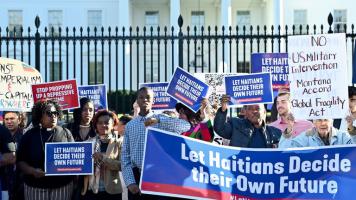
  • Why Is the U.S. Now Favoring Accelerating the Formation of a Force to Intervene in Haiti?
    Narciso Isa Conde
    Why Is the U.S. Now Favoring Accelerating the Formation of a Force to Intervene in Haiti?
    23 Aug 2023
    The impending occupation of Haiti is the latest example of imperialist aggression against that nation and others.

  • Load More
Subscribe
connect with us
about us
contact us

