The Black Panther Party did not begin in Oakland on October 15, 1966, but emerged from earlier organizing in Harlem and Lowndes County, Alabama. Celebrating only the famous founders erases the collective political work that made the Panthers possible.
[With historical commentary and written contributions by Dhoruba Bin-Wahad, former Field Secretary of the Black Panther Party, New York Chapter.]
On October 4, 1966, members of the Black Panther Party were arguing about whether they were ready to become a national organization. They discussed the loss of political support, the need to establish stronger local chapters, and the difficulties of building a revolutionary movement across the country. Lloyd Weaver cautioned that a national party would not be feasible for at least three months. The matter was tabled for further consideration.[^1] There was just one problem with the history most people know. Huey P. Newton and Bobby Seale had not founded their Black Panther Party yet.
These Panthers were organizing in New York. Their meeting took place eleven days before the celebrated October 15 founding in Oakland, California.[^2] And they were not some obscure group that happened to adopt the same name. They had been organizing since the summer of 1966 and were part of a developing national revolutionary movement with political programs, organizational relationships, and ambitions that extended far beyond Harlem.[^3] Yet sixty years later, we are still being told a story that begins in Oakland. The familiar account is practically rehearsed by now. Newton and Seale founded the Black Panther Party for Self-Defense, wrote the Ten-Point Program, organized armed patrols against police brutality, and built an organization that transformed Black political consciousness. Their photographs became revolutionary icons. Their organization became an international symbol of Black radical resistance.[^4] All this is relatively true and deserves props. The emphasis is on “relative”.
But somewhere along the way, however, the history of the most famous Black Panther Party, established in Oakland, California, in 1966, became the stealth historical account of how a porcelain figurine that rested on the mantels of Black households across the South became synonymous with armed Black self-defense. It is in this telling that we can perceive how the victories of the government’s COINTELPRO operations achieved their greatest impact on Black radical history of the late mid-20th century.
When asked about the revolutionary legacy of the BPP, Dhoruba Bin-Wahad, a former Field Secretary of the BPP, NY Panther 21 defendant and Political Prisoner for 19 years from Harlem, responded by first acknowledging the Lowndes County, Alabama Black Panthers, and Harlem’s pivotal role in the Black Panthers political and existential mystique.
The Untold Harlem Black Nationalist Origins of the West Coast Black Panther Party
Months before Dhoruba would emerge from a prison in upstate New York, in May 1966, Max Stanford, also known as Muhammad Ahmad, was helping to organize a Black Panther Party in New York City.[^5] Stanford was no newcomer to revolutionary politics. As a leading figure in the Revolutionary Action Movement (RAM), he belonged to an intellectual and organizational network shaped by Malcolm X, Robert F. Williams, Ella Baker, James Forman, and Queen Mother Audley Moore. RAM emerged in the early 1960s as a revolutionary Black nationalist organization committed to transforming the civil rights movement into a broader Black revolutionary struggle through mass direct action and organized self-defense.[^6] Today, attempting to denote the exact details and chronology of how Malcolm X, RAM, and Stanford’s ideas of revolutionary nationalism reached major Black urban enclaves on the West Coast like San Francisco, Los Angeles, or Oakland appears somewhat difficult, but not impossible. AfterMalcolm’s murder in 1965, the “Statue of Liberty Bomb plot” conspiracy case was brought against the “Black Liberation Front” also in New York, which seems far from coincidental. The Front was closely associated with RAM. Neither the NOI from which Malcolm was estranged at the time of his death, nor a group in San Francisco calling themselves the Black Panthers Party organized almost a year later at the same time as Newton and Seale’s now celebrated BPP of Breakfast Program fame in Oakland would seem unrelated to one another. But they were.
It wasn’t coincidental. Bin-Wahad said that in San Francisco there was a RAM-oriented BPP (The Black Panther Party of Northern California), an ideological offshoot of Harlem’s short-lived militant Black Panther Party led by Stanford, Herman Fergerson, Eddie Ellis, and several other RAM members. The ideological dissimilarity between the Oakland-based BPP and the San-Francisco BPP would go on to politically resonate with BPP leadership in Oakland for years to come. BPP Oakland-based leadership viewed the BPPNC as narrow, cultural Black Nationalists.[^7] But this is only the beginning of the story.
Fast forward to1968, when J. Edgar Hoover called the BPP the greatest threat to the internal security of the United States. His fear-mongering aside, the Oakland Black Panther Party had begun to grow far beyond the row houses of Oakland and the San-Francisco Bay Area. Chapters sprang up across the U.S. as the call to arms by Huey P. Newton and Bobby Seale galvanized Black young activists in communities routinely subject to police murder and brutality.[^8] It seemed as though the moral and political architecture of America’s white supremacist construct was crumbling from the relentless non-violent Civil Rights and voting rights movement in the South and the growing popular anti-Vietnam War sentiment of white youth. Additionally, the decade of Black urban rebellions terrified America’s racist law enforcement establishment and, for the first time in its ignoble history, America faced the distinct possibility of an organized Black insurrection. Lacking a national police force, LBJ and his successor, Richard Nixon, began to militarize the police. Declaring, in a devious sequence, Wars on Crime, Drugs, and Poverty, and by the early 70s, a war on Terror.
America’s burgeoning police state thought it could intimidate and cow Black people. Racist groups like the KKK and White Citizens Council morphed into armed militias funded by federal agencies such as FEMA. Police unions rose to unprecedented heights of political power and influence. Federal and local police agencies began concerted campaigns targeting radical Black activists and Black Power advocates.[^9] Corporate-financed PACs financed Democratic fascism’s grip on the electoral process to counter the symbolic gains of the Civil Rights movement. Mass incarceration exploded as reactionary and racist State legislatures pushed back against the distinct possibility of independently organized Black Power. Inner cities became drug-saturated war zones.
Even as the integrity of the BPP grew in the eyes of America’s subjugated Black populace, the repression and indictments of Black nationalist and Black Power movement activists increased.
Philadelphia, 1968; Police indicted RAM members for conspiracy to poison police drinking water.
Much later in April of 1969, the NY Panther 21 conspiracy case fell like a brick on the NY Chapter of the BPP. One of those charged in that case was Robert Collier, though not a member of the BPP, he linked the Panthers to both RAM and the Black Liberation Front.[^10]
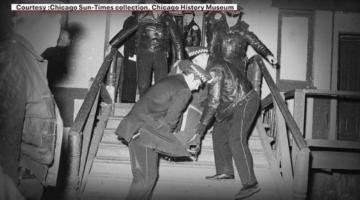
On December 8, 1969, the Panther office in Los Angeles was assaulted by the first operational police SWAT team. Just days earlier,, Fred Hampton and Mark Clark were set up and murdered by the Chicago police.
Bobby Seale was indicted on trumped-up murder charges in New Haven, Connecticut, in August 1969 and would later, in September 1969, Bobby Seale sat gagged and hog-tied in a Chicago courtroom during the now infamous Chicago Seven conspiracy case. Panthers were murdered in the streets by cowardly racist cops, and dozens of Panthers were imprisoned and entrapped by local police intelligence agents and even murdered while in prison.
The political and physical attacks on the BPP and Black activists, while relentless, were nonetheless anticipated by the Panthers, indeed likely. Bin-Wahad explained that Panthers fully anticipated being forced “underground” and covertly planned accordingly. But not everyone in the Party’s leadership wanted to relinquish their personal notoriety, public adulation, and public persona of Black militancy that brought money and influence to their hitherto mundane existence. The FBI knew this and identified those personalities in the BPP leadership who were susceptible to a reactionary ‘flip-mode’ and those who weren’t. Time and time again, the FBI directed their COINTELPRO ops against these insecure personalities until their paranoia reigned supreme.[^11] Those the government couldn’t flip, they killed straight away or publicly denigrated and imprisoned. Here’s where it gets deep.
By 1971, Oakland’s Panther leadership embraced an ideological exit stage right from revolutionary radical politics to reformist grassroots electoral politics to avoid further violent government repression and yet appear “reasonably” militant. Huey devised a seemingly brilliant ideological substitute for the Party’s anti-racist, anti-imperialist, and Maoist/Marxist class analysis. Intercommunal socialism pending revolution. Abetted by criminal opportunism (street set hustling) that subsidized fundraising, those around Huey could bring to an end the legalized targeting of the Oakland BPP as a Black revolutionary armed cadre formation. That targeting could conveniently be exclusively directed at those Panthers and supporters who vehemently disagreed “with let’s pretend” revolutionary poverty pimping mitt-game.
From 1971-72 onward, the Oakland-based BPP would become a grassroots de facto civilian social service program operating on the periphery of two-party neoliberal local politics. Its leaders were securing grants and engaging in coalition building with neoliberal formations to run themselves for political office, while the BPP’s legacy itself would become a retirement vocation for old moribund activists and a launching pad for others into careers of academia, identity politics, and community organizing. Functioning off the vapors of its once revolutionary position as the leading Black radical formation during the Vietnam era, the Oakland-led BPP slouched into irrelevance.
But somewhere along the way, however, the history of the most famous Black Panther Party, established in Oakland, California, in 1966, was resurrected and became the dominant historical narrative of Black revolutionary nationalism, and the image of a raging “Black Panther” became the emblematic socio-political logo for African self-defense in America. A logo so powerful that years after the Panther’s demise it would be patented, sold on T-Shirts and memorabilia as an insignia of Black Pride and Liberation for money. How was it that a sleek porcelain figurine of a “Black Panther” that rested on the mantles of Black households across the South became transformed into a raging symbolic Panther synonymous with Black Nationalism and armed self-defense? It is in the telling of this history that the significance of the government’s COINTELPRO repression of the Black Panther Party can truly be evaluated, as well as the detrimental effect of personalizing the BPP’s ideological roots discharged. Historical transformations are made by men and women – but it is the material social conditions that determine their thinking.
The Oakland-led BPP persisted well into the 70s and 80s. Bin Wahad states, “This was generally the precise objective of the FBI’s COINTELPRO neutralization efforts aimed at radical Black nationalist politics, which didn’t begin with the murder of Malcolm X in 1965, but damn sure would end in (1971) with emergence of the FBI’s NEWKILL criminal investigations and the creation of government Anti-Terrorist Taskforces”.[^12] Anti-terrorist, militarized policing supplanted the Racial Matters Desk of the FBI (most racial extremists were from the Right – not the left). With the culmination of COINTELPRO, new government acronyms emerged that would refocus on a revolutionary Black nationalist underground, a far more dangerous threat to racist law enforcement than selling bean pies and holding free breakfast programs in churches. But the sixtieth anniversary of the founding of the BPP in October of 1966, unfortunate for many, is an ahistorical celebration and an ahistorical and reactionary co-optation of a political movement that could have been the foundation for an independent Black political party instead, this anniversary is more like a gallery opening, selling artifacts, conducting edutainment events (with minimal entry fees) that teach less than it truly informs. And here’s why.
Stealth History \- The Concept of a Black Panther Party
In May 1966, Stanford was in contact with Stokely Carmichael (Kwame Touré) about establishing a Panther organization in New York. An FBI report documenting those discussions stated that Carmichael had offered assistance with the organizing effort.[^13] The report is significant not because federal authorities deserve credit for recording Black political history, but because it preserves evidence of a national organizational relationship already taking shape months before Oakland's founding. Carmichael's involvement also connects Harlem to another frequently overlooked part of Panther history. In Lowndes County, Alabama, the Lowndes County Freedom Organization had already adopted the black panther as a symbol of independent Black political power.[^14] This is common knowledge. The symbolic political Panther was not born in California. It had been used in a struggle over political representation in the Deep South before becoming associated with revolutionary organizing in New York and, eventually, Oakland. But the Harlem Panthers were doing more than adopting a symbol. They were developing a political vision of their own.
In July 1966, according to former Harlem Panther organizer Sam Anderson, members of the organization gathered at Yuri Kochiyama's apartment and transformed, in theory, the political program of Malcolm X's Organization of Afro-American Unity into a ten-point program for the Black Panther Party. Yuri Kochiyama was a Japanese comrade of Malcolm X. Sam Anderson made that history explicit in a public statement in 2018, explaining that the Harlem Panthers had adapted the OAAU's thirteen-point program and used their new platform to recruit individuals and establish Panther chapters throughout the country. Anderson also described the distribution of political mailers across the United States, including to Oakland.[^15] Consider what that means.
Before Newton and Seale founded their organization, another Black Panther Party had already developed a ten-point political program. According to one of its organizers, that program was being circulated nationally, including to the very city where the most famous Panther organization would emerge. We have spent six decades celebrating the Oakland Ten-Point Program as a foundational statement of Black revolutionary politics. Yet, the existence of an earlier Harlem program, developed within a political tradition shaped by Malcolm X's Organization of Afro-American Unity, raises questions about the intellectual and organizational chronicle behind that celebrated document.[^16]
Those questions cannot be answered by simply pointing to the fact that Newton and Seale wrote Oakland's platform. The issue is not whether they authored a document. It is how the political ideas expressed in that document developed, circulated, and reached the organizers who ultimately brought them to international prominence. The political genealogy was already extensive. The Nation of Islam's \[NOI\] What the Muslims Want had articulated demands for Black freedom and economic independence. RAM developed its own twelve-point program in 1964, advancing a revolutionary vision of Black self-determination. Malcolm X's OAAU sought to organize Black people around a political framework that connected domestic oppression to international struggles for liberation. These programs were not identical. Nor were they intended to be. Their significance lies in the development of a shared political language and in the organizations that carried those ideas forward. Perhaps this is why Huey’s “intercommunal socialism” pending revolution represented a sigh of relief for the U.S. government and FBI that had for decades wanted to squash the persistent “Freedom Dream” of Black self-determination before the introduction of the global digital communications age rendered national sovereignty politically superfluous and ordinary people would awake to the reality that they had a common enemy, the oligarchs of global capitalism.
Anderson's testimony adds something particularly important to this history. It identifies an actual organizing process through which an earlier political program was adapted for the Harlem Panthers and distributed to other communities. That is more historically revealing than simply observing that two documents contained similar demands. It does not establish that Newton and Seale copied the Harlem platform. That would require further evidence, including a direct comparison of surviving documents and a clearer record of their circulation. But the earlier program and Anderson's account of its distribution cannot simply be ignored because Oakland's version became more famous. Nor can the Harlem Panthers of 1966 be reduced to a political program.
In September 1966, they (Harlem Panthers) were confronting the educational conditions imposed on Black children in New York City. Their organizing included a call for a shutdown of Harlem schools and demands for educational institutions that served the community's needs. They wanted more schools in Central Harlem, greater Black representation in educational leadership, and the inclusion of African languages and history in the curriculum. These were not abstract revolutionary declarations. They were demands directed at institutions shaping the daily lives of Black families. The New York Public Library's Schomburg Center preserves archival records documenting Panther activity in Harlem during this period. The collection establishes that Black Panther organizing was underway in the city in the fall of 1966, including the September school campaign.[^17] And then there are the October 4 meeting minutes.
While the Harlem Panthers were fighting over the education of Black children, they were also confronting the practical problems of revolutionary expansion. Their minutes record discussions about declining support from Carmichael, the Student Nonviolent Coordinating Committee, and the Congress of Racial Equality. Organizers disagreed about the feasibility of establishing a national Black Panther Party before strong local organizations existed. One participant argued that the national project required a stronger foundation in communities across the country. Lloyd Weaver suggested that a national party would not be feasible for at least three months and proposed the formation of a national Black liberation front in the meantime. The minutes also referenced an upcoming October conference in Philadelphia.[^18] This was a movement wrestling with the difficulties of national organization before the Oakland Party existed. The significance of those discussions becomes even greater when we consider what happened next.
The Harlem Panthers did not become the internationally recognized organization that emerged from Oakland. Their early national ambitions faltered, and the original organization fragmented. But the failure of one revolutionary project and the success of another cannot be treated as a simple contest in which the better organization prevailed. Revolutionary organizations did not operate on equal ground, free from outside interference. As alluded to earlier, by the time the Harlem Panthers were organizing, RAM had already become a target of infiltration and political repression. Undercover agents had penetrated RAM by 1965\. In June 1966, police raids targeted RAM members in New York and Philadelphia, including Stanford. Those actions disrupted the very revolutionary networks from which the Harlem Panthers emerged. This is where the history becomes especially troubling.
Accounts of the original Harlem organization's decline include allegations of infiltration, financial disruption, and internal mistrust. The extent to which particular individuals deliberately undermined its operations still requires closer examination of organizational records and firsthand testimony. But the broader conditions are clear: the Harlem Panthers were attempting to build a revolutionary organization within networks that had already been infiltrated and subjected to police repression. That history complicates any assumption that Oakland's eventual prominence reflected a straightforward progression from a less successful organization to a more successful one.
The Oakland Party, of course, would experience devastating repression of its own. Its leaders and members faced surveillance, arrests, imprisonment, and lethal violence. But the chronology matters. The revolutionary networks associated with the earlier Harlem Panthers were already confronting infiltration before the Oakland Party was founded. What happens to our understanding of Black Panther history when we recognize that some of the movement's earliest organizers were struggling not only to establish a national organization but also to sustain the political networks necessary for its survival? What happens when we stop treating organizational disappearance as evidence of historical insignificance? The answers demand a different understanding of revolutionary history.
Movements do not develop through a neat succession of famous founders and celebrated organizations. They emerge through political relationships that are often difficult to reconstruct. Ideas travel through meetings, correspondence, publications, and personal relationships. Organizers borrow from earlier movements, revise their strategies, and attempt to build institutions capable of advancing their political goals. Some of those institutions survive long enough to establish a recognizable public identity. Others fragment before their contributions become widely understood. The danger comes when we confuse those outcomes with the origins of the ideas themselves.
The Oakland Panthers transformed revolutionary politics in ways that deserve continued study. Their community survival programs, international alliances, and confrontations with state violence left an extraordinary historical record. But their achievements cannot explain away the political work that preceded their founding. The Harlem Panthers were not waiting for Oakland to give their organizing meaning. They were already developing political programs, confronting local institutions, and debating how to build a national revolutionary movement. Their work belonged to a wider struggle that included the organizers of Lowndes County Panthers, the intellectual influence of Malcolm X, and the revolutionary networks of RAM. The historical problem is not that Newton and Seale have received recognition. It is that recognition has too often been mistaken for origination. And that distinction matters beyond the Black Panther Party.
When revolutionary history becomes organized around a handful of recognizable figures, we lose sight of the people who developed the political ideas those figures inherited. When personal opportunism copyrights historical information and memorabilia to enshrine stealth history as factual, we monetize the blood and sacrifice of our elders. We also lose the ability to understand how movements were weakened before they achieved lasting visibility. The result is a history that celebrates revolutionary leadership while obscuring much of the collective work that made it possible. Sixty years after the Oakland founding, we should be asking more demanding questions about the history we have chosen to commemorate.
Why do accounts of the Black Panther Party so often begin on October 15, 1966, when Panther organizing was already underway elsewhere? Why has an earlier ten-point program, reportedly circulated nationally, received so little attention? And how did the disruption of the movement's early organizational networks shape which Panthers became central to historical memory? These questions do not require us to invent a different history. They require us to examine the one that already exists.
The October 4 meeting minutes exist. The Harlem school campaign is documented. Stanford's political organizing preceded Oakland's founding. Anderson's account places an earlier Panther program in Yuri Kochiyama's apartment during the summer of 1966\. The evidence is not hidden in some distant, inaccessible past. Much of it has been preserved, published, or recounted by people who participated in the movement. What remains is the willingness to take it seriously. The Oakland Black Panther Party was founded on October 15, 1966\. That date deserves its place in history. But it was not the beginning of Black Panther organizing. The Panthers had already been making history. Oakland was simply not yet the center of it.
[^1]: Black Panther Party, meeting minutes, October 4, 1966, box 31, folder “BPP 1966–67, 1971,” Larry Neal papers, Sc MG 344, Schomburg Center for Research in Black Culture, Manuscripts, Archives and Rare Books Division, The New York Public Library.
[^2]: “A Huey P. Newton Story: BPP Formation,” PBS, accessed October 22, 2026, https\://www\.pbs.org/hueypnewton/actions/actions\_formation.htm
[^3]: “Negro Leaders Hammer at ‘Black Unity’ Theme,” Wellsville Daily Reporter (Wellsville, NY), August 30, 1966, 1\.
[^4]: “Black Panther Party History and Geography,” Mapping American Social Movements Project, University of Washington, https\://depts.washington.edu/moves/BPP\_intro.shtml
[^5]: Federal Bureau of Investigation, “Student Nonviolent Coordinating Committee: Stokely Carmichael,” August 19, 1966, 3, section “Black Panther Party, New York City,” FBI file 100-446080.
[^6]: Ahmad, Muhammad, We Will Return in the Whirlwind: Black Radical Organizations 1960–1975 (Chicago: Charles H. Kerr Publishing Company, 2007), 101\.
[^7]: Bobby Seale, Seize the Time: The Story of the Black Panther Party and Huey P. Newton (New York: Random House, 1970), 68\.
[^8]: Joshua Bloom and Waldo E. Martin Jr., Black against Empire: The History and Politics of the Black Panther Party (Berkeley: University of California Press, 2013), 37\.
[^9]: U.S. Senate, Select Committee to Study Governmental Operations with Respect to Intelligence Activities, Final Report, Book III, Supplementary Detailed Staff Reports on Intelligence Activities and the Rights of Americans (Washington, DC: Government Printing Office, 1976), 20-38.
[^10]: Ward Churchill and Jim Vander Wall, The COINTELPRO Papers: Documents from the FBI’s Secret Wars Against Domestic Dissent (Boston: South End Press, 1990), 361\.
[^11]: Moore v Levi FBI COINTELPRO suit, Newton Paranoia
[^12]: Dhoruba Bin-Wahad, written commentary provided to Johari Diata Osei, October 22, 2026, author's collection.
[^13]: Federal Bureau of Investigation, “Student Nonviolent Coordinating Committee: Stokely Carmichael,” August 19, 1966, 3, section “Black Panther Party, New York City,” FBI file 100-446080.
[^14]: Stokely Carmichael and Charles V. Hamilton, Black Power: The Politics of Liberation in America (New York: Random House, 1967), 74\.
[^15]: Sam Anderson, interview by Johari Diata Osei, January 26, 2025, author's collection.
[^16]: Muhammad Ahmad, We Will Return in the Whirlwind: Black Radical Organizations 1960–1975 (Chicago: Charles H. Kerr Publishing Company, 2007), 167; Organization of Afro-American Unity, “The Basic Unity Program,” 1964, https\://www\.malcolm-x.org/docs/gen\_oaau.htm.
[^17]: “Harlem School Strike, 1966,” box 1, folder 8, Black Panther Party Harlem Branch Files, Sc MG 80, Schomburg Center for Research in Black Culture, Manuscripts, Archives and Rare Books Division, New York Public Library, https\://archives.nypl.org/scm/20948
[^18]: Black Panther Party, meeting minutes, October 4, 1966, box 31, folder “BPP 1966–67, 1971,” Larry Neal papers, Sc MG 344, Schomburg Center for Research in Black Culture, Manuscripts, Archives and Rare Books Division, The New York Public Library.
Dhoruba bin-Wahad is a former member of the Black Panther Party (BPP) and the Black Liberation Army (BLA). He was a leading member of the New York chapter of the BPP, a Field Secretary of the BPP responsible for organizing chapters throughout the East Coast, and a member of the Panther 21.

 The 2026 French uprising is a continuation of the anti-colonial struggle, rooted in the 1961 Paris massacre of Algerians and the ongoing neocolonial relationship between France and its former…
 Disregard for Palestinian rights is a feature of Israeli politics rather than a bug. The upcoming Knesset election will change nothing for Palestinians, because every candidate across the political…
 Thousands of people took to the streets across Colombia on Wednesday in the first national strike against President Abelardo de la Espriella’s administration, as police used tear gas, rubber bullets…
 As we are experiencing a world order in disorder, with war and conflagrations and a shifting balance of power, Issa Shivji calls for a Sovereign Pan-African Project. The analyses recap the…
 In this week’s segment, we see through supposed disagreements between the US and Canada and recognize their partnership in settler colonialism, enslavement, and imperialism. But we begin with a…



