There is no evidence that Eritrea has surrendered its Red Sea Coast in exchange for relief from US sanctions.
On September 17, the US allowed its extremely harsh sanctions on Eritrea to lapse, along with less harsh sanctions on Ethiopia. President Joe Biden had imposed these sanctions five years earlier, on September 17, 2021, in Executive Order 14046. With the usual hegemonic hubris, it declared that the war then raging in Ethiopia, in which Eritrea was fighting on the government’s side, posed an “extraordinary threat” to US national security.
When the sanctions were lifted, commentators were quick to conclude that Eritrea had surrendered sovereignty over its 700-mile Red Sea Coast to the US in exchange for sanctions relief. The X platform social media star Mario Nawfal immediately posted that “Washington just quietly bought itself a seat on the Red Sea.” Prominent left commentator Laith Marouf, on an Activist News Network podcast, later speculated that the US must have engaged in negotiations with Eritrea in hopes of establishing a ring of military bases from Somaliland to Djibouti and Eritrea to counter Ansar Allah (“the Houthis”).
However, there is no evidence that Eritrea engaged in any such negotiations or that it made any such concessions.
Eritrea’s Minister of Information, Yemane Gebremeskel, welcomed the US decision and said that the sanctions imposed by the Biden administration in 2021 “were not warranted by any metrics” and had caused incalculable economic damage.
He added, “In this respect, we welcome the gesture and remedial measures by the Trump Administration.”
In subsequent remarks, he described the lift as reflecting “a reservoir of constructive political goodwill” that could open a new chapter of cooperation focused on investment and trade, and said that it sent a positive signal to the international community by removing a political obstacle to engagement. The Eritrean Ministry of Information published a statement using similar language.
These are fine words about what should motivate international relations, ideals that should be advanced. However, having suffered nearly two decades of US-imposed sanctions, Eritrean leaders no doubt realized that this was about US interests, as was shortly confirmed, when a State Department spokesperson told AFP that President Trump chose not to renew the 2021 national emergency “to advance US regional interests.”
The same official said that implementation of the 2022 Tigray peace deal had been “uneven,” but it was “time to adapt our foreign policy to current realities and collaboratively engage with both countries [Ethiopia and Eritrea] to advance US interests.”
Eritrea, Ansar Allah, and the Bab el-Mandeb Strait
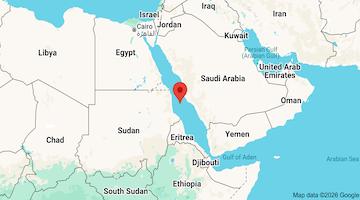
Just days before the sanctions were lifted, over the weekend of September 11–13, Ansar Allah seized the north side of the Bab el-Mandeb Strait and surrounding Red Sea coastline. In a rapid offensive they captured the strategic port city of Mocha and Perim Island inside the Strait.
Eritrea holdssome of the coast on the southern side of the Bab el-Mandeb, as does Djibouti, which is home to US, Chinese, French, Italian and Japanese military bases. Spain, Germany, the United Kingdom, and Saudi Arabia maintain smaller footprints in Djibouti with logistical staging areas, or personnel attached to multinational operations.
No one of these parties could be said to fully “control” the Strait. It’s a delicate balance in which any one or any alliance among them might cause or counter disruption.
The Bab el-Mandeb is of course a key chokepoint on the maritime trade route connecting East and West, with cargo passing through the Suez Canal, the Red Sea, and the Strait in both directions, from the Mediterranean to the Gulf of Aden, Arabian Sea, and Indian Ocean.
The US and Israel’s war on Iran has nearly halved the oil transiting through the Gulf of Hormuz, making the Bab el-Mandeb more geostrategically critical than ever. Saudi Arabia began moving more crude through its Saudi Aramco East–West Pipeline, the main land route between its eastern oilfields to the Red Sea for transit north through the Suez Canal and south through the Bab el-Mandeb. Ansar Allah is disrupting that trade as it now fights, most of all, Saudi Arabia.
The Saudis have asked Trump to intervene but he has so far declined, reportedly after Ansar Allah promised not to break its 2023 ceasefire with the US.
One might conclude that Trump lifted the sanctions on Eritrea in response to Ansar Allah’s triumph, but back in April, the Wall Street Journal published a piece suggesting the possibility titled “U.S. Seeks to Reset Ties With Reclusive but Strategically Vital African State.” It said that the US was finally looking to lift some of the sanctions in hopes that Eritrea could become a “bulwark against Iranian influence.”
As I wrote at the time, this exposed the fraud that US sanctions on Eritrea had ever been about democracy or human rights, as was often alleged. It was about naked imperial interest. Hegemony. Resources. Power, domination, and control.
Eritrea has resisted US domination for well over 30 years. It is the one African nation to have refused engagement with both AFRICOM and the IMF, and it has long been one of the most heavily US-sanctioned countries in the world. The sanctions just lifted excluded it even from the SWIFT system for conducting international financial transactions, like Russia and North Korea, and restoration to SWIFT remains just a promise that will take days or perhaps even weeks to negotiate, assuming the US follows through.
It now sits between two interconnected theaters of conflict, that in the Gulf and that in the Horn with its 700 miles of Red Sea Coast. Given all that its people have suffered due to the sanctions, it has every reason to welcome their lifting while at the same time keeping its cards close to its chest.
Did the US buy its neutrality? That may be what it sought, but Eritrea was already committed to neutrality in the Iran and Yemeni conflicts. Ethiopia has been threatening to invade Eritrea, making irredentist claims to its coast, since 2023, and the UAE-backed war in Sudan threatens the security of Eritrea’s Western border. This doesn’t leave Eritrea the leisure to engage in the US-Israeli war on Iran even if it were asked or were so inclined. Its leadership has to think of the Eritrean people.
I asked Eritrean American Elias Amare, noted Horn of Africa commentator and longtime supporter of his home country, for his thoughts on the sanctions’ lifting, and this was his response:
“As far as Eritrea is concerned, there is no quid pro quo in the U.S. lifting (or rather not renewing) its unjust, unilateral sanctions on Eritrea.
“Eritrea maintains strict neutrality in the current conflict/war on Yemen.
“Eritrea is wary of and vigilant about the usual ‘carrot and stick’ tactics of the Western imperialists. It must be noted that Eritrea is also a powerful cohesive state and not an easy pushover.
“Currently, Eritrea also has the strategic upper hand and is the center of gravity in the Horn of Africa and the critically important Red Sea basin and the Bab el-Mandab Strait choke point.
“Eritrea is always ready for a win-win proactive engagement with all forces in the region — as well as global powers — who respect her independence and sovereignty.”
There’s no sign that Eritrea’s done a deal with the devil, but only time will reveal the devil’s next move.
Ann Garrison is a Black Agenda Report Contributing Editor based in the San Francisco Bay Area. In 2014, she received the Victoire Ingabire Umuhoza Democracy and Peace Prize for her reporting on conflict in the African Great Lakes region. She can be reached at ann@anngarrison.com. You can help support her work on Patreon.

 Pan-African Community Action (PACA) released a Transit Solidarity Plan for Washington, DC that challenges DC fare evasion crackdowns by collecting and redistributing fare cards to residents in the…
 The United States got its hands on Alex Saab a second time in order to use him in its case against Nicolás Maduro. The U.S. succeeded in getting a guilty plea from Saab, but the current Venezuelan…
 “The Iraq invasion greatly accelerated the process of U.S. imperialism’s decline.”
 NSPM-7 and the State Department's international campaign against "far-left political terrorism" represent new and more dangerous forms of domestic repression in the 21st century, while reconstructing…
 In this series, we ask acclaimed authors to answer five questions about their book. This week’s featured author is Colin Kaepernick.


