Nicaraguan President Daniel Ortega. (Photo: el19 Digital)
Nicaraguan President Daniel Ortega stated that when the country's next elections take place, none who promoted a violent anti-government insurrection in 2018 will be allowed to stand for office. Western media outlets reported this as a total ban on voting.
Originally published in Common Dreams
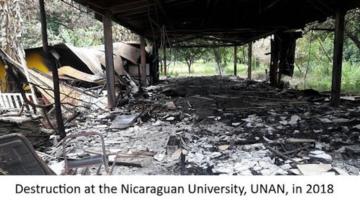
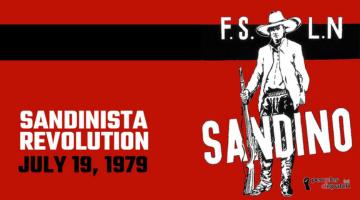
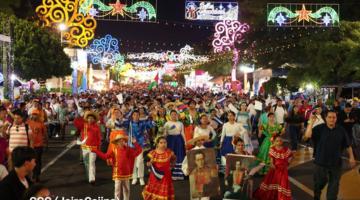
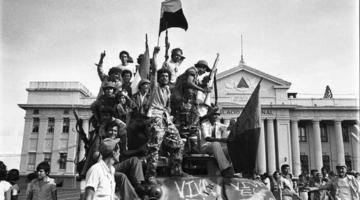
July 19 is a key date in Nicaragua’s calendar—the anniversary of the victory of its Sandinista revolution in 1979 and the overthrow of the vicious US-backed Somoza dictatorship that terrorized Nicaraguans for 43 years prior. Every year, huge crowds gather in celebrations across the country, culminating in a nationally broadcast speech by President Daniel Ortega. In recent years, Ortega has used the moment to discuss the country’s successes in the year prior, and lay out the agenda for the following year, while lauding not just the Sandinista Revolution’s triumph in 1979 but also the country’s resistance to the 2018 coup attempt—and lamenting the death and destruction it caused before peace was restored.
This July 19, while discussing that violence, Ortega proposed a blanket electoral ban on candidates who participated in fomenting the riots which plagued Nicaragua for months in a violent, US government-sponsored coup attempt that left hundreds dead:
There will be no elections like that again here—no more elections through which they can try cheating their way to government or cheat their way to taking power. We need to create laws that will put up a wall, a barrier, against the coup-plotters, against those who are traitors to their country. And no matter how much money the Yankees give them, they won’t succeed!
Even for casual observers, it was clear that the head of the Nicaraguan government was proposing restrictions on candidates funded and directed by a hostile foreign power situated in the US. But in corporate newsrooms across the country, editors pounced on the phrase “there will be no elections.”
Quoting the president’s statement completely out of context, The New York Times shrieked that Daniel Ortega planned to abolish elections completely, strengthening his “authoritarian grip” on the country. A headline in business journal Bloomberg blared: “Nicaragua’s Dictatorship Should Be Marco Rubio’s Next Problem.” Right on cue, Rubio issued a statement accusing the Nicaraguan government of “thwarting the basic tenets of our democratic hemisphere.”
At US legacy media outlets, clarification was sought not from the government or its supporters, but from right-wing apparatchiks financed and directed by Washington. The Times went to Felix Maradiaga, leader of an opposition group which “operates in secret in Nicaragua,” who claimed that “Ortega buried Nicaraguan democracy a long time ago.” Unmentioned by the NY Times was that Maradiaga is aligned with the far-right Atlas Network and was a key actor in the 2018 coup attempt, for which he received copious US funding.
As Max Blumenthal revealed in The Grayzone in 2018, the Yale-trained Maradiaga’s Institute for Strategic Studies and Public Policy (IEEPP) had received at least $260,000 from the US government’s National Endowment for Democracy since 2014.
The BBC, falsely asserting that Nicaragua’s next elections were now “cancelled,” rolled out another opposition activist, Juan Sebastián Chamorro, who labelled Nicaragua “the North Korea of Latin America.” Chamorro and his oligarchic family have historically been the biggest recipients of US funding directed at regime change in Nicaragua and almost certainly still are.
During the 2018 coup, Juan Sebastián Chamorro promoted the strategy of erecting tranques, or roadblocks, where opposition hooligans kidnapped, brutalized, raped, and even killed common Nicaraguan citizens in a failed bid to strangle the country’s economy and ultimately take over its cities.
It’s no secret that Maradiaga and Chamorro are competing to be Washington’s favored candidate if regime change were to ever occur. Reuters described Maradiaga as a “presidential hopeful,” while Chamorro is joint author of a new Atlantic Council report calling for Washington to back his “transition plan” for Nicaragua. Opposition media put this pair at the top of a list of eight potential candidates.
Washington’s plans for regime change in Nicaragua are hardly a secret, either. The National Endowment for Democracy’s president, Damon Wilson, bragged to a House committee in February that his organization is funding media in Nicaragua with an eye to undermining its Sandinista government. Commenting on latest developments, he said: “The Ortega-Murillo regime may seek to abolish elections, but it cannot abolish the Nicaraguan people’s desire for democracy. We will stand with them until that right is restored.”
The NED, a CIA cutout, currently spends over $2 million annually on Nicaraguan opposition groups—its highest funding level for any country in the region. And of course, the NED is only one source of US regime-change support for political groups who failed to overthrow Nicaragua’s government in 2018 and intend to try again.
In Nicaragua itself, figures such as Maradiaga and Chamorro have little credibility. Opinion polls consistently show that the government has significant popular support. For example, its approval levels ranged from 40-60% in Argentina’s CB Global Data polls over the course of 2026. This is hardly surprising in a country which now has the most modern and extensive public health system in Central America, the region’s best highways, and is building over 7,000 homes each year for those on the lowest incomes, all the product of 19 years of Sandinista rule.
Most Nicaraguans are well aware of what a government headed by the likes of Maradiaga or Chamorro would entail. Not only do they recall the violence and destruction of the coup attempt, but many remember that the last US regime-change operation—a heavily manipulated election in 1990—resulted in 16 years of neoliberal government which left the country with barely functioning schools, potholed highways, and only intermittent electricity supply. Ortega’s call for elections that bar the golpistas (coup mongers) from taking part was therefore met with cheers from the July 19 crowds.
Next-door Honduras provides a lesson of US electoral interference. Not only did President Donald Trump threaten Hondurans with aid cuts if they failed to vote as he wanted in last December’s poll, he also freed the convicted, narco-trafficking former president, Juan Orlando Hernández. To the horror of most Hondurans, he is returning to the country as I write this.
Now, Secretary of State Marco Rubio is being pushed by Florida Republicans such as Reps. María Elvira Salazar and Carlos Giménez to ensure that “after Cuba, Nicaragua is next.” Yet he must be aware the opposition has virtually no support in Nicaragua itself. This week, one of Ortega’s most prominent critics, Manuel Orozco of the Inter-American Dialogue, admitted to CNN, “Nobody is thinking about what it would mean for the United States to remove these people from power when there is no opposition, the public does not know who the leaders in exile are, and there is economic stability.”
While proclaiming “the statement by Daniel Ortega that under his family’s dictatorship Nicaragua will never again hold elections lays bare their true authoritarian nature,” Rubio threatened, “The Trump Administration and the international community will not stand by as the Murillo-Ortega dictatorship deepens repression at home and manufactures instability that threatens US national security.”
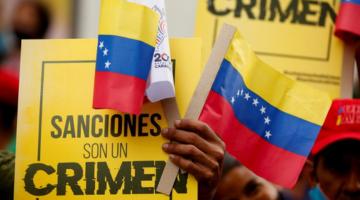
Nicaragua has already been included in a fresh round of US tariffs, and economic sanctions and attacks on its trade with the US will certainly continue. However, the political focus is likely to stay on electoral interference, now that Nicaragua’s National Assembly president has repeated earlier assurances that elections will indeed take place.
This brings us back to Daniel Ortega’s declaration during the celebrations in Managua. His government has the sovereign right to fight foreign interference in its electoral process. The US exercises the same right itself: Only days before Ortega’s speech, Trump railed against foreign interference in US elections, promising measures to protect their integrity.
Rubio’s statement supporting Trump’s address seems especially ironic in light of his escalation against Nicaragua. “Under @POTUS,” Rubio declared, “the Trump Administration will rout out foreign interference in our elections and safeguard our democracy. America’s future belongs to Americans.” Change the wording to refer to Nicaragua rather than the US, and you have a summary of what Daniel Ortega promised to Nicaraguans just two days afterward.
Nicaragua-based journalist John Perry writes for the London Review of Books, FAIR, Antiwar.com, and Covert Action.

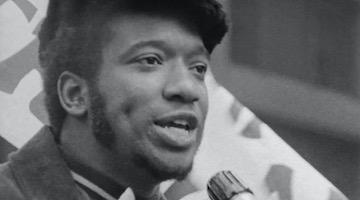 Hampton's body was dragged from the bloodstained bed to the hallway floor, to be displayed as the raiders' trophy “He's good and dead now."
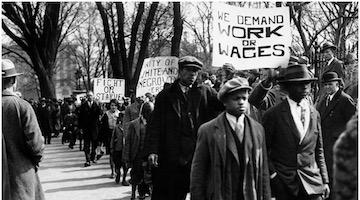 Anti-communists used the full powers of the state to silence, imprison, or deport radical Black activists.
 The Democrats’ relentless suppression of the Green Party affected the mind-set of more voters than all the right-wing howls put together.
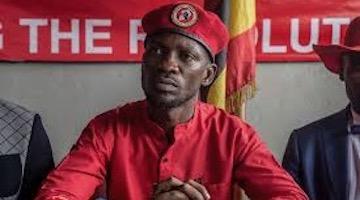 This week the role of US elites in controlling resistance by Ugandans and Black Americans were on your minds.
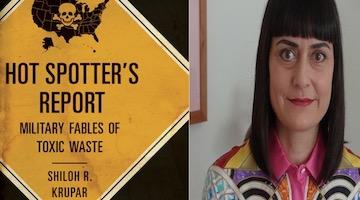 The U.S. military claims it is “green,” but what the Pentagon is really trying to prove is the planetary sustainability of war.



