Journalists at a press conference at the Pentagon in Washington, March 10, 2026. ABC News
The Pentagon is using censorship to control what Americans see as it carries out aggression around the world. However, censorship and war propaganda did not start with Trump or Hegseth.
I remember the moment I realized the Iran war had a second front. Not Tehran. Not the Strait of Hormuz. The second front was the Pentagon briefing room in Arlington, Virginia — and Pete Hegseth, Secretary of war, was winning it.
It was early March 2026. U.S. and Israeli strikes had been hitting Iran for less than a week. And the Pentagon press corps — reporters who had covered the U.S. military for decades — were either locked out of the building or sitting in a briefing room where the front rows had been handed to MAGA-aligned outlets. There was no independent verification of administration claims or follow-up questions from anyone who might actually push back. Just Hegseth, a former Fox News host turned Defense and then “War Secretary,”managing the narrative of a war that was killing thousands of people. The press restrictions were propaganda architecture.
A War You Weren't Supposed to See Clearly
Here's what Pete Hegseth press censorship actually looked like on the ground. In September 2025 — months before the first bomb dropped on Iran — the Pentagon distributed new guidelines requiring journalists to pledge to obtain official approval before publishing any information gathered at the building, even if that information was unclassified. Sign the pledge or lose your credentials. Dozens of Defense Department correspondents refused and by October, they had been forced to surrender their press badges.
The New York Times sued in December. A federal judge, U.S. District Judge Paul Friedman, ruled on March 20, 2026 — Day 21 of the Iran war — that portions of the policy violated the First and Fifth Amendments. Three days later, Pentagon announced journalists would be moved from their offices in the building into a separate annex and required escorts at all times. The Pentagon was losing in court and escalating anyway.
"The effect of the lack of information is that the war has become something of a black box." — Pentagon beat reporter, March 2026
One Pentagon correspondent described it bluntly: "Lots of chest-thumping, less concrete data." In ordinary wartime, reporters would receive two detailed briefings a day on how the conflict was evolving. Instead, the Pentagon was dropping tweets and videos with no mechanism for follow-up. A war being waged in the name of US citizens, , with their tax dollars, was narrated exclusively by the people prosecuting it.
This Is Not New. That's the Point.
Here's where most coverage of the Hegseth censorship falls short: it treats this as a Trump-era aberration. It isn't. It's a pattern that goes back at least to 1983.
When Ronald Reagan invaded Grenada in October of that year, the press was kept 170 miles away. It was the first time in U.S. history that journalists were barred entirely from a large-scale military operation. The rationale given was safety and operational security. The actual effect — and arguably the actual point — was that the Pentagon managed the narrative entirely through official statements, and the invasion received near-universal domestic approval. Barring reporters from Grenada, as one military analyst later observed, proved to be an effective means of controlling public opinion.
First Reagan in Grenada, then George H. W. Bush in Panama, then the first Gulf War press pool system — which was really licensing by another name. Then George W. Bush in Iraq in 2003, where embed culture turned reporters into guests who needed to keep their hosts happy. Hegseth has simply dropped the pretense. He isn't managing press access. He's selecting his audience with front-row seats for outlets that won't make him uncomfortable while everyone else is told to find a different job.
"Since the Grenada conflict, the Pentagon has linked victory with censorship." — New York Times Magazine, 1991
Who Pays When the Lights Go Out?
Here's the question the mainstream press freedom debate rarely asks: who actually bears the cost of this blackout?
Not the editors at the Washington Post. Not the bureau chiefs filing First Amendment briefs. The people who pay are the ones who have always paid for American military adventures: working-class communities in the United States, Black and brown families who send their children to serve in wars they didn't vote for, and people on the other end of the bombs — in Tehran, in southern Iran, in Yemen, in Gaza — whose deaths become statistics only when a journalist can independently confirm them.
The Committee to Protect Journalists documented arrests of reporters, interference with coverage, airstrikes on media infrastructure, and sweeping information restrictions across the region from day one of the Iran war. A visual investigation by the New York Times — published on March 5, 2026, only possible because the Times still had some Pentagon access — showed that U.S. airstrikes had hit an elementary school in southern Iran, killing more 165 children and others. That story would have not been publishes hadHegseth's policy held in full.
The deaths of 165 people, most of them children, should have been front-page news everywhere. Yet the tragedy appeared to receive limited attention from many mainstream media outlets. While questions remain about the reasons for the disparity in coverage, independent media organizations played a key role in bringing the story to a wider audience.
What the Briefing Room Tells Us
There's a detail in this story that deserves more attention than it's gotten. When the Pentagon did hold briefings during the Iran war, Hegseth called almost exclusively on MAGA-aligned outlets — which had been given front-row seats in the briefing room. This wasn't passive restriction. It was active construction. The administration wasn't just limiting what journalists could report. It was engineering which journalists were in the room, asking the questions, shaping the narrative.
This is what the liberal press freedom framing misses. The outrage tends to focus on the New York Times and its lawyers. It should focus on what gets built in the space that independent journalism vacates. Because the choice isn't between Hegseth's Pentagon and no information. It's between Hegseth's Pentagon and Hegseth's preferred mouthpieces. The war doesn't go dark. It goes curated.
That's how empire sustains itself. Not with silence but with managed noise.
What a Court Win Actually Means
Judge Friedman's March 20 ruling was, genuinely, a victory. The court found that Hegseth's credential-revocation framework violated constitutional protections. The Pentagon was ordered to restore press credentials to Times journalists, a necessary decision.
But by April 9, a revised Pentagon policy was already back before the same judge, who ruled it still flouted his original order. Hegseth responded to losing in court by moving journalists into a separate annex, mandating escorts, and closing the Correspondents' Corridor. The administration treats judicial oversight the same way it treats press freedom: as an obstacle to be rerouted, not a limit to be respected.
No one knows how this situation will end. Federal judges can rule, and the Trump administration can comply on paper while gutting access in practice. The press pool system created after Grenada — designed to restore trust while maintaining control — ended up producing the Gulf War's carefully managed media environment. Reform without structural change doesn't reform anything.
The War They Didn't Want You to See
I started by saying Pete Hegseth was winning the second front. To be more precise, he’s winning it in the sense that matters most to him: the American public is consuming this war primarily through official channels, official images, and official framing. A school full of dead children nearly disappeared from the record. A Defense Secretary who bans photographers because the pictures make him and the state look bad operates with minimal consequence.
But here's the thing about information control: it eventually fails. It failed in Vietnam — and the military spent the next four decades trying to make sure it never failed again. Grenada worked. Panama worked. The Gulf War worked. Iraq worked, for a while. Then the pictures from Abu Ghraib were released. Then the casualty counts couldn't be hidden. The Pentagon's information war always comes home. The question is whether enough people are paying attention when it does.
For Black communities, for working-class communities across the color line, for anyone who has ever watched a war get sold to them on television — the answer to Pete Hegseth's press censorship isn't to mourn the access journalism that enabled every previous war. It's to demand something harder: accountability, transparency, and the right to know what is being done in our name before the bill comes due.
Hassan El Biali is a political analyst and writer specializing in U.S. foreign policy, international security, and Middle East geopolitics. His work has appeared in Independent Australia and Counterfire. He publishes longform analysis at megam226.substack.com.

 The UN's renewal of the Gang Suppression Force mandate is part of a wider hemispheric project to reassert military control across the Americas. Caribbean leaders cannot claim to support a Zone of…
 The Trump administration's new sanctions on Cuba, are part of a dual strategy to create unendurable hardship while simultaneously making Cuba financially dependent on the United States.
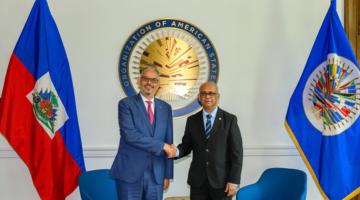 The armed groups in Haiti are not a spontaneous wave of banditry, but a scheme orchestrated by imperialist powers in concert with a reactionary and subservient Haitian political class. The…
 A coalition of Pan-African and socialist organizations has launched an international campaign to defend Cuba, arguing that African peoples must remember the sacrifices Cuban internationalists made…


