Black Agenda Report
Black Agenda Report
News, commentary and analysis from the black left.

  • Home
  • Africa
  • African America
  • Education
  • Environment
  • International
  • Media and Culture
  • Political Economy
  • Radio
  • US Politics
  • War and Empire

Negotiations or Annihilation: Can the Resistance Be Talked Away?
Zeinab Al Saffar
29 Apr 2026
🖨️ Print Article
Israel and Lebanon

Israel's diplomacy with Lebanon is a fiction. The goal is complete capitulation and annihilation of the resistance, at the cost of thousands of lives.

Originally published in Zeinab Al Saffar.

From the vantage point of the resistance in Lebanon, what is being paraded as a diplomatic track is, in reality, a refined instrument of coercion—an attempt to achieve through negotiations what could not be secured on the battlefield. Under Benjamin Netanyahu, diplomacy is no longer a parallel channel to war; it is its extension, calibrated to convert firepower into political submission.

The objective is neither ambiguous nor negotiable: the dismantlement of Hezbollah and the forced reconfiguration of Lebanon’s internal balance of power. This is not a framework for de-escalation; it is a blueprint for strategic erasure. By insisting on maximalist outcomes—security restructuring to the Litani, total disarmament, and the rejection of interim arrangements—Israel effectively positions diplomacy as a demand for surrender dressed in procedural language.

The doctrine of “negotiating under fire,” amplified by figures such as Danny Danon, rests on a familiar illusion: that sustained pressure will fracture the resistance’s political and social base. Yet this logic repeatedly collapses against Lebanon’s structural reality. The more coercion intensifies, the more (the resistance) is recast not as an anomaly, but as a necessity—an embedded deterrent within a fragmented state that cannot outsource its own defense.

Crucially, this strategy misreads Lebanon itself. It assumes a centralized authority capable of decisive realignment under pressure. In truth, Lebanon is a layered, decentralized system where power is diffused and legitimacy is negotiated, not imposed. Attempts to forcibly separate the state from the resistance do not resolve this complexity—they collide with it.

Even the reliance on the United States government as an external enforcer reveals its own fragility. American leverage is conditional, episodic, and constrained by competing global priorities. It can amplify pressure, but it cannot manufacture compliance where the underlying political terrain rejects it.

What emerges, then, is not a pathway to stability but a “managed” escalation cycle—one that institutionalizes confrontation while mistaking it for leverage. Agreements extracted under duress rarely endure; they incubate the next round of conflict.

From the resistance’s perspective, the equation is straightforward: a strategy built on coercion against a society conditioned to absorb and reinterpret pressure is less likely to dismantle the adversary than to reinforce it.

But perhaps the most revealing aspect of this entire exercise is its quiet premise—that Lebanon can be engineered from the outside, and that the resistance can be negotiated out of existence. A bold theory, certainly… just not one that has ever survived first contact with reality.

Bottom Line:

What is unfolding is not a peace process but a coercive bargaining model in which military force and diplomacy are fused into a single instrument. The objective is not de-escalation, but the forced restructuring of Lebanon’s internal and security architecture under sustained pressure. The viability of this strategy is highly uncertain—and may produce prolonged instability rather than resolution.

Lebanon
Israel
Zionism
Hezbollah
Ceasefire

Do you need and appreciate Black Agenda Report articles? Please click on the DONATE icon, and help us out, if you can.


Related Stories

Margaret Kimberley, BAR Executive Editor and Senior Columnist
U.S. Plans for An Attack on Iran
04 November 2026
Public opposition to war with Iran has forced Trump to wait until after the midterm elections to commit more war crimes.
Ali Abunimah
Israel’s “opposition” offers genocide with better PR
04 November 2026
Israel's election produced no real alternative for Palestinians, because every Zionist party from Eisenkot's Yashar to Golan's Democrats shares

Belen Fernandez
Israel’s Lebanese Land Grab
21 October 2026
Under the guise of a farcical “pilot zone” project to restore Lebanon’s sovereignty, Israel is pursuing a scorched-earth strategy whi
Gerald Perreira
October 7, 2023: The day that changed the world
21 October 2026
October 7, 2023, was not an isolated attack, but the culmination of generations of Palestinian imprisonment and resistance in Gaza, comparable
Edward Rhymes
What Changes For Palestine?
21 October 2026
Disregard for Palestinian rights is a feature of Israeli politics rather than a bug.
The Islamic Revolutionary Guard Corps
An open letter to the honorable people of the United States of America
07 October 2026
The Islamic Revolutionary Guard Corps (IRGC) has issued a letter addressed to the American people, outlining its views on recent developments a
Dr. M. Reza Behnam
Three Years of Genocide: How ‘Never Again’ Lost Meaning in Gaza
07 October 2026
If international law and justice are buried in the rubble of Gaza, the global community will ultimately be digging its own grave.
Sami Al-Arian
Why Hamas believed the status quo was more dangerous than its 7 October gamble
07 October 2026
Three years into Israel's genocide in Gaza, the consequences of a decision driven by siege, settlement expansion, and assaults on Al-Aqsa are s
Margaret Kimberley, BAR Executive Editor and Senior Columnist
Defending a Non-Existent International Law
30 September 2026
The Hague Group’s goal is to “. . .
Roberta Rivolta
Western Activism and the Axis of Resistance
23 September 2026
Western pro-Palestinian activism isolates Palestine from its regional allies, depoliticizing its struggle and reinforcing colonial

More Stories

  • Musings from the Margins
    ​​​​​​​ Ajamu Baraka, BAR editor and columnist
    Musings from the Margins
    09 Mar 2022
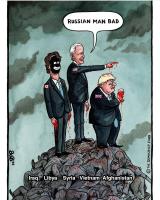
    U.S. determination to be the world's hegemon created the crisis in Ukraine. The impacts are felt by working people in this country, who must look outside for solidarity and leadership as…

  • ESSAY: Women's Organizations in the Caribbean Community from the 19th Century to Today, Rhoda Reddock, 1990.
    Editors, The Black Agenda Review
    ESSAY: Women's Organizations in the Caribbean Community from the 19th Century to Today, Rhoda Reddock, 1990.
    09 Mar 2022
    International Women's Day has radical roots going back more than 100 years. Caribbean women have always played a pivotal role in political organizing.
  • Russia, Ukraine, and the Race Problem
    Danny Haiphong, BAR Contributing Editor
    Russia, Ukraine, and the Race Problem
    09 Mar 2022
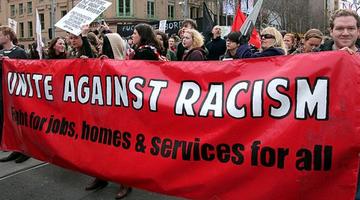
    The American public are inundated with anti-Russian war propaganda that is worse than in the days of the Red Scare.
  • Sanctions: A Sanctimonious Word for Economic Warfare and Outright Theft
    Ann Garrison, BAR Contributing Editor
    Sanctions: A Sanctimonious Word for Economic Warfare and Outright Theft
    09 Mar 2022
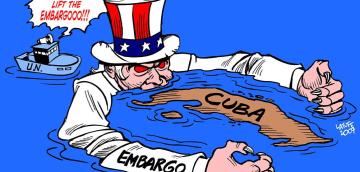
    The U.S. claims the right to sanction, to steal from other nations, with one-third of humanity suffering from these crimes. Sanctions are war by other means and cause great suffering…

  •  BAR Book Forum: Lindsey Green-Simms’ Book, “Queer African Cinemas”
    Roberto Sirvent, BAR Book Forum Editor
    BAR Book Forum: Lindsey Green-Simms’ Book, “Queer African Cinemas”
    09 Mar 2022
    In this series, we ask acclaimed authors to answer five questions about their book. This week’s featured author is Lindsey Green-Simms. Green-Simms is Associate Professor of Literature at American…

  • Load More
Subscribe
connect with us
about us
contact us