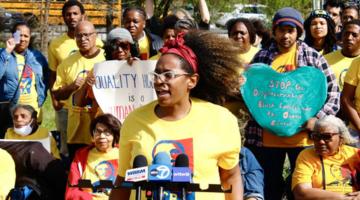
Chicago, March 19, 2025 – Federal workers rally against Donald Trump and Elon Musk’s mass layoffs outside the Kluczynski Federal Building. A Pew report found that, as of late 2024, Black people made up 18.5% of the federal civil service, compared to 12% o
Black workers built a strong U.S. labor movement. They now endure plant closings, deindustrialization, and low-wage work as a result of neo-liberal policies.
Originally published in Struggle La Lucha.
‘Last hired first fired’ still applies
The latest U.S. unemployment figures confirm that Black workers always have it twice as bad as white workers. While the seasonally adjusted jobless rate for white people in January was 3.7%, the rate for Black people was 7.2% — 95% higher. There’s often an even larger gap.
It’s been this way ever since pedophile slave masters like Thomas Jefferson founded the country. The labor leader A. Philip Randolph noted that during the 1830s, Black people were twice as likely to be confined in New York City’s poorhouse as white people. Randolph helped organize the 1963 March for Jobs and Freedom, at which the Rev. Martin Luther King delivered his “I have a dream” speech.
Before the Civil War, enslaved Black workers produced two-thirds of U.S. exports. In 1860, cotton — which was picked by Black women, children and men from “no see” (before dawn) in the morning to “no see” (after dark) at night — alone accounted for half of all exports.
Wall Street got a big share of the profits. The British, French and Yankee capitalists who owned the cotton textile mills would have gone bankrupt without Black labor on the plantations. Some of them did so during the “cotton famine” of the U.S. Civil War.
As W.E.B. DuBois pointed out in “Black Reconstruction in America,” it was the general strike of enslaved Africans during the Civil War that was indispensable to the defeat of the Confederates. So were the 200,000 Black soldiers and sailors serving in the Union army and navy.
Just for this, Black people are owed reparations. We need a coast-to-coast general strike to abolish ICE and overthrow all the Trumps.
The great betrayal
The short springtime of Reconstruction following the Civil War lasted barely a decade. Public schools were brought to half of the United States upon the bayonets of the Union army.
It was often Black leaders who set up school systems. That was the case in Florida, where the Black minister Jonathan C. Gibbs was the state’s superintendent of public instruction between 1873 and 1874.
According to DuBois, Gibbs “virtually established the public schools of the state as an orderly system” that benefited both Black and white students.
This brief flowering of democracy in the South benefited all poor and working people. South Carolina’s Black-majority state legislature — dubbed the Black Parliament — was the best government poor whites ever had in the South.
Railroad tycoons and Wall Street banksters gave Reconstruction’s bloody overthrow the green light. Pennsylvania Railroad President Tom Scott helped broker the rotten deal in 1877 that allowed the Republican presidential candidate Rutherford Hayes to take office.
Federal troops were pulled out of the South in exchange. Ku Klux Klan terror killed thousands. Within a generation, the right to vote was taken away from Black people throughout the Deep South.
The same year President Hayes took office, the Great Railroad Strike of 1877 broke out. Workers revolted against pay cuts. The Black educator Peter Clark, a co-worker of Frederick Douglass, spoke to strikers in Cincinnati.
“Put the strikers on a rifle diet,” declared railroad boss Tom Scott. Dozens were killed in Pittsburgh, Philadelphia and Reading, Pennsylvania. At least 20 were killed in Baltimore.
Cops and private gunmen killed workers in almost every big strike before World War II. Twenty coal miners and their family members would be killed in the April 20, 1914, Ludlow massacre during a strike against the Rockefeller-owned Colorado Fuel and Iron Co.
The next day, hundreds of Mexicans were killed when the U.S. Navy shelled Veracruz. The same capitalist class committed both atrocities. Among those with bloody hands was future president Franklin D. Roosevelt, who was then the Assistant Secretary of the Navy.
While hundreds of strikers would be killed in the North — largely white workers, many of whom were immigrants — thousands of Black workers were lynched in the South. As Karl Marx wrote, “labor in the white skin can never free itself as long as labor in the Black skin is branded.”
The Great Migration
Andrew Carnegie sent agents throughout Eastern Europe to recruit workers for his Pittsburgh steel mills. Why didn’t the tycoon just go south?
That’s because both Black and white workers were needed there. Cotton production increased fourfold in the years following the Civil War to reach 16 million bales.
Even though the United States had become the world’s largest manufacturer, cotton still accounted for 29% of U.S. exports in 1911. (The socialist People’s Republic of China now produces twice as many factory goods as the U.S.)
World War I largely stopped European immigration. Big capital summoned Black labor to come north. The Great Migration of Black workers had begun.
By 1917, Black workers accounted for a quarter of the 50,000 employed in Chicago’s Union Stockyards. Four thousand Black workers labored in the Newport News shipyards.
Black workers became absolutely essential to steel mills and foundries. In 1930, there were 55,000 Black coal miners, 25,000 of whom were in West Virginia.
The Pullman Company’s railroad sleeping cars had been for decades the largest private employer of Black labor. For many Black college graduates, the best job available was being a Pullman porter. The Brotherhood of Sleeping Car Porters, led by A. Philip Randolph, played a vanguard role in the freedom struggle.
Now, U.S. Steel became the biggest boss of Black workers. Eventually, even more Black workers were employed by General Motors, which was then the world’s biggest corporation. Ford, Chrysler and Bethlehem Steel also hired thousands of Black workers.
By 1968, one quarter of all U.S. auto workers and steelworkers were Black. (“Organized Labor and the Black Worker, 1619-1981,” by Philip Foner.)
Police brutalized and killed Black people in Northern ghettos. Black workers continued to be twice as likely to be jobless. But they were also twice as likely to work in what were then the two biggest U.S. industries: auto and steel.
A Black union vanguard
Black workers became the bedrock of the U.S. labor movement. Labor organizers in Southern textile mills felt they needed at least 40% of the workers in a plant to be Black in order to win a union representation election. (“Hiring the Black Worker,” by Timothy J. Minchin.)
Ford’s gigantic Rouge complex — which had its own steel mill and employed 100,000 workers during World War II — depended on Black workers.
By 1974, 50% of the workforce there was Black. So were 65% of those working on Rouge’s assembly lines. (“Black Worker’s Struggles in Detroit’s Auto Industry, 1935-1975,” by Kuniko Fujita.)
Representing these workers was UAW Local 600 — the United States’ largest union local — which had a Black communist leadership even in the early 1950s during the McCarthy witch hunt.
Ford and GM only hired Black workers in their Atlanta assembly plants because Black workers in Detroit threatened to go on strike. Detroit became home to the League of Revolutionary Black Workers, which, like the Black Panther Party, was a nightmare to the capitalist power structure.
U.S. “blue chip” corporations hated and feared that they were dependent on Black workers. The 1% feel the same way about their Latine and immigrant employees.
Sixty years ago, GM built an assembly plant in Lordstown, Ohio, to make the subcompact Vega because it was miles away from a major Black community. Management wanted to make white workers to turn out 100 cars an hour.
That’s a car rolling off the line every 36 seconds! White workers at Lordstown rebelled at this speed-up and became allies of the League of Revolutionary Black Workers in Detroit.
Fifty years of attacks
The counter-attack against Black workers accelerated in the mid-1970s, taking advantage of severe economic recessions. Wall Street demanded and got 50,000 New York City public workers, including 10,000 teachers, fired in 1975.
Trump has fired hundreds of thousands of federal workers, many of whom are Black women.
The Chrysler plants in the Detroit area were 70% Black. The U.S. Government’s bailout of Chrysler demanded their closures, a death sentence for Motown.
The Midwest was the industrial heartland of the United States. The thousands of plant closings in the region were devastating to the working class.
White families’ median income fell by 7.1% there between 1978 and 1982. That was a deep recession.
But Black families’ median income in the same region fell by 35.8% — five times as much. That’s a great depression. (U.S. Census historical income tables.)
In 1982, Black median income in the Midwest actually became lower than in the South. Hundreds of thousands began a “reverse migration” there.
Many cities outside the Midwest were also hard hit. The closing of Bethlehem Steel’s Sparrows Point facility just outside Baltimore — which had been the largest U.S. steel mill — and its shipyards cost 35,000 jobs.
Over the decades, 200,000 jobs were lost in New York City’s Garment District. They were among the 900,000 manufacturing jobs lost in the Big Apple.
Hundreds of textile mills, where Black workers had struggled to get hired, were shut down from Virginia to the Carolinas to Georgia.
Black workers never recovered from these attacks. Deliberate deindustrialization closed nine of the 10 GM plants in the Black-majority city of Flint, Michigan.
Instead of Black workers being hired in the big factories, many young Black workers were railroaded to the big prisons. Prisoners are members of the working class, too. (Even though they’re not counted in the jobless figures, which falsely lowers the unemployment rate.)
Today, the largest private employer of Black workers is anti-union Walmart. It’s because Walmart workers are so poor that the Walton family is filthy rich with a $513.4 billion fortune as of December 2025.
Yet there are more Black workers than ever. They played a vital role in the victorious 2023 UAW strike against the Big Three automakers. They’re helping to lead the way in union organizing drives at Amazon and Starbucks.
Black workers and immigrants will lead the entire working class in defeating fascist Trump and overthrowing capitalism.






 In this week’s segment, we discuss student protests by Black and brown youth in France against austerity measures and race-based inequality in the education system. But we begin with a discussion of…
 Brazil's incumbent president Lula da Silva finished second behind Flavio Bolsonaro in the first round of the presidential election. Because neither man received at least 51% of the vote, a run-off…
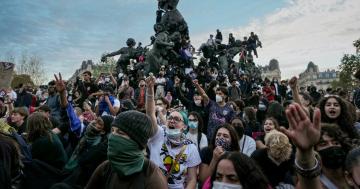 Students in France are engaging in mass protests. Hundreds of them have been arrested and injured by police, and many schools are closed. Annick Metefia joins us from Paris. She is a member of the…
 Ajamu Baraka of the Black Alliance for Peace joins Dimitri Lascaris on BettBeat Media for a conversation about something Western publics have not yet come to terms with — the fact that resistance to…
 Progressive candidates rarely remain so after winning public office. Zohran Mamdani is no exception, but his capitulation to New York zionists angered his supporters, and the people he hoped to…


