An end-of-the-year radical Black reading list from the editors of The Black Agenda Review.
For the Black Agenda Review’s final post of 2025, we want to draw your attention to a number of recently published and forthcoming books. These books critically illuminate the Black past while offering bold, unflinching insights into these increasingly violent and vexatious white times. In different ways, at different historical moments, and from different locations in the Black world, they offer radical perspectives on the consolidation of global white supremacy, the rise of modern-day fascism, the ongoing cries of capitalism and imperialism -- and the history and form of Black revolt. It goes without saying that all are from Black authors, and most are published by non-corporate, independent presses. We encourage BAR readers to check them out, do the reading, and continue the struggle in 2026.
Brandfort, Liberation Capital [1977-86] (Chimurenga, 2025). In 1977, South Africa’s Apartheid government banished Winnie Madikizela-Mandela to Brandfort, a small agricultural town in the Free State. They did not realize her presence there would make it a center of Black radicalism. A project of the Capetown-based production house Chimurenga, Brandfort, Liberation Capital reconstructs Mama Winnie’s small-town geography of anti-Apartheid activism.
Fatou Sow, Feminism in Africa: Gender, Knowledge and Resistance (Polity, 2026). A long-overdue translation of the work of the legendary Senegalese feminist activist and scholar, Fatou Sow, that brings together her insights on the complexities and contradictions of the struggles of African women, and the future of Africa itself.
Mário Pinto de Andrade, The Revolution Will Be a Poetic Act: African Culture and Decolonization (Wiley, 2024). A collection of speeches and essays from the late Angolan critic and activist Mário Pinto de Andrade (21 August 1928 – 26 August 1990), The Revolution Will Be a Poetic Act is an important contribution to debates on culture, colonialism, and anti-colonialism that should be read alongside the better-known works of Frantz Fanon, Amilcar Cabral, and Aime Cesaire.
Zophia Edwards, Fueling Development: How Black Radical Trade Unionism Transformed Trinidad and Tobago (Duke 2025). At a moment when the misleaders of the Caribbean twin-island republic have embraced the war-mongering of the Yankee imperialist (while kissing the hand of Modi's Hindu fascism), Zophia Edwards’ work recovers a local history of working class activism committed to Pan-Africanism, anti-imperialism, and multi-racial alliance. Deeply researched and elegantly written, Fueling Development is urgent, hopeful, and critically relevant.
Gerald Horne, Armed Struggle?: Panthers and Communists, Black Nationalists and Liberals in Southern California, through the Sixties and Seventies (Monthly Review, 2025). Another banger from our greatest living radical historian, in Armed Struggle? Gerald Horne examines the rise of militancy in the volatile post-Civil Rights era, showing how SoCal was both a cross-roads of liberation ideologies, and in the crosshairs of political factionalism. A work of staggering research beautifully rendered.
Tami Navarro, Virgin Capital: Race, Gender, and Financialization in the US Virgin Islands (SUNY, 2021). An ethnography of the recolonization of the US Virgin Islands by the predatory Economic Development Commission – an off-shoring program that encouraged US mainland financial services corporations to set up in the USVI in exchange for staggering tax exemptions — Virgin Capital is a masterful inquiry into financialization as a process of racialization. One of the best studies of racial capitalism out there, Virgin Capital is an important contribution to our understanding of the devilish work of US imperialism in the Caribbean.
Sobukwe Odinga, Treachery and Diplomacy: The Shadow Politics of US–Africa Relations (Columbia, 2026). A ruthlessly forensic assessment of the history of US-Africa security arrangements, Sobukwe Odinga has produced an instant classic in the study of diplomacy, foreign policy, imperialism, and African sovereignty. Nuanced in its analysis of high-level negotiations and revealing for its exposure of the race politics of international clientelism, Treachery and Diplomacy reveals in shocking but finely-wrought detail the internal politics of US power-brokering and African statecraft.
Michael L. Blakey, The Blinding Light of Race: Race and Racism in Western Science and Society (Routledge, 2025). The magnum opus of anthropologist Michael L. Blakey, The Blinding Light of Race combines three volumes that, together, trace the scientific and social origins of white supremacy back to the transformations of European Christian chauvinism in the context of colonial expansion and slavery. A massive, brilliant, and powerful work of scholarship.
Aisha M. Beliso-De Jesús, Jemima Pierre, and Junaid Rana, eds., The Anthropology of White Supremacy: A Reader (Princeton, 2025). Another massive, brilliant, and powerful work of scholarship, the edited collection The Anthropology of White Supremacy throws a grenade into the class rooms of eugenicists and race scientists and explodes the theoretical pretenses of the entire race-based discipline of anthropology in its entirety. Don’t go into the field without it.
W.O. Maloba, Revolution this time: Towards a New Africa (Africa World Press, 2024). A bold, unambiguous call for revolutionary resistance against imperialism, violence, and racism in Africa. Let’s go!
Kamau Brathwaite, The Arrivants (New Directions 2026). A re-release in one volume of the late Bajan poet and scholar Kamau Brathwaite’s visionary pan-African trilogy, consisting of Rights of Passage (1967), Masks (1968), and Islands (1969). One of the greatest long-poems of the twentieth century and a defining literary work of the global Black experience by one of our greatest writers and ancestors.
Also recommended: Fred Anderson, Eyes Have Seen: From Mississippi to Montreal (Baraka, 2025). Samia Hemmi, Colonial Toxicity: Rehearsing French Radioactive Architecture and Landscape in the Sahara (If I Can’t Dance/Framer Framed, 2024). Dhoruba Bin-Wahad, Revolution in these Times (Common Notions, 2025). Edwidge Danticat, We're Alone: Essays (Gray Wolf, 2024). Mikaela Loach, It’s not that radical: climate action to transform our world (Haymarket, 2025). Aaron Kamugisha and Victoria J. Collis-Buthelezi, Eds., The Caribbean Race Reader: From Colonialism to Anticolonial Thought (Polity, 2024).
Black Agenda Review, Radical Black Reading, 2023.

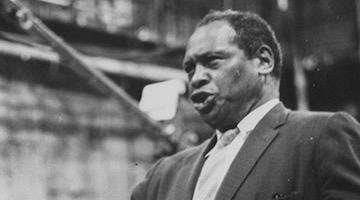 Brilliant and amazingly multitalented, Robeson was once among the most popular men in the U.S;, but became a non-person under relentless red-baiting.
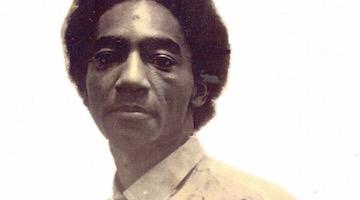 Ruchell Magee is the longest-held political prisoner in the United States and the world.
 Even as many more people around the world have access to education, schooling everywhere remains intertwined with systems of oppression, including racism and capitalism.
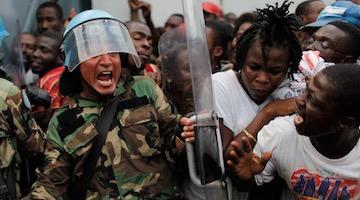 For fifteen years Latin American nations collaborated in the military occupation of Haiti, but have yet to apologize for their crimes.
 Insiders say Dataminr’s “algorithmic” Twitter search involves human staffers perpetuating confirmation biases, searching specific neighborhoods, streets, and even housing complexes for crime.


