Imam Jamil Al-Amin was a revolutionary targeted by the state from the 1960s until he was unjustly convicted of murder in 2002. He died on November 23, 2025, an elder political prisoner who had been denied medical care. We republish a 2012 Black Agenda Report article about his legacy.
“As a SNCC leader in rural Alabama, he helped lay the foundation for what black political power currently exists in the deep south today. “
Imam Jamil Al Amin has been on the right side, really the left side of history a long time. As a college student in the early sixties, he joined and eventually led SNCC, the Student Nonviolent Coordinating Committee, the corps of fearless young people who risked their lives organizing freedom schools, cooperatives and registering voters in the violent, Klan-infested rural south. Summoned to a White House meeting with President Johnson at the age of twenty-one, he fearlessly demanded federal action to ensure the safety of SNCC workers and ordinary African Americans, when older big-time civil rights leaders present were too busy being grateful for a chance to meet with the president at all.
As a SNCC leader in rural Alabama, he helped lay the foundation for what black political power currently exists in the deep south today. Targeted by COINTELPRO and the FBI for his advocacy of black political and economic power, self-defense and the eradication of drugs, he was arrested dozens of times. Congress even passed a law with his name on it, specifically intended to lock him up. While serving a 5 year prison sentence in New York, he converted to Islam, and upon his release Jamil Al Amin moved to Atlanta in 1976.
In the same spirit that guided his earlier political and human rights work, he set about organizing and community building in Atlanta's West End. He studied languages and traveled to the West Indies and the Middle East, to India, Pakistan, and Africa. He taught, learned and led by example, becoming Imam Jamil Al Amin, an internationally acknowledged leader among US Muslims. Along the way, he started several small businesses, including a grocery store and helped organize youth sports, anti-drug and anti-violence campaigns.
But once you earn the FBI's attention, you don't lose it. Surveillance and harassment of Al Amin continued the next quarter-century. When a West End drug dealer was shot in 1995, Atlanta police arrested him despite a good deal of evidence pointing in other directions, and had to release him when another man confessed to the crime.
“This week more than two hundred who hunger and thirst for justice gathered on the steps of Georgia's state capital to demand justice for Imam Jamil Al Amin, his return to Georgia for a new trial and his eventual freedom....”
In March 2000, two Fulton County deputies were shot in front of Imam Jamil Al Amin's home. The apparent shooter, one Otis Jackson, fled to Nevada before turning himself in, and confessed his role to FBI interviewers there. Georgia officials, however, declined to request his extradition, and Jackson was pressured into recanting his confession. Al Amin was not allowed his choice of attorneys, was denied proper discovery or the chance to present evidence of his innocence at trial, and the jury pool purged of those most likely to recall his civil rights work of the sixties.
Blatantly framed, Imam Jamil Al Amin was sentenced to life in prison, where his false conviction, status as a prominent Muslim leader and forty years of work in the service of human liberation made him Georgia's most high-profile political prisoner, though he was confined to a tiny cell 23 hours of every day. In 2007, when local and international pressure began building in earnest for a new trial and his release from solitary confinement, Georgia prison officials spirited him away to federal custody 1400 miles away in the federal supermax prison at Florence, Colorado, a living tomb where conditions of enforced isolation and sensory deprivation are widely recognized as torture.
This week, more than two hundred who hunger and thirst for justice gathered on the steps of Georgia's state capital to demand justice for Imam Jamil Al Amin, his return to Georgia for a new trial and his eventual freedom. “The next time we come back here,” declared Mauri Saalakhan of the Peace Thru Justice Foundation, “we can fill these steps, this street. We can. We must. And we will.” Brother Saalakhan is correct, of course. We can, and we must create the public pressure that ultimately leads to justice for our political prisoner, Imam Jamil Al Amin. Only time will tell if we will. Instead of retweeting and Facebooking phony Kony2012 propaganda to each other, we should be “raising awareness” of and demanding justice for Imam Jamil Al Amin. Let's make some of that happen.
For Black Agenda Radio, I'm Bruce Dixon. Find us on the web at www.blackagendareport.com.
The late Bruce A. Dixon was the managing editor of Black Agenda Report and a member of the Georgia Green Party state committee.

 Let’s not allow our revolutionary wish-list to keep us from appreciating the ways this film intervenes—with force and clarity—in our present American political discourse.
 Once we are able to secure Community Control over Police and ensure that entire communities are empowered to exercise such control, we will be free to re-imagine and re-envision the very nature of
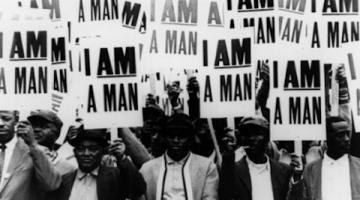 The author, a former corporate journalist like Hedges, reminds him that white workers betrayed Black workers and class solldarity, not the other way around.
 Together, we can demand that one of the wealthiest nations on earth upholds its responsibility to provide the basic necessities for its people.
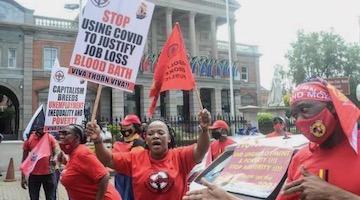 Millions of workers took part in the general strike on February 24, according to the South African Federation of Trade Unions which called for the labor action.


