
Related Stories


Public reaction to the Fani Willis soap opera is an example of how cynical Black misleadership creates confusion among the masses.

The Supreme Court will soon decide if unhoused people can be issued jail time or fines for sleeping on the streets.

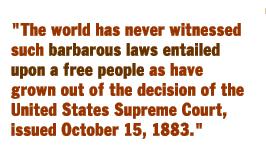
The Supreme Court has always been a political institution.

The recent Supreme Court decision which banned the use of race as a criterion for college admissions is indeed racist.

The recent Supreme Court ruling which bans affirmative action as an admissions' criteria does not apply to the military academies.

An essay by the late Glen Ford recounts the perverse origin story of the twisted life and lies of Clarence Thomas.

I.
Didn’t Lynne say something like, “The law’s
What they say it is…today…” (????????????????)

More Stories
 Rich and manipulative people like Hillary Clinton and her DNC cohorts were defeated by their own emails. “You can expect her to run for president once again.”
 Black, working and poor people can expect no relief from Democrats, who will continue to divert the nation’s resources to foreign wars and coups.
 Cory Booker rose to prominence as a fanatical backer of school privatization, yet poses as a friend of public education and teachers.
 This week the reader discussion was on the limits of electoral democracy in the United States and the accommodation of diversity in American imperialism.
 The author employs Frantz Fanon’s discussion of protest culture as a lens of analysis of hip-hop in Africa.



