In this series, we ask acclaimed authors to answer five questions about their book. This week’s featured author is Stacy J. Lettman. Lettman is an Assistant Professor of English at Florida Atlantic University. Her book is The Slave Sublime The Language of Violence in Caribbean Literature and Music.
Roberto Sirvent: How can your book help BAR readers understand the current political and social climate?
Stacy J. Lettman: The Slave Sublime: The Language of Violence in Caribbean Literature and Music speaks to the ongoing legacies of slavery and colonialism and the ways in which Black people not only continue to experience the slave plantation but also its related violence—yet have found ways to dispel this violence. What I refer to and codify as the slave sublime (drawing upon Paul Gilroy’s seminal term) is an articulation in literature and music of the violent legacies of Caribbean slavery as well as newer forms of bondage (the ghetto, prison, globalization, IMF debt servitude, etc.,) and the immeasurable levels of trauma that stem from the realization that plantation structures persevere despite the formal end of slavery and the advancement of the post-slavery periods and independence. The book moves across a range of disciplines and critical approaches to elucidate economic, textual, religious, musical, psychological, and linguistic legacies of violence and loss. In essence, the book prompts us to understand the ways in which modern-day political and economic arrangements are re-figurations of the plantation system that foreground the experiences of the ghetto, prison, madness, poverty, and unemployment.
What do you hope activists and community organizers will take away from reading your book?
They will better understand that the traumas from slavery still exist despite political demagogues’ desire to silence rather than to reckon with that history and its afterlife. I hope to draw attention to the importance of performance modes (such as music and dance), especially because they arose historically from the felt violence of the slave plantation and the crucial role of performance in allowing for the sublimation and mitigation of violence in lives of those who continue to feel the structural, psychic, and physical violence that extend beyond the formal practices of plantation slavery. In many ways, as the Caribbean psychoanalyst Frantz Fanon has suggested, violence is a learned behavioral language and the teacher of that violence was the colonial master through his use of soldiers and police. For instance, as The Slave Sublime reveals, in Jamaica the police (The Jamaican Constabulary Force) have a direct genealogy to the slave drivers and constables from the eras of slavery and apprenticeship. The function of the police today is similarly about protecting capital and the interests of the economic elites. What we are faced with is the prolongation of plantation systems as the “changing same”—in the sense that the mechanisms of power and its harnessing of violence “change” but remain the “same” in our contemporary era. The ghettos and prisons are bounded spaces (similar to the plantation) in which the descendants of slaves are patrolled and kept at bay through violence, whether as structural or physical violence.
We know readers will learn a lot from your book, but what do you hope readers will un-learn? In other words, is there a particular ideology you’re hoping to dismantle?
I hope readers will un-learn the belief that slaves lacked agency to express the sublime levels of violence they experienced in their lives. I hope readers will also un-learn negative assumptions about African-diasporic religious practices and to understand the ongoing significance to performance and resistance, given the continued effects of the plantation system and its translation to contemporary mechanisms and modes of oppression. I discuss, for instance, in chapter one the significance of Vodou to the Haitian Revolution and Obeah to slave rebellions in Jamaica and elsewhere in the Caribbean. I draw upon the works of religious scholars to explain that the negative regard for these practices stemmed from a European desire to thwart the revolutionary efficacy and potential of these religious practices, particularly in the nineteenth century. During this time period, ideas from leading philosophers sought to brand African-derived religious practices as primitive and barbaric and lacking a foundation in reason, which was positioned as a prerequisite for being classified as the human. There was also an assumption that Black people were incapable of reason, thereby lacking that which was necessary to be classified as human. Instead, philosophical ideas suggested that in this absence of reason, Blacks were instead ruled by sensations and the body that connected them to lower animal form.
Which intellectuals and/or intellectual movements most inspire your work?
As The Slave Sublime seeks to challenge European philosophies about Blackness and inferiority, particularly Kantian notions of the sublime, I am inspired by the intellectual works of Frantz Fanon, Paul Gilroy, Orlando Patterson, Sylvia Wynter, Achille Mbembe, and Carolyn Cooper. The book engages in a decolonization of aesthetics in relation to issues about representation, particularly by challenging Kant’s conception of the sublime as transcendence through disinterested reason. As such, the book seeks to reconfigure the sublime along the lines of the embodiment of terror and the centrality of the imagination that refutes Kantian notions of rationally-driven and disinterested contemplation. As I argue, for the historical and contemporary slave, the sublime is not only a bodily experience, but also one in which the imagination interiorizes terror—wherein the terror associated with the sublime remains ever-present without transcendence through reason, a contrast to Kantian philosophy and Cartesian cogito ergo sum that overlook an embodied notion of phenomenology that is so central to African and African-diasporic performance. And as Kant suggests in his writings, Blacks were incapable of experiencing the sublime, given the important role reason plays in transcending the awe central to this overwhelming experience of momentary terror. For many reasons, I challenge this Kantian perspective. I propose that for Blacks the sublime isn’t transitory but ever-present when thought about in relation to the specter of the slave plantation and its related oppression that lingers as the afterlife of slavery.
Which two books published in the last five years would you recommend to BAR readers? How do you envision engaging these titles in your future work?
Christina Sharpe’s In the Wake: On Blackness and Being and Achille Mbembe’s Necropolitics are important works published in the last five years. My next book project is in its embryonic stage, and I am still grappling with the spectral and spectacular elements of Black death and what Mbembe refers to as the living dead. In this project, I want to explore the soul crushing experiences of physical and social death during the Middle Passage. My response is limited here because I am only at the beginning stage of this next project.
Roberto Sirvent is editor of the Black Agenda Report Book Forum.

 The two corporate parties agree on almost everything of substance. “The one-party state doesn't negotiate police brutality, mass incarceration, or any other manifestation of white supremacy. Nor does…
 by BAR contributor Ann Garrison Rwandan dictator Paul Kagame will stage sham elections, this week, to keep himself in power for another term. He has already arranged to stay in office until 2034, if…
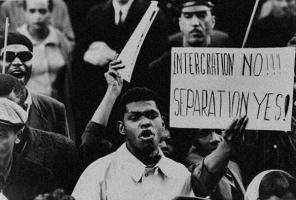 BAR contributor Pascal Robert takes the mic at Dead Pundits Society to discuss the Haitian scene, his love-hate relationship to the project of black nationalism and its relationship to class struggle…
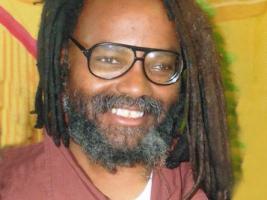 A new book of essays by Mumia Abu Jamal sheds light on the historical roots of police violence. “The state will always utilize its ‘law" as a tool of repression, but movements must create and expand…
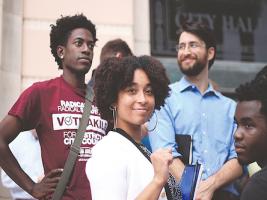 The Uhuru Movement is running a serious race for mayor and a city council seat in St. Petersburg, Florida, on a platform of social justice and reparations to the Black community. The Black south side…



