This book focuses on whether discrimination and violence against Muslim women are sanctioned by the Qur’an, as critics of Islam allege.
“This ideology of male supremacy that Muslims have grafted into the Qur’an actually runs counter to its teachings about both God and about human beings.”
In this series, we ask acclaimed authors to answer five questions about their book. This week’s featured author is Asma Barlas. Barlas is professor emerita of politics at Ithaca College. Her book is Believing Women in Islam: Unreading Patriarchal Interpretations of the Qur'an, Revised Edition.
Roberto Sirvent: How can your book help BAR readers understand the current political and social climate?
Asma Barlas: My book isn’t directed at understanding the current political and social climate but in challenging it, especially its negative stereotypes of Islam. In particular, it focuses on whether discrimination and violence against Muslim women are sanctioned by its scripture, the Qur’an, as critics of Islam allege. In Believing Women in Islam, I demonstrate why such a view amounts to misrepresenting the Qur’an’s teachings for three reasons. First, it draws on less than five or six verses/ partial verses in the text out of a total of over 6,000 and, for that reason, is selective and mis-leading. Second, and for that reason, this view ignores the Qur’an’s foundational teachings about sexual equality. Third and most troubling, it imputes a sex/gender and sexual partisanship to God by making it seem that God “himself” has favored men over women. This ideology of male supremacy that Muslims have grafted into the Qur’an actually runs counter to its teachings about both God and about human beings, as I have tried to illustrate in my book.
What do you hope activists and community organizers will take away from reading your book?
For people who work in Muslim communities, and especially with Muslim women, Believing Women should help broaden their perspective on the rights the Qur’an gives them. Although the Qur’an is not the only source of rights today, for observant Muslims, it is empowering to know that many of its teachings support principles like sexual equality, mutual guardianship of women and men, and the idea that they are both God’s vice-regents on earth. In short, it is possible for Muslim women to argue for the right to equal and equitable status vis-à-vis men from within the framework of the Qur’an’s teachings. Since most Muslims don’t seem to have read the Qur’an for themselves, it always comes as a surprise to them to hear this. As such, community organizers can help to educate Muslims by giving examples from the Qur’an discussed in my book.
We know readers will learn a lot from your book, but what do you hope readers will un-learn? In other words, is there a particular ideology you’re hoping to dismantle?
Ever since Islam’s advent, there has been a history of misrepresenting and demonizing it in the West. While it is difficult to dismantle this 1,400 long history of negative stereotypes, it is important to keep pushing back against it.
Among other things, readers of Believing Women will be able to question their own implicit assumptions that there is a ‘natural’ relationship between Islam and patriarchy; that there is just one fixed, patriarchal, reading of the Qur’an and that Muslim women can’t find liberation in their scripture. Learning these simple truths means unlearning some of the untruths and falsehoods that underpin the study of Islam in the West.
Who are the intellectual heroes that inspire your work?
I’ve learned a great deal from the work of Fazlur Rahman who was from Pakistan (my home country) and who spoke of the need to develop a method for interpreting the Qur’an that would do it justice. He called this method a “double hermeneutic movement,” from the present to the past and then back to the present. By this he meant learning about the historical contexts in which specific Qur’anic verses were revealed so as to understand the principles they were meant to convey. This is important because, while some verses spoke to seventh century cultural practices that no longer obtain, we can still derive some principles from these verses without interpreting them in a literal way.
For instance, the Qur’an speaks about the need for both men and women, to dress and behave decently in the public arena. In one case, the Qur’an asks the women to wear a “jilbab” (shawl) so that they are recognized by non-Muslim men and not molested.
However, today, many Muslims think a woman should be “veiled” so as to protect her from Muslim men, when this is not what the Qur’an says. Similarly, some Muslims feel that they need to dress as Arabs do and this, again, isn’t the point of the verses. What they were and are stressing is the need for sexual modesty and chastity on the part of both men and women.
This is one of the methods I’ve used in my own reading of the Qur’an.
In what way does your book help us imagine new worlds?
If Muslims are to imagine a new interpretive world, at the very least it would avoid imputing a sex/gender to God and also ascribing injustice against women to God’s word, the Qur’an. This is what I’ve tried to do in my own reading as well. It seems to me that too often these days Muslims use their sacred texts to oppress and punish those with whom they disagree or whom they want to keep subservient to male authority. However, a scripture isn’t just a compendium of rights or punishments. Before all else, it is a way to “know” one’s Creator; this is why M.M. Taha, the noted Sudanese scholar, once called the Qur’an nothing less than the “methodology of ascent to God.” This being so, I take God’s self-disclosure (how God describes God in the Qur’an) as the basis for reading the Qur’an. After all, the Qur’an is God’s speech and what better way to read it than to align my understanding of it with my conceptions of God? And, God in the Qur’an is unlike anything created, hence also beyond sex/gender. This means God is beyond sexual partisanship as well which means God is beyond favoring men just because they are males. Then, too, God in the Qur’an is just in that God does not violate the rights of another (do zulm). In light of this, I cannot impute injustice to God’s word, the Qur’an. If all Muslims were to learn to read the Qur’an in light of a theologically sound concept of God, I feel we would all be the better for it.
BAR Book Forum editor Roberto Sirvent is a teacher living in California.
COMMENTS?
Please join the conversation on Black Agenda Report's Facebook page at http://facebook.com/blackagendareport
Or, you can comment by emailing us at comments@blackagendareport.com

 In this week’s segment, we hear about the ongoing uprising in France against neo-liberal austerity, colonialism, and white supremacy. But first, we discuss a new report that reveals a 25% decline in…
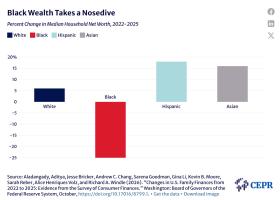 The Center for Economic and Policy Research (CEPR) recently reported on Federal Reserve data indicating that Black people in the U.S. have lost 25% of their wealth between 2022 and 2025. Whites,…
 Bouna Mbaye is an activist, writer, and a member of the Pan-African League-Umoja, the Pan-African Brigade for Palestine, and the US Out of Africa Network. He joins us from Paris to discuss the…
 As Black Agenda Report is poised to celebrate its 20th anniversary, we reprint Glen Ford's commentary on the killing of Trayvon Martin and the impunity provided to his killer in a criminal justice…
 The Democratic Party is terrified of even small liberal reforms and will not abide left leaning democrats thwarting their plans for austerity and neoliberal orthodoxy.


