A Black Agenda Radio commentary by executive editor Glen Ford Where did all the Black men go? Analysis of population data shows so many Black males have gone to prison, died of disease of accidents, or by violence, that Black females in many communities outnumber Black men by ratios of 6 to 10. A national policy of mass Black incarceration is the primary factor – a factual basis for a charge of genocide.
We Charge Genocide: 1.5 Million Black Men “Missing” A Black Agenda Radio commentary by executive editor Glen Ford “There are more Black men missing from their communities than the combined Black male populations of Los Angeles, Philadelphia, Houston, Washington and Boston.”
A new analysis of population data confirms what has long been obvious to every minimally conscious Black person in the United States: a huge proportion of the Black male population is missing, physically absent from the daily life of the community. Many are prematurely dead, but the largest group has been consigned to the social death of incarceration. According to a study by the Upshot unit New York Times , when prison inmates of both sexes are taken out of the equation, there are now 1.5 million more Black women in the country, age 25 to 54, than there are Black men. In some locations – for example, Ferguson, Missouri – there are only six Black men physically present in the community for every ten Black women.
In white America, there is almost no imbalance in gender among the 25 to 54 age group. For every 100 white women, there are 99 white men.
There are more Black men missing from their communities than the combined Black male populations of Los Angeles, Philadelphia, Houston, Washington and Boston. Six hundred thousand of them are in prison, and that’s not counting Black male prison inmates that are younger than 25 and older than 54. The analysts estimate that roughly half, and maybe as many as three-quarters, of the other 900,000 missing Black men have died before their time from diseases and accidents, and that 200,000 are no longer here due to homicide
“The war of attrition is a race war.”
Black life in America does not start out with these bizarre imbalances between the sexes. There is no gender gap among Blacks in childhood. Roughly the same number of boys and girls are born, and the ratio stays stable until the teenage years, when the war of attrition begins mercilessly grinding down the numbers of Black males. How else is this phenomenon to be described except as a war, in which 600,000 are held captive during their most productive years, 200,000 are killed by violence, and most of the rest go to early graves from accidents and diseases that cause far lower casualties among whites.
The data show that U.S. society has become much more toxic for Black men during the very period in which Blacks were supposedly making such fantastic “progress.” The numbers show that the missing-Black-men phenomenon “began growing in the middle decades of the 20th century.” The increasing ratio of Black women to men is primarily a product of the age of mass Black incarceration. The war of attrition is a race war deliberately and methodically initiated by the U.S. government, the effects of which have been devastating to Black society on the most fundamental level: stunting the formation of Black families and the Black American group as a whole by physically removing and eliminating the men.
The data support a totally plausible, factually grounded charge of genocide, based on international law
The facts bear witness to the indictment. So do 1.5 million missing Black men.
For Black Agenda Radio, I’m Glen Ford. On the web, go to BlackAgendaReport.com.

 American exceptionalism is a white exceptionalism that portrays the U.S. as a society rooted in democracy rather than slavery, liberty rather than brutality and genocide.
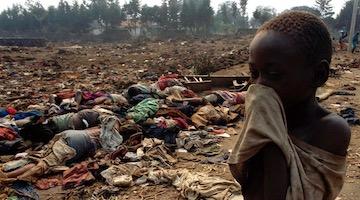 Citing the Rwandan bloodbath, the US Senate is considering yet another measure justifying so-called “humanitarian” military intervention.
 This week readers wanted to discuss Tulsi Gabbard’s views on war and Barack Obama’s black critics. Thoughtful responses came for “
 This is a story about the ways in which the Maroons positioned themselves within a powerful and expanding empire.
 The members of the Art Ensemble represented “five different articulations of Africanity.”



