A Black Agenda Radio commentary by executive editor Glen Ford
The term “tipping point” used to be synonymous with white flight from the cities. Now that Blacks are being forced from high priced urban neighborhoods, what is the “tipping point” for maintaining the Black urban presence? “How many upscale, mostly white people does it take to make a neighborhood, and ultimately whole cities – like San Francisco – unaffordable and downright hostile to Black habitation?”
Are We Passing the “Tipping Point” for Black Habitation in the Cities?
A Black Agenda Radio commentary by executive editor Glen Ford
“In Harlem and elsewhere in New York City, the tipping point has clearly been passed.”
Back in the early Sixties, sociologists began to use the term “tipping point” to describe white response to the entrance of Blacks into formerly white neighborhoods. The raw statistics showed clearly that such “tipping points” existed, although sociologists argued about the dynamics of precisely when white exits turned into sudden, wholesale flight. Certainly, real estate agents and developers understood the phenomenon, having set it in motion in city after city in the Forties and Fifties in order to make a killing in the market. So-called “block-busters” played on racist hysteria, buying up white properties at rock bottom and selling them at inflated prices to Blacks desperate to escape densely-packed ghettos. The churning of neighborhoods generated billions in profits and changed the face of America in a remarkably short period of time. Ultimately, whites’ refusal to share urban space with Blacks created an American racial and economic geography unique in the world, in which the Black and brown poor resided in hollowed out, shrunken, capital-deprived central cities surrounded by a belt of suburban white wealth – the exact opposite of the historical world model of urban development.
America, which invented modern white racism through the establishment of Black chattel slavery, had once again been reshaped through the socio-economic dynamics of white racism.
For more than half a century, racial tipping points referred primarily to the behavior of white people, a predictor of white flight, creating new spaces for Black habitation in the cities. But, racism is irrational, as were the socio-economic landscape created by white racism, with whites traveling ridiculous distances to find racially exclusive environments at affordable prices. The corporate class longed for the centralized amenities that only big cities can provide, and finance capitalists looked forward to trillions in added values if only the Blacks and browns could be evicted from urban real estate.
“It is more like a purge, an ethnic cleansing.”
Finance capital, corporate muscle, and the political parties that serve them have set in motion the new phenomenon of Black flight from the cities, and white return. Unlike white flight of the previous era, the current Black exodus is mainly involuntary and economic. In reality, it is more like a purge, an ethnic cleansing based on the reality that, in a racist society, the very presence of substantial numbers of Black people brings down the value of land and other assets.
Today, the question in city after city is, What is the tipping point for maintaining Black populations? How many upscale, mostly white people does it take to make a neighborhood, and ultimately whole cities – like San Francisco – unaffordable and downright hostile to Black habitation? In Harlem and elsewhere in New York City, the tipping point has clearly been passed, as it has in Washington DC, and will soon occur in Atlanta. Blacks are under siege – up against the tipping point – in Chicago. Even in cities such as Baltimore, where Black majorities make wholesale purges impractical – for the moment – targeted Black neighborhoods are rapidly tipping. Outrageously, the governor of Michigan proposes to bring in a steady stream of upscale immigrants to dilute the 82 percent Black population of Detroit.
And yet, there is nothing approaching a national Black consensus on a response – which means the political tipping point may have already passed, and the purge of the cities will continue, without effective Black resistance.
For Black Agenda Radio, I’m Glen Ford. On the web, go to BlackAgendaReport.com.
BAR executive editor Glen Ford can be contacted at Glen.Ford@BlackAgendaReport.com .

 The Trump administration plans to execute five people before there is a change of power. “The death penalty is the ultimate human rights violation.”
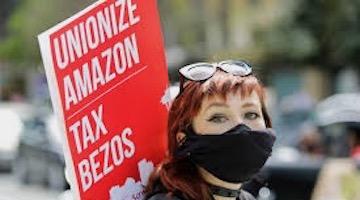 Dozens of leaked documents from Amazon reveal the company’s use of Pinkerton operatives to spy on warehouse workers, labor unions and social movements.
 Cuban medical professionals created a project to join science and statecraft and secure health as a fundamental right of citizenship.
 Imperialists continue to exercise control of former colonies from the comfort of their metropolises as their former subjects appear resigned to their post-colonial fates.
 Writing one’s own history is an act of emancipation. “Former slaves organized a government and controlled most of the colony.”



