A Black Agenda Radio commentary by executive editor Glen Ford
The Dominican Republic, which defines itself in opposition to Haiti, has enraged its Caribbean neighbors by preparing to deport a quarter million residents of Haitian descent. Dominican racial views are well known. “They are perpetually resentful that the deep Black presence of Haiti is always there to remind them of their own indelible African origins.”
Caribbean Peoples Outraged at Dominican Racism
A Black Agenda Radio commentary by executive editor Glen Ford
“Anyone born after 1929 who cannot point to one parent who was a Dominican citizen faces deportation.”
If there is a country where self-hatred is the national creed, it is the Dominican Republic, an overwhelmingly mulatto nation that seems constantly at war with its own Blackness. It is a country where Europeans have always been a small minority, yet whose national legislature once passed a law declaring that all Dominicans are white. Dominican beauticians have done their best to enforce that law by becoming the most skillful skin lighteners and hair straighteners in the world. It is obvious to any sane person that the Dominican Republic does not like itself, and has no national identity except in opposition to the deeper Blackness of Haiti, with whom it shares the island of Hispaniola, and to which Dominicans owe a great debt, for ridding their common territory of slavery more than two centuries ago. But, the Dominicans are not grateful; rather, they are perpetually resentful that the deep Black presence of Haiti is always there to remind them of their own indelible African origins. Unable to purge themselves of their Blackness, Dominicans periodically attempt to dispel the Haitians.
In 1937, the Dominican Army killed as many as 20,000 dark-skinned people on the border with Haiti in what was called the Parsley Massacre. The most recent eruption of Haiti-hatred was set off this September, when a Dominican court ruled that up to a quarter million people of Haitian descent could be declared stateless persons. These include the children of Haitians who arrived generations ago, who speak only Spanish, dance to Latin rhythms and have never been on the Haitian side of the border. Anyone born after 1929 who cannot point to one parent who was a Dominican citizen faces deportation.
“The mostly African-descended Caribbean neighborhood has run out of patience with Santo Domingo.”
All the peoples of the Caribbean are familiar with the Dominican disease, that peculiar mass mental illness of self-hatred. Self-haters also make bad neighbors, and before long, grassroots activists across the Caribbean were urging their governments to take action against the Dominican outrage against Haitians and all Black people. Although today’s crop of Caribbean politicians is notable for its meekness, the Dominicans had gone too far. The Organization of Eastern Caribbean States expressed its “collective abhorrence” at the Dominicans’ “repulsive and discriminatory” actions. Ralph Gonsalves, prime minister of St. Vincent and the Grenadines, called for the Dominican Republic to be suspended from the Caribbean Community and cut off from access to subsidized Venezuelan oil.
The Dominican Republic needs to learn that its twisted racial attitudes will no longer be tolerated. It may take generations to cure the sickness that afflicts so many Dominican minds, but the mostly African-descended Caribbean neighborhood has run out of patience with Santo Domingo. Dominican president Danilo Medina will soon submit to his legislature a “National Regularization Plan for foreigners.” Medina pretends that his countrymen want only to create an orderly system of immigration. But everyone knows it’s all about Haitians, and Blackness. The fact is, Haitians make up more than 90 percent of the Dominican agricultural workforce; they are indispensable to the economy. The two peoples are linked by history and blood – a lesson that Dominicans will have to be taught by their Caribbean neighbors.
For Black Agenda Radio, I’m Glen Ford. On the web, go to BlackAgendaReport.com.
BAR executive editor Glen Ford can be contacted at Glen.Ford@BlackAgendaReport.com.

 This week we discuss how U.S. policy creates suffering in Gaza. We also hear about the case of a New Afrikan political prisoner, and a plan to involve more children and youth in Maryland’s carceral…
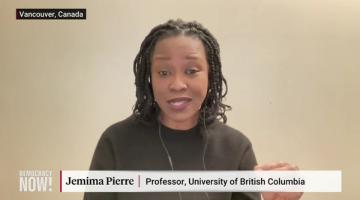 Watch Black Alliance for Peace member and scholar, Jemima Pierre, in this interview on 3/11/24 on Democracy NOW. Here, she discuss the current events in Haiti, where she asserts that the crisis in…
 The State of the Union address exemplifies everything that is wrong with this country. Trivialities are spun as being important, the most serious issues are glossed over, and lies are said to be true…
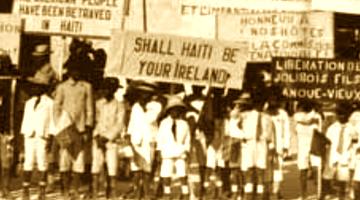 A 1930 essay by Black activist Hermina Dumont Huiswood tells of the bold resistance of the Haitian population to U.S. occupation, and offers hope for the resistance to come in 2024.
 African Stream is an anti-war, anti-imperialist video and text website based in Nairobi, Kenya. Ann Garrison spoke to its founder, Ahmed Kaballo.


