Kenya and Rwanda Have Little in Common - Except Colonialism
A Black Agenda Radio commentary by Glen Ford
"Both ethnic conflict and its attendant grievances are colonial phenomena."
 Hardly a story is done about the killings in Kenya without reference to the 1994 genocide in Rwanda. Although the events are entirely different in both scope and historical background, facts make little difference to "western" reporters who lump all mass bloodletting in Africa under the same implicit category: African barbarism, savagery, and immutable tribalism. No further explanation is considered necessary.
Not that any would be forthcoming from most non-African journalists, few of whom bother to acquaint themselves with the actual histories of African nations, and virtually none of whom trace the current crises in Africa to colonial rule. No, African "savagery" is sufficient to explain everything. Thus, Kenya 2008 equals Rwanda 1994.
In Kenya, it appears that as many as one million votes may have been stolen by the ruling party, dominated by Kikuyu people, in last month's elections. Hundreds have died and thousands been displaced as the opposition, particularly the Luo ethnic group, demands new elections. Western reporters almost uniformly lament that Kenya has long been a "beacon of democracy" in post-colonial Africa, forgetting to mention that dictator Daniel Arap Moi ruled the country for 24 years, to the great profit and political satisfaction of Britain and the United States. Few reporters point out - or even seem to know - that it was the British who, as Kenyan independence approached, "drew electoral boundaries to cut the representation of groups they thought might cause trouble."
"The Brits and the Americans have urged Kenyans to ‘behave responsibly' - as if it is innate, childlike African irresponsibility that is the source of the problem."
In the United States, that's called gerrymandering - a corruption of the electoral process. In Kenya, according to Harvard African Studies professor Caroline Elkins, it was the Brits' method of continuing their legacy of tribal manipulation even after they were no longer colonial masters. As Prof. Elkins writes, "both ethnic conflict and its attendant grievances are colonial phenomena."
The Belgians worked tribalism to maximum profit in Rwanda, a country that even in pre-colonial times had been dominated by the Tutsi minority. The Belgians made it official, distributing identification cards designating Tutsis and Hutus, and favoring the Tutsis in colonial business, education and politics, thus hardening the ethnic divide. The Tutsi military regime that took power after the genocide and the defeat of Hutu nationalists is now one of Washington's two most trusted clients in Africa, along with the military strongman in Uganda, who has presided over horrifically brutal policies against the Acholi people of that country.
Tribalism has many uses for imperialists, who strongly encourage such divisions. It is, of course, perfectly suited to "divide and conquer" strategies of direct - or indirect - rule. It is also a convenient, Euro-supremacist explanation for whatever ails Africa. The Brits and the Americans have urged Kenyans to "behave responsibly" - as if it is innate, childlike African irresponsibility that is the source of the problem. The former colonizers and current imperialists have no positive role to play in Kenya - only a desire to preserve their own economic and military interests. They ought to stay the hell out.
For Black Agenda Radio, I'm Glen Ford.
BAR executive editor Glen Ford can be contacted at Glen.Ford@BlackAgendaReport.com.

 An exploration of how to simultaneously act on and under radars of all kinds.
 This novel puts the “too often secreted issues of intraracial classism and colorism” up front and center, along with Black cop contradictions and color-coded witnesses.
 How can a union tolerate three or four different “tiers” of workers, with different pay scales and rights, and then call for “solidarity”?
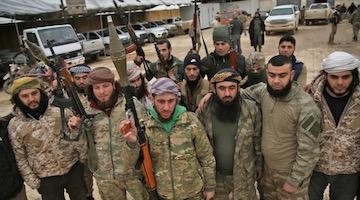 The same jihadist head-choppers that the US deployed against Syria are now fighting alongside Turkey to occupy the northeast of the country.
 Frank Chapman’s book should be on the shelf with the Autobiography of Malcolm X and Soledad Brother.



