A discussion on the protests in Iran, US imperialism, and Iranian resistance.
Originally published in Pambazuka News.
Iran has witnessed protests since 28 December 2025. This interview unravels the various domestic and international factors around the protests, and resistance against imperialism.
1. Dynamics of the Situation: Can you historicize a bit the eruption of recent protests? Are they a continuation of other protests Iran experienced in recent years? In your answer, can you integrate the local dynamics (e.g., the gender question; the relevance of the Tudeh - Communist Party of Iran - if at all) with global factors that are meddling in Iran?
The protests in Iran began following a severe drop in the value of the national currency, the rial, of somewhere between 30 and 40 percent. This was caused by sanctions and intentional currency manipulation on the part of US and European-led actors. In fact, US Treasury Secretary Scott Bessent announced at Davos the “economic statecraft” policy that the US has deployed against Iran, which includes currency manipulation.
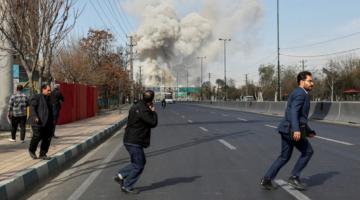
Following the drop in the rial’s value, merchants and shopkeepers, numbering in the low thousands, protested. Officials from the government quickly met with them and with labor unions and created a plan to address the concerns. After this resolution to the protestors’ concerns, the Mossad and the US launched an urban warfare campaign in major cities across Iran to distort and displace the calls made by Iranians into a regime-change operation. Thousands were killed by these foreign agents with methods that are eerily similar to those of ISIS and the Zionists, including slit throats, beheadings, etc.
The gender question in Iran is significant because the Western media and pundit class largely approaches it in a decontextualized and anti-factual way. But it is important to arm ourselves with facts, with actual information. For example, Iranian women continue to dominate university student populations, and the STEM fields. They are active throughout society, at all levels. It is only after the 1979 Revolution that this occurred, and that literacy among women dramatically increased. To the extent that we want to use women’s clothing as a metric of women’s liberation, the government no longer enforces hijab restrictions. Though I will say that this is a remarkably capitalist, individualistic, and frankly backward method for assessing liberation, as it recenters the capitalist gaze on the commodified female body as the primary metric, rather than women’s actual development and participation in society as full human beings.
As for the Tudeh Party, it lost much of its membership, influence and power during the monarchy after experiencing severe repression. Its heyday was nearly a century ago, after which it was effectively replaced by more radical left forces. It continued to be a relatively small political party, with membership in the low thousands, through the 1979 Revolution and after. It came under fire from the Iranian left after the Revolution because it publicly supported and participated in the establishment of the Islamic Republic, but clandestinely sought to destabilize it during the Iran-Iraq War through attempts to organize a military insurrection. At that time, most of the Iranian left united to defend the nation’s sovereignty against the US proxy’s invasion. The other significant political party that expressed this type of opportunism was the Mujahedin-e-Khalq, which is now expressly working with the CIA and the Mossad. Lacking in modern significance, clear strategy and political honesty, the Tudeh Party is largely distrusted and dismissed. It is notable that the fall of the Islamic Republic of Iran will not be good for workers, for farmers, for women and the youth and the elderly. Syria and Libya are instructive in this regard, as is the fall of the Soviet Union. I will explain that further, later in the interview.
2- History of anti-imperialism to the present: Combatting western mainstream media framings of ‘regime’, ‘authoritarian’ and ‘theocratic’. How are these framings used to delegitimize the Islamic Republic of Iran’s staunch anti-imperialist stance?
First, it should be noted that Iran’s position in support of the oppressed peoples “anywhere in the world” is enshrined in its constitution. The Islamic Republic has fulfilled this position in practice throughout its existence, but it is especially evident today in its alliances. Iran has important alliances in the West Asia region with both state and non-state actors that likewise have a commitment to national liberation and anti-imperialism. This is why Iran has steadfastly supported the Palestinian resistance, including Hamas, Palestinian Islamic Jihad, and other resistance organizations. In fact, as the late Palestinian activist Nizar Banat emphasized, Iran is the only country in the world with a permanent clause in its national budget that supports the Palestinian Revolution. Iran’s support for anti-imperialist resistance also permeates across the region. It supports Hezbollah in Lebanon, Ansar Allah in Yemen, and the Popular Mobilization Forces in Iraq, all of whom have resisted foreign domination in their homeland (together, these forces in Iran, Yemen, Palestine, Iraq, and Lebanon comprise the Axis of Resistance). Iran also played a significant role in supporting the Syrian government against the predations of the United States and Israel until it was toppled in December 2024. And beyond the region, Iran has fostered friendly ties with Venezuela, with whom it collaborates in various industries, along with Cuba, the Democratic People’s Republic of Korea, the Alliance of Sahel States, and of course, China and Russia. The common denominator among all these countries is their resistance to U.S. imperialism. Imperialism targets each country in various ways, be it sanctions, blockades, proxy wars, terror attacks, bombing campaigns, and outright invasions and military occupations.
Iran presents the greatest threat to Zionist-imperialist interests in the region, and the U.S. and Israel are running out of options to topple the Islamic Republic. It’s therefore not a coincidence that Western media would depict the Islamic Republic as a “regime” or “authoritarian” because that is precisely how it characterizes any country which opposes U.S. domination. The United States aims to trivialize and criminalize anti-imperialist resistance and has historically done so in the name of “freedom” and “democracy.” The Trump government has mostly dropped these pretenses, though. This reality reflects the failure of liberalism to contain and pacify anti-imperialist resistance.
3- Development within the imperialist system: Iran’s national sovereign development is clobbered by sanctions and economic warfare. Some critics claim that Iran is even a capitalist country. Can you explain how this framing ignores the role of imperialism and its impact on the working classes in Iran?
The defining feature of the age in which we live is US-led imperialism, the primary contradiction in the world today. Imperialism is characterized by material relations of exploitation between the Global North and the Global South. As the central process undergirding imperialism, capitalism is a world system premised on the accumulation of capital and the movement of value from Global South nations to the metropole.
Iran is of the Global South. It is a formerly colonized nation that, despite great resistance to US imperialism through the 1979 revolution and its continuing progress toward national liberation from US-led imperialism, is still victimized and criminalized by it, precisely because of its resistance. That criminalization occurs through sanctions and blockades, designations of its political leadership, military apparatuses and industries as terrorist, and its isolation in the global economy. US-led imperialism steals Iran’s national resources through physical seizure of its tankers, currency devaluation leading to dramatic inflation, and devaluation of its resources on the global market. In sum, Iran does not extract resources from others and is not a recipient of value transfer. It is a victim of drain including wealth drain, brain drain, premature death of its population, military incursions, etc.
The premise that Iran is capitalist presumes a transnational capitalist class in which Iran is a beneficiary or participant. It also presumes a transnational working class outside of the nation-state system in which anti-imperialist national liberation is most commonly practiced. Class is then abstracted outside of geographic, global economic, racial, and political dynamics. In point of fact, the wealth gap between the North and South has increased, not decreased since at least the 1970s. The wealthiest in the world—the possessors of capital—continue to be located overwhelmingly in the North, in the regions of the world racialized as white, while the overwhelming majority of the exploited continue to be in the South, the darkened regions of the world.
I read the claim of a capitalist Iran as a discursive move to shift attention away from US-led imperialism and its violence against Iran. This move has the effect of reinforcing the imperialist position that Iran is terrorist or authoritarian by virtually sidelining imperialism as an abstracted and non-primary force in Iran and the world today. It is anti-internationalist, anti-dialectical, anti-materialist, and incorrect.
I’ll end by adding that Iran’s national resources are largely controlled by Iranian government institutions. It is in effect a nationalist economy. The wealth acquired through government control of those resources is then used to subsidize social development programs that since the 1979 Revolution have improved literacy, infant mortality, life expectancy, and decreased poverty, alongside the development of an excellent national healthcare system informed by collaboration with and knowledge gained from Cuba. This has all been done in spite of the US, European and UN imposition of one of the most severe sanctions regimes in world history.
4. Oil and sanctions: The U.S. has a history of using control over oil resources as a weapon of empire, as recently seen in Venezuela. Iran's economy is being strangled by sanctions that are a form of economic warfare. How does the struggle over Iran's oil and the use of sanctions reflect a broader neo-colonial strategy of resource control and punishment for sovereignty?
Here, we see how resistance exposes the contradictions of imperialism and renders them irreconcilable. On the one hand, yes, sanctions do reflect an imperialist strategy of resource control and punishment for sovereignty. On the other hand, the imposition of sanctions indicates how the U.S. has been unable to truly eradicate Iranian self-determination. This is where the contradiction is most apparent. While sanctions intend to cripple the Iranian economy and produce difficulties in people’s everyday lives, they have also forced Iran to develop a national culture of self-reliance rooted in resilience and ingenuity. Iran’s self-reliance prevents sanctions from producing their intended effect. We can speak about Iran’s oil and other resources, but it’s actually important to start with Iran’s sovereign defense capacity. Iran possesses robust and world-leading ballistic missile and UAV programs. Those capabilities were decades in the making and derived from a staunch emphasis on self-reliance. Thus, the contradiction of sanctions stems first and foremost from resistance and self-reliance.
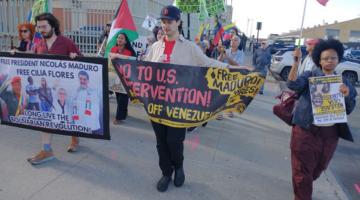
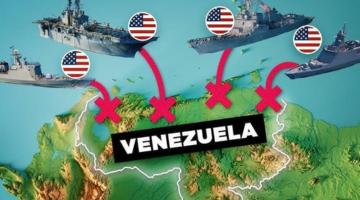
Regarding the oil industry, Iran absolutely remains a constant target of the U.S.-led imperialism. As we know, the U.S. attack on Venezuela and the unlawful and brutally violent kidnapping of President Nicolás Maduro and First Combatant Cilia Flores highlights the U.S.’s effort to control Venezuelan oil. But it also shows how every other mechanism the U.S. had used to date has failed, and it remains to be seen whether even the kidnapping will work in controlling Venezuela’s oil industry.
Beyond this, we should also note that the entire discourse around oil sometimes obscures the real effects of sanctions. Sanctions intentionally target everyday people. People in Iran do not have access to life-saving medications because of sanctions, for instance. Yet, Iran endures, as does Venezuela.
5. Weaponization of the “diaspora”: While we recognise that some strata of the population have grievances that you alluded to in your answer to the first question, western mainstream media focuses largely on the diaspora, platforms them, and presents them as the sole experts who know the facts on the ground. Can you speak about the role of the diaspora in the imperial core in legitimizing imperialist interventions? How is the weaponization of “let’s hear from an Iranian to speak about Iran” a shallow use of identity politics camouflaged in orientalist framing of an alleged subaltern who is speaking?
So too does the notion of the diaspora as an abstracted category facilitate US-led criminalization, isolation and exploitation of Iran. Iranians both in Iran and around the world are diverse and have a range of views on Iranian politics, but by and large they support the Iranian government against US-led imperialism. This support was showcased during the 12-Day War when Iranians around the world defended the state’s sovereignty against the US-sponsored attack by Israel. It was showcased again in January when millions of people in Iran marched through the streets of multiple cities in protest against the urban warfare of the Zionists and the US.
What is understood to be the “Iranian diaspora” includes a small group of organizations created and/or funded by the CIA’s National Endowment for Democracy. It also includes opinion leaders who seek a sort of Perestroika in Iran, similar to that imposed on the USSR, which ultimately enabled the western pillaging of the Russian and Eastern European economies, led to civil war, balkanization, and the estimated death of 17 million, as argued in the article, “Neoliberal Holocaust” by Paweł Wargan.
In this context, “Let’s hear from an Iranian” and “two things can be true at once” are platitudes designed to advance US imperialism’s aims against Iran. They erase context, contingency, history, dialectical processes, and material relations. They replace political and economic analysis with identity and vibes.
6. The triad of Imperialism, Zionism and Reactionism: Why are the Zionists, the reactionary Iranian diaspora, and the US benefit from the destabilisation of Iran? Can you speak about the documented cases of CIA, Mossad and their local functionaries (paid agents or individual actors acting on behalf of imperial-zionist interests) exacerbating the loss of life and property?
The story of the CIA’s involvement in Iran begins with the lead-up to the 1953 coup d’etat that ousted the democratically elected Prime Minister Muhammad Mossadeq. The oil issue is again relevant here because Mossadeq sought to nationalize Iran’s oil industry at the expense of the Anglo-Iranian Oil Company, a British company. Oil nationalization had widespread popular support across Iran. Conversely, the British initially sought to oust Mossadeq without the U.S.’s help, but they were only successful with the CIA orchestrating the operation in August 1953 (it should also be noted that the U.S.’s initial coup attempt failed as well). Part of this operation included the CIA paying local functionaries to engage in rioting as a diversion while military personnel positioned themselves to besiege Mossadeq. So, the “riots” we have seen in 2026 have historical precedent.
With the reinstatement of the shah Muhammad Reza Pahlavi after the coup, the U.S. essentially took control of Iran’s oil industry. The shah meanwhile developed an expansive police state, undergirded by his secret police force, SAVAK. Both the CIA and Mossad had a close relationship with SAVAK, including by training Iranian agents. It’s therefore no surprise that the former shah’s son, Reza Pahlavi, is likewise cozying up to the U.S. and Israel. When the Mossad-orchestrated urban war (riots) began, it was Reza Pahlavi who beat the war drums and even called on the U.S. to bomb Iran. These monarchist counterrevolutionaries are directly responsible for the violence and death that occurred in Iran during the urban war. And we should be clear that they are complete opportunists who are willing to hand Iran over to the United States and Israel if it means they can serve as loyal puppets to imperialism.
7. Opposition to foreign intervention: What are the specific dangers of this "US-Zionist meddling" in Iran today, and how might it seek to transform Iran from a pole of regional resistance into a client state, particularly regarding control of its oil? How can solidarity networks abroad articulate a clear, unambiguous opposition to foreign military intervention, sanctions, and hybrid warfare?
The primary goal of US-led imperialism in Iran is to end its support of the Palestinian resistance and its participation in the Axis of Resistance, and to wrench control of Iranian resources away from the Iranian government and into the hands of Global North oil majors, commonly called “Big Oil.” It’s as simple as that. This would lead to massive underdevelopment across all aspects of social and political life not just in Iran, but across the region. I encourage everyone to read Walter Rodney to understand this process.
Thus, the answer to this question is also quite simple. Just say no sanctions on Iran, no war on Iran, call for an end to US meddling and imperialism, for a Free Palestine from the River to the Sea. Otherwise, we risk the end of the last independent and sovereign state in West Asia, the only state that has a budget for supporting the Palestinian resistance and the regional resistance. We risk US imperialism’s complete takeover of West Asia and its many resources. We risk the expansion of zionist genocide across the whole region. The Palestine, Syria and Libya examples have unfortunately proven that if we do not resist US imperialism, we risk the continuity of life itself.
8. Iran, Axis of Resistance, and Multipolarity: Why is Iran framed as a “terrorist state”? What role does it have in combatting imperialism in Western Asia (and much of the world)? How is Iran integral to the decline of US imperialism and the rise of multipolarity?
The 12-Day War has proven Iran’s pivotal role in challenging and ultimately defeating Israel. We should be clear that even despite the unprovoked attack against Iran in June of last year, the Islamic Republic swiftly recovered and dealt the Zionists a strategic defeat over the ensuing twelve days. By the end of that war, Israel called upon the U.S. to intervene by hitting Iran’s nuclear facilities and then to call for a ceasefire. And now, as we wait to see whether the U.S. will again strike Iran, reports from Israeli media are surfacing that Netanyahu told Trump Israel is not ready to defend itself should Iran respond. These reports may be part of the psychological war but the point remains that Iran did significant damage to the Zionist entity.
All of this to say, if Israel collapses, U.S. imperialism stands no chance in the West Asia region. These are the stakes of an Iranian victory over the U.S. and Israel. The world now knows who the actual terrorist states are even despite all the resources allocated by the Zionist-imperialists to spread propaganda about the Palestinian resistance, Iran, and the rest of the Axis of Resistance. The imperialists have already lost the narrative war, and we must be clear on this.
Lastly, Iran absolutely reflects the rise of multipolarity, both in the region and the world. However, Iran also shows that multipolarity cannot be achieved without national liberation. During the 1960s, the Soviet Union aligned with national liberation movements across the globe. In doing so, it also undermined U.S. imperial hegemony. We are witnessing a similar phenomenon now. The momentum toward national liberation in West Asia, West Africa, and I’d say other parts of the world very soon, fuel multipolarity. Conversely, multipolarity gives space to national liberation movements. For instance, Russia’s defensive war against NATO in Ukraine helped create the conditions which led to Operation Al Aqsa Flood. Russia and China’s support for the Alliance of Sahel States have helped those countries to withstand attacks by counterrevolutionary forces to date. In short, we can’t talk about multipolarity without equally uplifting national liberation in the struggle against imperialism.
Navid Farnia is a scholar of African American Studies. His research broadly explores the relationship between racial oppression in the United States and U.S. imperialism with a focus on revolutionary movements and counterrevolutionary responses. Navid’s book manuscript, National Liberation in an Imperialist World: Race, Counterrevolution, and the United States, traces the U.S. national security state’s evolution by examining how U.S. officials responded to national liberation movements at home and abroad from the 1950s to 1980. Navid has also written on the impact of economic sanctions imposed by the United States on Third World countries, the emergence of a multipolar world order, the South African liberation leader Chris Hani, and the regional dynamics of the ongoing Palestinian liberation struggle. Navid is a member of the Anti-Imperialist Scholars Collective.
Nina Farnia is a law professor and legal historian whose scholarship exposes the role of imperialism in US law and politics. Her forthcoming book is entitled Imperialism and Resistance (Stanford University Press 2026), and is based on her dissertation, Imperialism in the Making of U.S. Law, 1940-2008, which won the 2023 Julien Mezey Dissertation Award from the Association for the Study of Law, Culture, and the Humanities. Nina is a member of the Anti-Imperialist Scholars Collective.


 “So the calypso ceases to be entertainment on a trivial level and becomes a vehicle whereby the society is going back and searching for its soul.”
 Chile, Colombia, Bolivia, Honduras, Peru, and Costa Rica have all elected right-wing presidents in the past year, and most are open Trump allies. Brazil's runoff between Lula and Flávio Bolsonaro is…
 October 7, 2023, was not an isolated attack, but the culmination of generations of Palestinian imprisonment and resistance in Gaza, comparable to Nat Turner's rebellion. History will record the Al…


