by Lacino Hamilton
The struggle against mass incarceration has gained broad support in recent years. However, “as long as reducing the incarceration rate is confined to fiscal pressures, little attention, if any at all, will be paid to the root cause of mass incarceration (racism), or how caging people for part or all of their lives has removed from the community and the family the abilities to sustain themselves free of state and corporate domination.”
Incarcerated Lives Matter
by Lacino Hamilton
“To eliminate mass incarceration, maximum cooperation and solidarity is required on the part of incarcerated and non-incarcerated people.”
Just a few years ago, the crises of mass incarceration was largely thought of as an invisible issue, talked about almost exclusively in abolitionist circles and on prison yards. It is now part of the mainstream discourse. Publications and groups spanning the political spectrum, even presidential hopefuls in both parties, claim support for reducing the incarceration rate. Still, we must not be naïve.
Elite-level alliances, the dominant voice, taped and stapled together by mounting fiscal pressures, are unlikely to result in more than a few modest reforms. To eliminate mass incarceration, which is leading to nothing but social devastation and the making of a permanent underclass, maximum cooperation and solidarity is required on the part of incarcerated and non-incarcerated people.
Here’s the thing: as the incarceration rate increasingly grew over the last four decades, so did the political influence and power of groups, organizations and institutions with vested economic interest in maintaining the world’s largest penal system. It is unlikely they will allow the incarceration rate to be significantly reduced without a fight.
Furthermore, as long as reducing the incarceration rate is confined to fiscal pressures, little attention, if any at all, will be paid to the root cause of mass incarceration (racism), or how caging people for part or all of their lives has removed from the community and the family the abilities to sustain themselves free of state and corporate domination.
Eradicating mass incarceration ultimately requires struggles against all its forms, and coalitions among diverse people offer the most promising strategies for the challenge. Therefore, prisoners here in Michigan and throughout the country encourage everyone to encourage someone to get involved in the movement to bring mass incarceration to an end.
“As the incarceration rate increasingly grew over the last four decades, so did the political influence of those with a vested economic interest in maintaining the world’s largest penal system.”
The impetus for this more often comes from incarcerated people and their families, because their lived experience often allows them to see more clearly the contradictions between myths and reality and lead them to develop a critical perspective on crime and punishment in America. But, those not directly affected by mass incarceration also have an important role to play in challenging the system as well.
The Civil Rights movement illustrates the potential of a coalition between a disadvantaged group working with allies from a wide range of people. Everyone brought their own perspective and more commitment to the struggle, and willingness to risk their lives, that forced American society as a whole to confront the ugly truth of racism. Struggling to eliminate mass incarceration gives us a similar opportunity to confront one of the defining social crises of our time.
As individuals and as groups our vision can only be partial. But working together brings multiple ways of analyzing oppressive structures, understanding the world, and “imagining otherwise.” So where do we begin? Self-examination, collecting facts, attitudes and images, empathic listening, and dialogue.
History illustrates both how tenacious and variable systems of oppression are and how dynamic and creative we must continue to be to rise to the challenges they pose. I hope this essay will contribute to an ongoing dialogue about mass incarceration in ways that can have more potent and sustained impacts for justice, fairness, and equality in our world. #IncarceratedLivesMatter.
Lacino Hamilton is imprisoned (247310) at Thumb Correctional Facility, 3225 John Conley Dr., Lapeer, MI 48446.

 We reprint Dr. Jemima Pierre’s remarks at the 20th anniversary celebration for Black Agenda Report, New York City, November 7, 2026.
 We reprint Ajamu Baraka’s remarks at the 20th anniversary celebration for Black Agenda Report, New York City, November 7, 2026.
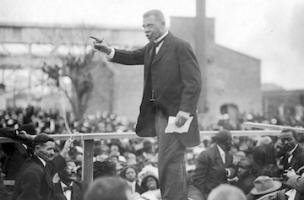 “Mr. Washington represents in Negro thought the old attitude of adjustment and submission…Mr. Washington’s programme practically accepts the alleged inferiority of the Negro races.”
 We reprint Dr. Gerald Horne's keynote speech at Black Agenda Report's 20th anniversary celebration.
 "Pentagon pimpin" is the latest from BAR's Poet-in-Residence and was delivered at the 20th anniversary celebration for Black Agenda Report, New York City, November 7, 2026.



