A kindergarten student in Havana poses in a doctor costume (Photo: Enrique De La Osa/Reuters)
To move from 59 infant deaths out of every 1,000 live births to no infant deaths in the matter of a few decades is an extraordinary feat.
This article was produced by Globetrotter.
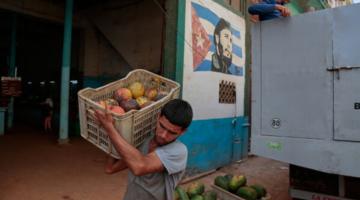
Palpite, Cuba, is just a few miles away from Playa Girón, along the Bay of Pigs, where the United States attempted to overthrow the Cuban Revolution in 1961. Down a modest street in a small building with a Cuban flag and a large picture of Fidel Castro near the front door, Dr. Dayamis Gómez La Rosa sees patients from 8 AM to 5 PM. In fact, that is an inaccurate sentence. Dr. Dayamis, like most primary care doctors in Cuba, lives above the clinic that she runs. “I became a doctor,” she told us as we sat in the clinic’s waiting room, “because I wanted to make the world a better place.” Her father was a bartender, and her mother was a housecleaner, but “thanks to the Revolution,” she says, she is a primary care doctor, and her brother is a dentist. Patients come when they need care, even in the middle of the night.
Apart from the waiting room, the clinic only has three other rooms, all of them small and clean. The 1,970 people in Palpite come to see Dr. Dayamis, who emphasizes that she has in her care several pregnant women and infants. She wants to talk about pregnancy and children because she wants to let me know that over the past three years, not one infant has died in her town or in the municipality. “The last time an infant died,” she said, “was in 2008 when a child was born prematurely and had great difficulty breathing.” When we asked her how she remembered that death with such clarity, she said that for her as a doctor any death is terrible, but the death of a child must be avoided at all costs. “I wish I did not have to experience that,” she said.
Eradicate the Diseases of the Poor
The region of the Zapata Swamp, where the Bay of Pigs is located, before the Revolution, had an infant mortality rate of 59 per 1,000 live births. The population of the area, mostly engaged in subsistence fishing and in the charcoal trade, lived in great poverty. Fidel spent the first Christmas Eve after the Revolution of 1959 with the newly formed cooperative of charcoal producers, listening to them talk about their problems and working with them to find a way to exit the condition of hunger, illiteracy, and ill-health. A large-scale project of transformation had been set into motion a few months before, which drew in hundreds of very poor people into a process to lift themselves up from the wretched conditions that afflicted them. This is the reason why these people rose in large numbers to defend the Revolution against the attack by the United States and its mercenaries in 1961.
To move from 59 infant deaths out of every 1,000 live births to no infant deaths in the matter of a few decades is an extraordinary feat. It was done, Dr. Dayamis says, because the Cuban Revolution pays an enormous attention to the health of the population. Pregnant mothers are given regular care from primary care doctors and gynecologists and their infants are tended by pediatricians—all of it paid from the social wealth of the country. Small towns such as Palpite do not have specialists such as gynecologists and pediatricians, but within a short ride a few miles away, they can access these doctors in Playa Larga.
Walking through the Playa Giron museum earlier that day, the museum’s director Dulce María Limonta del Pozo tells us that the many of the captured mercenaries were returned to the United States in exchange for food and medicines for children; it is telling that this is what the Cuban Revolution demanded. From early into the Revolution, literacy campaigns and vaccination campaigns developed to address the facts of poverty. Now, Dr. Dayamis reports, each child gets between twelve and sixteen vaccinations for such ailments as smallpox and hepatitis.
In Havana’s Center for Genetic Engineering and Biotechnology (CIGB), Dr. Merardo Pujol Ferrer tells us that the country has almost eradicated hepatitis B using a vaccine developed by their Center. That vaccine—Heberbiovac HB—has been administered to 70 million people around the world. “We believe that this vaccine is safe and effective,” he said. “It could help to eradicate hepatitis around the world, particularly in poorer countries.” All the children in her town are vaccinated against hepatitis, Dr. Dayamis says. “The health care system ensures that not one person dies from diarrhea or malnutrition, and not one person dies from diseases of poverty.”
Public Health
What ails the people of Palpite, Dr. Dayamis says, are now the diseases that one sees in richer countries. It is one of the paradoxes of Cuba, which remains a country of limited means—largely because of the U.S. government’s blockade of this island of 11 million people—and yet has transcended the diseases of poverty. The new illnesses that she says are hypertension and cardiovascular diseases as well as prostate and breast cancer. These problems, she points out, must be dealt with by public education, which is why she has a radio show on Radio Victoria de Girón, the local community station, each Thursday, called Education for Health.
If we invest in sports, says Raúl Fornés Valenciano, the vice president of the Institute of Physical Education and Recreation (INDER), then we will have less problems of health. Across the country, INDER focuses on getting the entire population active with a variety of sports and physical exercises. Over 70,000 sports health workers collaborate with the schools and the centers for the elderly to provide opportunities for leisure time to be spent in physical activity. This, along with the public education campaign that Dr. Dayamis told us about, are key mechanisms to prevent chronic diseases from harming the population.
If you take a boat out of the Bay of Pigs and land in other Caribbean countries, you will find yourself in a situation where healthcare is almost nonexistent. In the Dominican Republic, for example, infant mortality is at 34 per 1,000 live births. These countries—unlike Cuba—have not been able to harness the commitment and ingenuity of people such as Dr. Dayamis and Dr. Merardo. In these other countries, children die in conditions where no doctor is present to mourn their loss decades later.
Vijay Prashad is an Indian historian, editor and journalist. He is a writing fellow and chief correspondent at Globetrotter. He is an editor of LeftWord Books and the director of Tricontinental: Institute for Social Research. He is a senior non-resident fellow at Chongyang Institute for Financial Studies, Renmin University of China. He has written more than 20 books, including The Darker Nations and The Poorer Nations. His latest books are Struggle Makes Us Human: Learning from Movements for Socialism and (with Noam Chomsky) The Withdrawal: Iraq, Libya, Afghanistan, and the Fragility of U.S. Power.
Manolo De Los Santos is the co-executive director of the People’s Forum and is a researcher at Tricontinental: Institute for Social Research. He co-edited, most recently, Viviremos: Venezuela vs. Hybrid War (LeftWord Books/1804 Books, 2020) and Comrade of the Revolution: Selected Speeches of Fidel Castro (LeftWord Books/1804 Books, 2021). He is a co-coordinator of the People’s Summit for Democracy.

 Messages and texts from those suspected of the plot to assassinate Haitian president Jovenel Moise make for fascinating reading. One of them communicated with Ariel Henry, who was named Prime…
 Claims of anti-Black racism in revolutionary countries should be treated with great skepticism. This trope is used as a tool to target countries for regime change plots and other attacks. While in…
 There cannot be any discussion of Cuban politics that does not include perspectives from the African descended population. There is much to learn from people who are living in a revolutionary process…
 Cop City is the culmination of years of "Atlanta Way" neo-liberalism intended to advantage corporate interests and affluent white people. Black people have been pushed out and those that remain live…
 The catastrophe for the Palestinian people began 75 years ago and their struggle against the apartheid state continues.


