In this series, we ask acclaimed authors to answer five questions about their book. This week’s featured author is Jarvis C. McInnis. McInnis is the Cordelia and William Laverack Family Assistant Professor of English at Duke University. His book is Afterlives of the Plantation: Plotting Agrarian Futures in the Global Black South.
How can your book help BAR readers understand the current political and social climate?
Afterlives of the Plantation begins with the founding of Tuskegee Institute in 1881, following the end of Reconstruction, when the progress and success of formerly enslaved people were met with vehement white backlash, or what historian Carol Anderson has termed “white rage.” The failure of Reconstruction led to the rise of Jim Crow segregation, a form of anti-blackness that codified Black people’s second-class citizenship for another 100 years. Through Tuskegee, I explore how Black people responded to this rampant racial retrenchment. Despite the limitations of Booker T. Washington’s political stances, I argue that Tuskegee represents an important, if conservative, model of black self-help, placemaking, and self-determination after the federal government abandoned the formerly enslaved and left them to their own devices, often at the whims of the very treasonous state governments that declared war on the republic to keep them in shackles.
If we fast forward to the present day, one way to think about our current political crisis is as a backlash, at least in part, to the Obama presidency and the gains Black people have made since the Civil Rights Movement. Although this moment is distinct from the post-Reconstruction period in a myriad of ways, Afterlives of the Plantation is a reminder that we’ve seen this before, and, through Tuskegee, elucidates how Black people navigated an earlier moment of racist retrenchment. Secondly, the book’s emphasis on “plotting agrarian futures” vis-à-vis George Washington Carver’s soil regeneration experiments at Tuskegee is chock full of wisdom for our current ecological crisis. Tuskegee was founded on a former cotton plantation, where the soil had been depleted by abusive cultivation practices during slavery. Through sustainable agricultural techniques, Carver regenerated Tuskegee’s worn-out soils and made them productive again and strove to teach Black farmers how to do the same.
This brings me to my next point: Despite the fact that Black people were once relegated to the outdoors, forced to cultivate staple crops for the global market, and the resulting shame they understandably carried toward that history, there’s also a long and proud history of Black environmentalism. Even in the immediate aftermath of slavery, Black people proudly farmed and stewarded the land, linking their social and ontological regeneration from the condition of enslavement to the regeneration of the worn-out soils depleted by the plantation’s extractive practices of extractive monocrop agriculture. So, by recovering the significance of Tuskegee’s agricultural vision for uplifting the race and its efforts to spread those ideas to the broader diaspora as they too wrestled with the challenges of plotting Black life in the ruins left by slavery and colonialism, Afterlives of the Plantation invites readers to recover these cultural and ancestral memories as inspiration for becoming better stewards of the Earth in our own moment of ecological crisis. This is even more important for the numerous Black communities located in food deserts that do not have access to fresh, quality food, leading to a plethora of health complications and disparities. In the face of unfortunately similar conditions today, whereby the gains of the Civil Rights Movement, the Obama presidency, and even the racial reckoning brought on by George Floyd’s heinous murder are being strategically and categorically dismantled, Afterlives of the Plantation encourages readers to draw inspiration from past practices of Black self-determination, wherein our ancestors grew their own food, shared resources, and engaged in other modes of mutual aid to counteract state violence and neglect.
What do you hope activists and community organizers will take away from reading your book?
As stated above, I hope that the book’s emphasis on strategies of black world making in the late nineteenth to early twentieth centuries reminds readers that we have not only been here before, but we also navigated our way through it. I also hope those activists engaged in environmental justice will draw inspiration from older models of black agrarian futures, wherein Black people understood that the improvement of Black life was inextricably linked to caring for the earth. I especially hope activists and community organizers will learn from the pitfalls of our foreparents as they navigated their respective social and political moments: namely, the pitfalls of patriarchy, racial and class paternalism, heterosexism, ethnic absolutism, and black capitalism that plagued earlier black freedom struggles. I argue in the book that Tuskegee is both a model and a cautionary tale for Black Studies, because it was caught between genuine care for Black people and racial and class paternalism. On one hand, Tuskegee’s faculty, staff, and students enacted a host of strategies that sought to ameliorate the lives of poor, rural Black communities. For instance, by disseminating up-to-date agricultural knowledge to poor Black farmers who did not have access to formal education and redistributing resources such as vegetable seeds to help them grow nourishing food to feed their families and diversify their crops, Tuskegeeans performed invaluable care work for people who were otherwise the fodder of the post-slavery plantation system.
On the other hand, Tuskegeeans sometimes held racial and class paternalistic attitudes toward those same communities, viewing them as subjects to be uplifted and civilized rather than as self-determining agents of their own futures. As I argue in Chapter 4, in Haiti, many members of the Haitian elite held similar attitudes toward the peasant masses, investing in their education only insofar as it made them more efficient workers for the national economy. So, to the activists and community organizers, I ask: How can we organize in ways that build and imagine with those communities we aim to assist, rather than for them. How do we create a more equitable approach to Black freedom that ensures that the concerns of Black people across ethnic, gender, sexual, regional, and class identities are free too? What does diasporic solidarity look like in the face of asymmetrical relations to power, where some Black people in the United States are citizens (however precariously) while our Haitian kin, for instance, are being targeted by the US government with the vilest propaganda? For instance, in my book, I briefly discuss Booker T. Washington’s vehement objection to the 1915 African Exclusion bill, which sought to prohibit the immigration of Afro-descended peoples into the United States. He launched a broad newspaper campaign that decried the unfairness of the proposed legislation and successfully helped to defeat it. With this example in mind, how can we recommit ourselves to similar forms of racial solidarity that understand that anti-Blackness anywhere is a threat to blackness—and ultimately, unfreedom—everywhere?
We know readers will learn a lot from your book, but what do you hope readers will un-learn? In other words, is there a particular ideology you’re hoping to dismantle?
I hope readers will unlearn some of the bias against southern African Americans and the Black US South that often obtains in Black Studies due to the history of slavery, Jim Crow, and an anti-rural or “anti-country,” if you will, sentiment. I especially hope readers will rediscover the cultural and intellectual contributions and sophistication of both historically black colleges and universities (HBCUs) and Black rural, agricultural peoples throughout the diaspora. Jamaican writer Claude McKay, who is the subject of Chapter 6, shared a similar frustration, noting, “People who are born and grow up in large towns and cities have a tendency to imagine that people from small towns and villages are naturally stupid and unintelligent . . . The country or small town man may not be as slickly dressed [as the city-dweller] but somehow he does use his brains to think.” So, in our unlearning, how might we understand black farmers and herbalists as intellectuals of the land, for instance, who hold invaluable ecological and environmental knowledge, as opposed to backward and provincial.
As I argue in my chapters on McKay, Zora Neale Hurston, and the Marcus Garvey, Black rural and agricultural peoples in the US South and the Caribbean were no Luddites and were often engaged in transnational networks. Through labor migration and print culture circulation, they were often possessed of a cosmopolitan sensibility from below, as the “machines inside the machine,” to borrow from Ralph Ellison, of global capitalism. Relatedly, I hope readers will reconsider Tuskegee and its significance to Black modernity. Tuskegee is not reducible to Booker T. Washington’s political accommodationism nor to the reprehensible syphilis experiments that unfortunately took place there. It was an experiment in Black worldmaking that was committed to elevating the lives of Black people, even as it made some missteps in doing so. Finally, I hope readers will unlearn a practice that I see on social media a lot these days: the “diaspora wars,” wherein people from different parts of the Black world are unnecessarily critical of each other and attempt to police each other’s blackness.
What I show in my book is how Black people from different parts of the hemisphere forged solidarities by exchanging ideas and “strategically translating” each other’s approaches to navigating the plantation’s ongoing assault on Black life and freedom. For instance, many global black southerners engaged in a practice I term “black economic (inter)nationalism,” wherein they sought to link up the economic interests of the race through a range of cooperative agricultural schemes, such as when African Americans purchased Haitian coffee. Through “strategic translation” and “black economic internationalism,” then, I show how these figures maintained the richness and distinctiveness of their respective ethnic backgrounds, while reaching across linguistic, cultural, and political differences to combat the rapaciousness of global anti-blackness.
Which intellectuals and/or intellectual movements most inspire your work?
In the book, I draw considerable inspiration and theoretical insights from Caribbean scholars and thinkers, such as Sylvia Wynter, Édouard Glissant, C. L. R. James, and David Scott, among others. It was these writers who helped me to understand the plantation’s fundamental modernity, and to ask myself, “If Caribbean sugar plantations were fundamentally modern, as James argues, then what about Mississippi’s cotton plantations and South Carolina’s rice fields?” This new conception of the plantation shifted my spatio-temporal understanding of Black modernity: It did not begin in the post-emancipation period when Black people migrated to the urban, Global North. Rather, Black modernity began in the 15th century with the origins of the modern world and on the plantations of the Global South. It was a violent and apocalyptic interpolation into modernity, but they were modern nonetheless. Furthermore, Glissant’s conception of the plantation as a structure that produced a similar “style of life” throughout the hemisphere helped me to understand the social, political economic, and cultural ties linking the Caribbean and the US South; Wynter’s theorizations of the slave garden plot as a site of resistance to the plantation system helped me to understand what Washington and Carver were doing at Tuskegee by encouraging Black farmers to grow their own food to circumvent white planters’ efforts to keep them in cycles of debt and dependency; and Scott’s conception of how the plantation “reshaped both the kinds of choices available to them [enslaved peoples] and the kinds of subjects who made choices” helped me to better appreciate the magnitude of what Booker T. Washington in particular and global black southerners in general were up against as they fought to imagine alternatives to a world order that had been fundamentally reshaped by the plantation’s logics and practices of racial and eco-capitalist extraction and exploitation.
In terms of Afterlives of the Plantation, I’d be remiss not to mention Zora Neale Hurston, whose life and work inaugurated my inquiry into the connections between southern African American and Caribbean peoples and cultures. Upon reading her ethnographic studies, Mules and Men (1935) and Tell My Horse (1938), I thought: Here was this maverick of a Black woman in the 1930s traveling between the US South and the Caribbean and theorizing the connections between Black people in the region. Despite the oppressive conditions of Jim Crow in the US and the pervasive forces of colonialism and imperialism in the Caribbean, she recognized and celebrated the humanity, brilliance, and aesthetic innovation of Black people. She viewed Black people as complete beings and Black culture as sophisticated. It completely changed how I saw my home region and made me want to delve more deeply into what it would mean to think about Black modernity from the South as opposed to from the North. I thought, what if, like Hurston, we (the field of Black Studies) shift our geographic focus southward? What new knowledges might emerge? For instance, the Harlem Renaissance was no doubt singular and important, but where did many of its chief figures hail from? They came from the South and the Caribbean by way of the Great Migration. So, I wondered, how might engaging the South from a Hurstonian perspective—as global and diasporic—allow me to tell a different story about my native region?
Most recently, I’ve been inspired by what feels like a renaissance in Black southern art and scholarship. From literary works by Jesmyn Ward, Kiese Laymon, Rivers Solomon, and Imani Perry to television shows such as Queen Sugar and Atlanta, and films like Ryan Coogler’s blockbuster hit, Sinners, there’s so much exciting work about the Black South. This wasn’t the case when I was in graduate school and first conceiving of Afterlives of the Plantation. So much so that I was nervous about writing a dissertation that focused too narrowly on the South, for fear of being pigeonholed as too provincial. I had long been interested in Caribbean literatures and the broader African diaspora, so thankfully I was able to pursue of a project that allowed me to put the Black US South in conversation with our kin in the Caribbean and other parts of the Americas. What I appreciate about this recent reclamation of the US South is that it's neither facile nor one-dimensional. These writers and creators extol the beauty and ingenuity of Black life and culture in the region, while also exposing the ugly realities of racism, heterosexism, poverty, and ecological precarity, past and present.
Which two books published in the last five years would you recommend to BAR readers? How do you envision engaging these titles in your future work?
This is a tough question, because there’s so much new work that excites me. Tiya Miles’s All that She Carried: The Journey of Ashley’s Sack, A Black Family Keepsake impacted me profoundly, both the story itself and Miles’ gifted storytelling. It’s the story of a cottonseed sack that an enslaved mother, Rose, gave to her daughter, Ashley, just before Ashley was sold away from her. Rose filled the sack with a tattered dress, three handfuls of pecans, a braided lock of her hair, and told Ashley it was “filled with my Love always.” Sadly, Rose and Ashley never saw each other again. Ashley’s sack was passed down to her granddaughter Ruth Middleton who, in 1921, embroidered this story that, until then, had only been passed down orally, onto Ashley’s sack. I appreciate how Miles uses a single object to tell a dynamic and intergenerational story of slavery in the United States. Through micro stories of the various contents of Ashley’s sack—from the cotton used to make it to the place of pecans in enslaved people’s diets, for example—Miles takes readers on a winding journey to recover Rose's and Ashley’s life stories of enslaved womanhood and girlhood, respectively, in the South Carolina Lowcountry, as well as Ruth’s story growing up at the turn of the twentieth century and migrating to the urban US North. Although Miles is trained as a historian, she skillfully draws on neo-slave narratives by contemporary Black women writers such as Gayl Jones and Toni Morrison, for instance, to aid her in reimagining the nuances and interiority of Rose’s, Ashley’s, and Ruth’s lives, given that there is so little archival evidence about them. All That She Carried is deeply researched and deftly draws on cultural criticism and theory in ways that remain accessible to mainstream audiences. In this way, it models the kind of accessible storytelling and rigorous interdisciplinary approach to Black cultural and material history that I hope to bring to my future work on Black geographies and ecologies in literature, art, and popular culture.
As a scholar of African American & African diaspora literature, I’d be remiss not to include a work of fiction in my recommendations. Kiese Laymon’s novel, Long Division (2021) is on my mind a lot these days: both the novel itself and its publication history. Long Division was originally published in 2013, but Laymon purchased the rights to it, revised it to reflect his original vision for it, and rereleased it in 2021. Long Division is many things: first and foremost, it’s an experimental novel written across two interconnecting parts (Book 1 and Book 2), where the protagonists travel through time between 2013, 1985, and 1964 as they wrestle with Mississippi’s—and thus the United States’s—history of racial violence and its impact on the present and consider what it would mean to alter the past to create a different future. It’s a work of meta-fiction offering meta-commentary on literature and canon formation, and language and writing: including, grammar, syntax, punctuation, and importantly, the necessity of (re)reading and revision. Long Division is also the story of City Coldson, an adolescent boy growing up in Mississippi, who is infatuated with words and especially composing dynamic sentences. City is black, southern, fat, irreverent, and always questioning and wrestling with the contradictions of the world around him, especially racism and other forms of bigotry—sometimes his own. Other characters include LeVander Peeler, a teenage Black boy who gets a rude awakening when he realizes the folly of tokenism and “black excellence”; Shalaya Crump, a teenage black girl, who makes the courageous decision to travel to the past and remain there in hopes of creating a better future; and Baize Shepard, an openly queer Black teenage female rapper in south Mississippi who wears a fro-hawk and whose parents were disappeared by Hurricane Katrina. Through these characters and several others, Laymon captures the brilliance, dynamism, and vulnerability of Black southern adolescents in ways that we rarely see in contemporary fiction. Furthermore, the metafictional quality of the novel fascinates me, both as a teacher and writer. As a teacher, it allows me to have conversations with my students about the politics and ethics of allyship, the importance of questioning the structures that govern our world, interrogate the Western literary canon and the very notion of canon formation, and to reflect on the power of language—reading, writing, and revision—for social change. For instance, Book 1 ends with two black boys in a hole in the ground in Mississippi, learning to read and re-read together, and what platonic love, vulnerability, and friendship look like among black boys and men. Book 2 concludes with the protagonist in that same hole in the ground learning the importance of writing and revision for imagining new and freer worlds. These are the lessons that I want my students to carry with them when they leave my class, and Long Division helps me to get at them in an inventive way. As a writer, I appreciate the experimental quality of the novel. Laymon took risks, both on the page and in his decision to revise and republish the novel to reflect his original vision for it. This is the kind of writer, scholar, and teacher I aspire to be as well, as I strive to tell more stories that center the richness, brilliance, and dynamism of global black south peoples and cultures.
Roberto Sirvent is the editor of the Black Agenda Report Book Forum.

 Three years into Israel's genocide in Gaza, the consequences of a decision driven by siege, settlement expansion, and assaults on Al-Aqsa are still unfolding.
 In this week’s segment we hear about the right-wing politics of the anti-migrant movement in South Africa, ANC failures, and upcoming elections in that country. But we begin with the first and only…
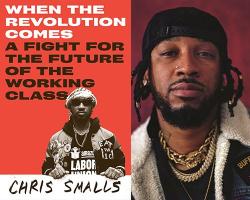 Chris Smalls discusses his memoir, "When the Revolution Comes: A Fight for the Future of the Working Class," published by Penguin Random House. He is the first and only union leader to successfully…
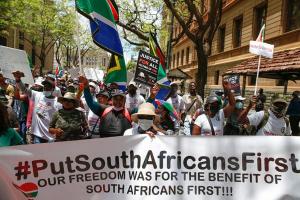 Our guest is Nairobi based political writer and strategist Clinton Nzala. He joins us to provide an update and an analysis of the South African anti-migrant March and March movement, which is…
 The Hague Group’s goal is to “. . . take coordinated legal and diplomatic measures against Israel’s violations of international law.” But international law was never a reality.


