More policing rarely results in justice for anyone, and only puts Black, Indigenous, and other communities of color (BIPOC), including Asian people, at risk for more violence.
“The model minority stereotype portrays Asian people as ‘successful’ and able to pull themselves up by the bootstraps even in the face of racism and systemic oppression.”
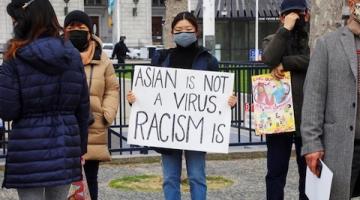
This past year of the pandemic has seen a horrifying uptick in anti-Asian violence and hate crimes in the U.S., many targeting the elderly. From Vicha Ratanapakdee, an 84-year old Thai man who was knocked to the ground, to Noel Quintana, a 61-year old Filipino man who was slashed in the face, many Asian elders have been assaulted and attacked since the pandemic’s onset. Asian people, especially Chinese folks have been subjected to verbal and physical violence—much of which has been fueled by Trump’s anti-Asian rhetoric pertaining to COVID-19’s origins. Racial epithets such as “kung flu” and “Chinese virus” have only exacerbated the situation. While some people have donated or raised awareness, others have expressed their grief by calling on more policing as a means for justice. The problem is that more policing rarely results in justice for anyone, and only puts Black, Indigenous, and other communities of color (BIPOC), including Asian people, at risk for more violence.
From 1977 to 2017, state and local spending on policing increased from $42 billion to $115 billion. Policing is not only problematic, but would further negatively impact the health, well-being, safety, and livelihood of BIPOC and other marginalized people. Research has shown that police brutality has ramifications on Black health, underscoring the importance of reallocating police funds to community-based interventions. It’s linked to death and excess morbidity including fatal injuries, adverse physiological responses, racist reactions that exacerbate stress, arrests and incarceration, and systematic disempowerment.
“Policing would further negatively impact the health, well-being, safety, and livelihood of BIPOC and other marginalized people.”
Policing is a system deeply rooted in upholding white supremacy and anti-Blackness, while enabling racist systems to inflict harm on communities of color. The origins of policing have been linked to slave patrols that date back to the 1700s who chased down runaway slaves and prevented rebellions from occurring. We see the legacy of this policing today in the mass killing of unarmed and innocent Black people from Trayvon Martin to Eric Garner.
Additionally, more policing only catalyzes racial tensions between Asian and Black communities—a racial divide that has persisted in large part due to the model minority myth. The stereotype ahistorically and dangerously portrays Asian people as “successful” and able to pull themselves up by the bootstraps even in the face of racism and systemic oppression. It’s used as a weapon to pit Asian people against Black communities by implying that anti-Blackness and white supremacist systems—like policing—benefit Asian people.
This is a lie. Far from protecting us, policing has also harmed and taken the lives of Asian Americans, such as Angelo Quinto, a 30-year old Filipino American man who was knelt on and killed by Antioch Police, and Fong Lee, a 19-year old Hmong man who was killed in 2006 by the Minneapolis police—the same institution and system that would kill George Floyd, a 46-year old Black man, 15 years later. Policing is a harmful and inequitable system of justice and advocating for more policing in our communities does not mean we will see more justice or less crime. It would only call for more violence against BIPOC communities, especially police brutality and unfair treatment on Black and brown lives, violence that Asian Americans have taken part in as police officers themselves.
“Far from protecting us, policing has also harmed and taken the lives of Asian Americans.”
Instead of calling on more policing, we need Asian solidarity with Black and brown communities as a catalyst for tackling white supremacy and the systems that continuously uphold and enable racism. Dismantling these divides requires unlearning the “scarcity mindset,” a belief that tells us that there are not enough resources for everyone’s needs. In Audre Lorde’s Sister Outsider, Lorde highlights “the false notion that there is only a limited and particular amount of freedom that must be divided up between us … So instead of joining together to fight for more, we quarrel between ourselves for a larger slice of the one pie.”
Scarcity mindset underpins the lie that we should fight solely for Asian liberation at the expense of others, and ignores an existing history of alliance and successful collaboration between Asian Americans and Black and brown communities. For example, Jesse Jackson, a Black political activist, called for justice for the murder of Vincent Chin, a Chinese American draftsman who was beaten to death by two white men. Yuri Kochiyama, a Japanese American civil rights activist and Grace Lee Boggs, a Chinese American social activist advocated alongside the civil rights and social justice movements for Black liberation–which served as inspiration that was used to advance Asian American liberation. So much of Asian American rights that we see today are in large thanks to Black activists and their fight and struggle for freedom. Further, the Delano Grape Strike, one of the most important economic movements in U.S. history, resulted from the collaboration of Filipino and Mexican farmworkers, led by Larry Itliong, César Chávez, and Dolores Huerta. Sadly, much of this history is erased and ignored while conflicts between Asian American communities and other BIPOC, particularly Black communities, are amplified to the benefit of the white supremacist systems that oppress us all.
“We need Asian solidarity with Black and brown communities as a catalyst for tackling white supremacy.”
While the fight for racial justice is a collective effort, working in solidarity does not mean that we should expect Black communities to do or lead the work. Asian Americans must talk directly with family and friends who believe that “police keep us safe,” giving family members the opportunity to share how they feel before speaking, because family members are more likely to listen when you hear them out first. We must remind our communities of the many examples of America’s racist history toward Asians, such as the Chinese Exclusion Act, the colonization and denigration of Filipinos, and Executive Order 9066–which incarcerated a disproportionate amount of Japanese people who were “under suspicion as enemies” during WWII, and how this was a prelude to more recent hate crimes such as the murder of Vincent Chin, the targeting of South Asians since 9/11, and prominent Asian Americans like Jeremy Lin speaking about the racist harassment he’s experienced on the NBA courts. You can learn more about having these conversations by following organizations such as AAPI Women Lead and South Asians for Black Lives, both of which have created and shared informative content about speaking with elders or loved ones who might not speak English about breaking anti-Black stereotypes in the household.
Another way to engage is by learning how to stop xenophobia and harassment targeting Asians in America through bystander training. In collaboration with Hollaback, Asian Americans Advancing Justice offers free bystander and de-escalation training to learn how to intervene when anti-Asian hate and harassment occurs.
White supremacist systems like policing thrive on the dissonance between BIPOC communities. Asian lives cannot afford to have hate and racism win. Instead of looking to more policing as a solution, we must redirect our grief toward positive healing in the form of solidarity. We must organize together, mobilize together, and stand alongside one another in all spaces, and not just in performative ways. There is a long history of Asian American communities working in collaboration with Black and other communities of color that offers far richer and more beneficial pathways to justice than more police, and as we’ve seen time and again, we’re stronger and safer when we work together for our mutual liberation.
Kayla Hui (she/her) is a freelance journalist covering health, policy, social justice, and climate change. Her work appears in the Pulitzer Center, Anti-Racism Daily, Verywell Health, Healt.
This article previously appeared in Prism.
COMMENTS?
Please join the conversation on Black Agenda Report's Facebook page at http://facebook.com/blackagendareport
Or, you can comment by emailing us at comments@blackagendareport.com

 The very physical category of femaleness was articulated by feminists and non-feminists alike as the sole property of whiteness in the 19th century,
 Seventy years after the civil preparedness film Duck and Cover, it is long past time to reckon with the way white supremacy shaped U.S.
 Textbooks are a battleground in which the humanity and status of black Americans are contested
 Amazon will not stop squeezing every drop from workers until those workers have more power.
 The Swazi military has reportedly warned the population to “obey instructions” or “face full wraith of troops.”


