Mural in tribute to Florinda Soriano Muñoz, activist and defender of peasant rights in the Dominican Republic. She was assassinated while fighting against the unjustified dispossession of peasant lands in Hato Viejo, Yamasá, during the second government.
Fighting apartheid in the Dominican Republic is essential to achieving redress for people of African descent in that country.
Originally published in Haiti Liberte.
The Bicentennial Forum for Reparations for People of African Descent was held in Santo Domingo from January 16 to 18, with the participation of representatives from 19 countries, as part of the United Nations International Decade for People of African Descent. Ten years after the launch of this initiative, it is clear that in the Dominican Republic, the years of the UN Decade coincide with the consolidation of an apartheid regime, a consequence of Decision 168-13 and Law 169-14, which denationalized more than 200,000 Dominicans of Haitian descent, and other government policies such as mass expulsions starting in 2021, within the framework of a de facto suspension of constitutional guarantees and the widespread use of arbitrary detentions based on racial profiling.
The "Santo Domingo Declaration," issued following the Bicentennial Forum for Reparations for Afro-descendants, does not denounce these policies of the Dominican government. We agree with certain points of the declaration, including its solidarity with Haiti and its denunciation of military intervention in that country. We also agree with the denunciation of human rights violations in Ecuador and Colombia. However, when it comes to the racist policies of the Dominican government, only the harassment of human rights defenders is denounced, without even mentioning the perpetrators of this harassment, namely the government itself and its far-right allies.
When demanding reparations for colonial crimes, such as the transatlantic slave trade, and their historical consequences of marginalization and capitalist exploitation, it must be clearly understood that this is a demand directed against the governments of imperialist and former colonial countries, and that, more than lobbying, it requires enormous mobilizations. A serious debate on reparations, in an apartheid regime like that of the Dominican Republic, must include the demand to dismantle institutionalized racial discrimination, advance toward equal social, economic, and political rights, end human trafficking, racist repression, and superexploitation perpetrated by the government and local and foreign capitalists, dismantle neo-Nazi paramilitary groups, and compensate the victims of these recent racist state crimes.
In the Dominican Republic, reparations involve restoring nationality to all Dominicans of Haitian descent denationalized by the unconstitutional Ruling 168-13, and compensating the victims of this policy. Reparations involve paying pensions to all retired sugarcane workers and compensating them for their decades-long arrears. Reparations involve justice for victims of racist lynchings like Jean Harry "Tulile" and compensating survivors and affected families. Reparations involve stopping the mass, racist expulsions of Haitians and Dominicans of Haitian descent and providing compensation. An end to warrantless searches, arrests based on racial profiling, the separation of children from their families, and the detention of pregnant women, among other racist crimes perpetrated daily by the Dominican government, is also called for. Of particular importance are the families of those killed by police, military, and immigration officials during mass deportations, as well as those of women who died because they were unable to give birth in hospital due to Abinader's illegal April 2025 hospital protocol.
While it is certainly important to redress colonial slavery, it is even more urgent to end the Dominican apartheid regime, which has accumulated countless crimes over time. For example, it is urgent to end the current forced labor in the Dominican sugar industry and to guarantee respect for freedom of association. It is also essential to provide regularization facilities for the Haitian immigrant community, similar to those offered to Venezuelan immigrants, in order to progress towards the eradication of human trafficking and the corrupt deportation trade. With true immigration regularization without racial discrimination, with unionization, and the official recognition that the Haitian immigrant community is not a burden but, on the contrary, makes an important economic, social, and cultural contribution, we would progress towards greater democratic freedoms and the possibility of defeating neo-Trujillism.
It is also necessary for the Dominican government to acknowledge and apologize for the 1937 genocide perpetrated by the Dominican state, and to return the lands and properties stolen by Trujillo officials and sympathizers to Haitians and Dominicans of Haitian descent in the border region.
One possible mechanism for the payment of reparations by imperialist countries is the cancellation of the external debts of the former colonial countries and, in the case of Haiti, the payment of compensation for the exorbitant debts imposed by France in exchange for the recognition of Haiti's independence.
The first reality that confronts any demand for reparations is that we are facing a racist and Holocaust-denying government. This government denies the existence of current racist policies, statelessness, mass deportations that violate human rights, and has even gone so far as to deny the existence of slavery in the Spanish colony before the creation of the Dominican state. There is not even an official commemoration of the abolition of slavery in 1822 or the genocide of 1937.
Governments and their allies are using the International Decade for People of African Descent (UN) to whitewash and conceal their capitalist policies of exploitation and oppression. The results of the first decade (2015-2024) in the Dominican Republic are negative, and we must approach the new decade beginning in 2025 with a critical eye. Only through genuine political struggle in the streets, mobilization, and the strengthening of solidarity among peoples against governments can we move toward the reparations, justice, and dignity needed by Afro-descendant communities in the Dominican Republic and throughout Latin America and the Caribbean.






 Dr. Anthony Monteiro joins us to discuss the 2024 presidential election results, why Kamala Harris failed to connect with millions of voters, and what will happen under a Trump presidency.
 Anthony Rogers-Wright provides his analysis of the latest United Nations climate change summit, COP29, now being held in Baku, Azerbaijan.
 Democrats are in a collective state of panic because Donald Trump is returning to the presidency. But Joe Biden is escalating conflict in the Ukraine proxy war against Russia and endangering the…
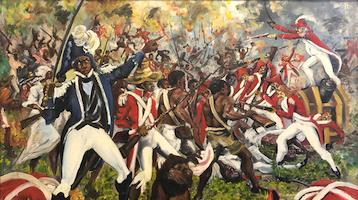 Haiti’s Battle of Vertières reminds us that resistance is not futile, that victory will come.
 Malaika Jabali’s book explains our toxic relationship with capitalism and says it’s time to break up.


