“The [AIDS] epidemic continued to gobble up the first phase of us…”
The anthology Sojourner: Black Gay Voices in the Age of AIDS was published in 1993, at a moment not far removed from a time when contracting HIV was seen as a death sentence and the public stigmas attached to a positive diagnosis were intensified by uninhibited homophobia and racism. For Black queer folk, this meant turning inwards. It was quickly realized that a response to the HIV/AIDS pandemic within the Black gay community would not come from the Black community, nor from the community at large. Instead, Black queers organized their own health care at the grassroots level, while embarking on their own political advocacy and epidemiological research.
Sojourner emerges from this era of Black queer organizing and advocacy. It was published by Other Countries, a writer’s collective of Black gay men founded in 1986 in New York City. As part of their mission to support and nurture Black gay writing Other Countries, organized writing workshops, readings, and performances. It also published an occasional journal. Its first edition was the 1983 anthology of 32 writers titled Other Countries: Black Gay Voices. This was followed by Sojourner: Black Gay Voices in the Age of AIDS (1993) and Voices Rising: Celebrating 20 Years of Black Lesbian, Gay, Bisexual & Transgender Writing (2007).
Sojourner: Black Gay Voices in the Age of AIDS is a staggering collection. At times both defiant and melancholic, it is an elegiac archive of Black gay responses to the AIDS crisis. Loss — death — is ever-present. The collection opens by invoking the names of brothers who had recently joined the ancestors. In his introduction, editor B. Michael Hunter writes that the Sojourner is about “the beginning of our search for ways to face the day after the wakes, the funerals, the memorials of yet another friend-lover-family member.” Marlon T. Riggs’ contribution is titled “Letters to the Dead.” Craig G. Harris’ is titled “Post-Mortem Correspondence.” Robert Vazquez-Pacheco’s poem is called “Necropolis” while fabian thomas writes a short, intimate piece titled “The Day I Saw Death.”
Sojourner is also remarkable for its documentation of the work of Black gay organizing. The interview with the late Reverend Carl Bean is essential in this regard, describing his work with the Unity Fellowship Church Movement. So too is the essay “When to fight, when to care,” written by Floyd Dunn. A Detroit native, Dunn was a dancer, playwright, and activist who worked with the Detroit Coalition of Black Lesbians and Gays and was the founding director of the organization Project Survival. In “When to fight, when to care,” Dunn describes the exhausting care work and organizing of Black gay men for Black gay men in the early years of the pandemic — which he dates to 1979. Dunn writes: “As important as it is to build coalitions with others, we must not allow others to advocate or speak for us. No one knows our needs better than we do. In a world of self-interests, we cannot really rely on others to fight for us without us.”
To mark World AIDS Day and to commemorate our Black queer ancestors, we reprint Floyd Dunn’s “When to fight, when to care” below.
When to fight, when to care
Floyd Dunn
The politics of HIV/AIDS has affected my life so drastically that I had no choice but to speak out, to take care of myself, and nurture other Black Gay men as well. First, let me take you back to February, 1979. I know some of you are saying, “Wait a minute, this epidemic is only 10 years old.” Don’t believe everything you’re told. I had just returned to New York from my second State Department Fellowship studying theater and dance in Leningrad and Moscow, and had signed with the Alvin Ailey American Dance Theater as guest artist on its 20th anniversary tour. I soon learned that four of my closest friends were suffering from drastic weight loss, swollen lymph glands in the neck or groin, hacking coughs, drenching night sweats (sometimes the sweating was so severe we had to flip the mattress), and a general loss of appetite. Two other friends joined me in trying to help them. One friend and I provided direct care, while the third acted as a driver or ran errands, anything that didn’t involve being alone with the sick friends.
There wasn’t much information available about what was happening. In fact, the condition I’ve described didn’t even have a name at the time. But with the promise of learning something, we would drive northbound to Boston and southbound to D.C., stopping in Cleveland and Atlanta, following every meager lead. All that we learned was that it “seemed like an infection of some kind.”
Doctors tried to miss two of my friends because of their substance-abuse histories. On a number of occasions I found myself telling a doctor or hospital administrator to “kiss my Black ass,” when they started that self-righteous bullshit about drugs. I even suggested to one physician that he concentrate on healing himself upon observing his shaking hands and darting pupils.
There were times when I was touring that I felt like a mother or father checking to see how the kids were doing. I’d send money or other things, and battle with my guilt for not being there. All the while praying and hoping that when I returned, this crazy nightmare would have ended. For two of my friends, the nightmare lasted nine months. Their families refused to accept or participate in their funerals. My drag sisters and I resurrected our La Diva La Rue act to raise enough money for their funeral expenses.
In the midst of this madness, my great-grandmother, Omega, was dying of cancer back in Detroit. I reached into several of my trade’s pockets to support friends in New York and rushed off to Motown to take care of the head of my family clan.
My other two friends lasted until the summer of 1982. They got better, than worse, than better, on and on until BAM! Being so engrossed with taking care of them, we failed to realize that within a two-year period, we had known over 75 people who died. They were either gay, lesbians, drag sisters, drug users, Black or Latino. Even when health officials identified Gay Related Immune Deficiency (GRID) as the cause of these deaths, we went into super denial mode: “That’s; the, not me!” Ten years into the epidemic, there are too many of us still saying, “Not me, just them.”
When I returned to New York, after Omega’s passing, I spent the next two years trying to get my career back in order. Being a dancer, and not having danced in two years, is rough. I was still in great shape, but my reputation was shot to hell. I had broken several contracts, one with Ailey, one with the Martha Graham Dance Company, and one I would really regret with a Michael Bennett show that went not to become “Dreamgirls.”
The epidemic continued to gobble up the first phase of us, and only got worse. Everyone knew someone who knew someone, but people rarely spoke about it or knew anything about it.
I found two teaching jobs in Connecticut, one in Hartford, the other in New Haven. Then I was hired by the Pauline Koner (Bless her soul) Dance Consort. Our first stop was South America, and then it was on to Europe. I was glad to be away from New York, but something wasn’t right. For the first time in my fifteen-year career I was not giving my all. I couldn’t concentrate. My timing and energy was off. I distanced myself from family and friends and I wouldn’t return phone calls. Ms. Koner sensed something was wrong, but gave me my space. I had performed with the troupe in the mid-1970s, so they were very supportive. Then, on our last gig in Paris, I fell and hurt my back. I returned to Detroit to recuperate and to get some peace and quiet.
Once I was settled in the States, the phone started ringing. It was L.A. or Frisco or N.Y., informing me that someone had died or someone was sick. It got so bad that each time the phone rang, I would start shaking uncontrollably, feel lighted, and break out in a cold seat. My condition was attributed to my back injury and nerves. But I was also emotionally drained by the losses I had suffered, which now included a former lover who killed himself after testing HIV-positive. I had never taken the time to reflect, examine, grieve, or understand these tragedies. Knowing that there would be more losses to come, I decided it was time for a shrink again, or I’d flip my top. And my top could not take much more flipping.
The other thing I realized was that I knew nothing about this LAV (lymphadenopathy-associated virus) or HTLV-3 (human T-cell lymphotropic virus type 3), as the agent that was thought to cause AIDS, was being alternatively called. I sent for information from the Pasteur Institute in France, the Centers for Disease Control in Atlanta, San Francisco General Hospital, Gay Men’s Health Crisis in New York, the Mayo Clinic in Minnesota, and Johns Hopkins University in Baltimore. I began to understand that I had to work through my own fears and ignorance in order to equip myself to survive. This new thirst for knowledge took me back to school with pharmacy on my brain, and resulted in an associate degree in pharmacology. Thank God for my survival skills. Even today, after over eight years of studying, questioning, watching, and learning of my own HIV-positive states in 1985, I’m still scared, but I move on.
The epidemic began to touch Detroit and I began to challenge folks to talk about or learn about AIDS. I met Jerome Boyce who had started an agency with the white boys, because he couldn’t find any of us. The white boys jumped in and took over, as usual. Jerome made me realize that it was going to take caring for us to heal us. I think deep down inside I knew this, but internalized self-hatred is never totally gone. We must remember, too, how hard we are on each other. Jerome wasn’t a complete stranger to me. He was a member of a dance company in Detroit called Soup’s Troupe, we’d seen each other out and about, and had even been involved in the same theatrical productions. So there I was, starting a project that brought me back to the front lines of the AIDS crisis. I’d come full circle.
For me, the caring part is easy, I love who I am and others like me. There are things that we do to each other and ourselves that piss me off, but they are things we can change. They do not warrant self-hatred or our own homophobia. And, as important as it is to build coalitions with others, we must not allow others to advocate or speak for us. No one knows our needs better than we do. In a world of self-interests, we cannot really rely on others to fight for us without us. Every time we do, we get swept under the rug.
It’s important as Black Gay men, PWAs [People with AIDS], and PWHs [People with HIV], to stop letting agencies, commissions, coalitions, people, or situations continue to pimp our minds without the proper acknowledgement or reward. This means, as we work for others, we must work for ourselves. Too often we fall into thinking that someone else, somewhere else, is going to take care of us. The game is so high-tech now that others utilize us to pimp us— and we do a damn good job. We refuse to come together based on who we like or dislike, as opposed to who is doing the work for them. We need to start teaching the younger generation about our lives, and those before us, to establish some legacy. When we hurt each other, our grades can’t be forever, it’s not realistic. We must take time to discuss who we are and why we are, and be honest and open about the diversity and variety in our Black Gay male community. We have to stop feeding into the many stereotypes that have been created about us, and start carving out a new Black Gay Man who is not afraid, ashamed or apathetic about himself or the world. We can never forget that politically we are only assets when we can be used or studied for others’ interests or gain, therefore, WE MUST HAVE AND KEEP OUR OWN AGENDA.
Our fight is increasing on many levels. Yet to stop fighting is to stop living. It is past time for us to know when to care and when to fight. We must honor and love ourselves now and without regret, create our own visions of how we will live, work, play, hope, dream, and die. I now know that we must never stop caring or fighting.
Floyd Dunn, March 5, 1951 – April 17, 1996.
Floyd Dunn, “When to fight, when to care,” Sojourner: Black gay Voices in the Age of AIDS (New York: Other Countries Press, 1993)




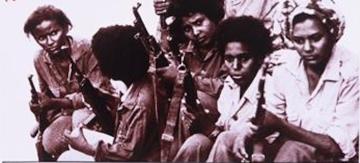


 In this week’s segment, we discuss student protests by Black and brown youth in France against austerity measures and race-based inequality in the education system. But we begin with a discussion of…
 Brazil's incumbent president Lula da Silva finished second behind Flavio Bolsonaro in the first round of the presidential election. Because neither man received at least 51% of the vote, a run-off…
 Students in France are engaging in mass protests. Hundreds of them have been arrested and injured by police, and many schools are closed. Annick Metefia joins us from Paris. She is a member of the…
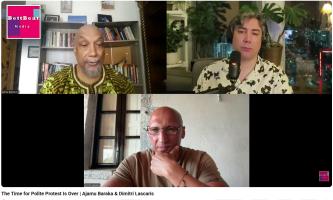 Ajamu Baraka of the Black Alliance for Peace joins Dimitri Lascaris on BettBeat Media for a conversation about something Western publics have not yet come to terms with — the fact that resistance to…
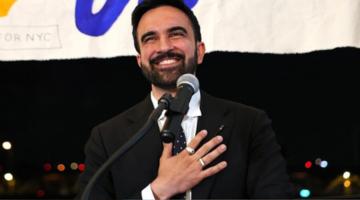 Progressive candidates rarely remain so after winning public office. Zohran Mamdani is no exception, but his capitulation to New York zionists angered his supporters, and the people he hoped to…


