Eritrean President Isais Afwerki arrived in Port Sudan on November 29 to stand with General Abdel Fattah al-Burhan for the unity of Sudan.
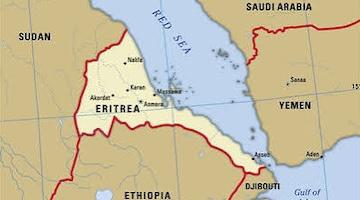
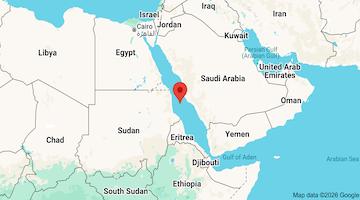
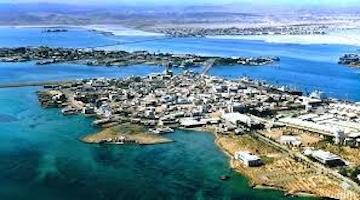
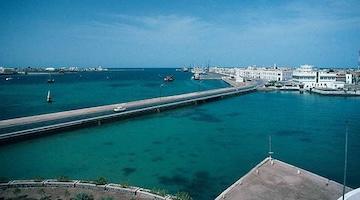
President Isaias Afwerki arrived in Sudan on November 29 on the invitation of General Abdel Fattah al-Burhan, the Chairman of Sudan’s Sovereign Council and Commander of the Sudanese Armed Forces (SAF). Isaias and his entourage traveled 305 miles by road from Asmara, the Eritrean capital, to the entrance of Port Sudan on the Red Sea, where thousands of the city’s residents came out to welcome them.
Eritrea’s Ministry of Information described the visit as “both symbolic and a vivid gesture of the warm and robust solidarity that Eritrea harbours towards the people of Sudan and their government in these times of adversity.” By standing alongside the Commander of the national army, President Isaias is standing for the unity of Sudan at a time when it is in danger of a second partition, which would create two smaller, weaker nations, both more vulnerable to neocolonial domination and resource exploitation.
Eritrea also has its own national security concerns, as the conflict has spilled into Sudan’s eastern Gedaref, Kassala, and Red Sea States, which share a porous 605-km border with Eritrea and ethnic ties to its western provinces. Eritrea is protecting itself from spillover violence, arms trafficking, and further refugee influxes. Over 100,000 Sudanese had fled to Eritrea by late 2025.
The worst humanitarian crisis in the world
The UN and humanitarian agencies now describe Sudan as the worst humanitarian crisis in the world with estimates of the displaced ranging from 9 to 13 million, at least a million more than the 8 million displaced in the Democratic Republic of the Congo. Seven million remain within Sudanese borders with the rest sheltering in neighboring countries.
On November 5, the International Rescue Committee reported that 30.4 million people, more than half the population, need aid but that attacks on aid workers make it difficult to deliver. They also called it “the largest recorded and fastest displacement crisis in the world.”
Over 635,000 people, many in the country’s largest camp for displaced people, are experiencing famine conditions and a heightened risk of death. That’s a greater population living in famine conditions than in the rest of the world combined. Food shortages are leaving people vulnerable to illness and infection, and basic medicines are in short supply if available at all.
The UN says it has received alarming reports of human trafficking by the Rapid Support Forces and widespread rape of girls, women, and children.
The Sudanese Armed Forces and the Rapid Support Forces
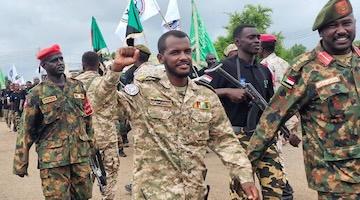
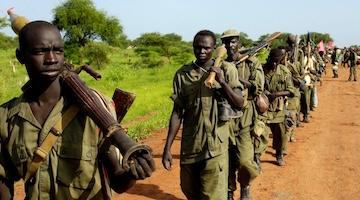
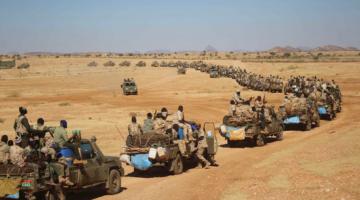
Sudan’s civil war began in April 2023 as a fight for power and resources between General al-Burhan, the Sudanese Armed Forces, and General Mohamed Hamdan Dagalo, also known as Hemedti, Commander of the Rapid Support Forces (RSF). The RSF is a paramilitary group that grew out of the Janjaweed, Arab militias that operated primarily in Darfur, western Sudan, and parts of eastern Chad during the Darfur conflict that began in 2003. Omar al-Bashir, the dictator who ruled Sudan from 1993 to 2019, used the Janjaweed to fight Sudan’s non-Arab populations. The group did not disband after the partition of Sudan and instead became a mercenary force serving both Saudi Arabia and the United Arab Emirates (UAE) in their war with Yemen’s Houthi rebels.
Al-Burhan and Hemedti at first united to overthrow al-Bashir in 2019, but Hemedti then refused to integrate his forces into the national army. He and his RSF are not fighting a secessionist war to detach a specific ethnic or regional territory (like Darfur) from Sudan to form an independent state. They have been fighting for national control and power, but their consolidation of a parallel government in the areas they control has led to de facto territorial divisions that risk once again partitioning Sudan.
On March 6, Sudan filed an application at the International Court of Justice (ICJ) accusing the UAE of violating the 1948 Genocide Convention through its alleged military, financial, and political support for the RSF. The case claims that the UAE is complicit in RSF-perpetrated atrocities against the non-Arab Masalit ethnic group in West Darfur, including killings, rapes, and forced displacement amounting to genocide. Sudan requested provisional measures to halt UAE support and ensure reparations, but the ICJ rejected the case on jurisdictional grounds.
The Quad: US, Egypt, Saudi Arabia, and the UAE
"The Quad" refers to a diplomatic grouping of four key international actors—the United States, Egypt, Saudi Arabia, and the UAE—purportedly formed to mediate and push for an end to the civil war. This is distinct from the earlier "Quad" on Sudan (involving Saudi Arabia, UAE, UK, and the US from 2023), which focused on initial ceasefires but has since evolved.
In September 12, 2025, it put forth a proposal for a three-month humanitarian truce, a permanent ceasefire, and a nine-month transition to a civilian-led government excluding the warring parties and "extremist groups," implicitly targeting Islamist factions like the Muslim Brotherhood.
However, as of December 2025, the proposal remains stalled, with fighting intensifying and the RSF advancing in the Darfur region where they have filmed themselves committing massacres and atrocities that much of the world is now calling genocide.
Positive as the Quad's proposal sounds, its authors are external powers who’ve been fueling the conflict. Egypt and Saudi Arabia have backed the national army, but most importantly, the UAE has armed and financed the RSF, its sometime mercenary army, largely with profits from gold smuggled from Sudan to Dubai.
The UAE was NATO’s ally in the 2011 destruction of Libya and has since become an even closer US ally, so their agenda can be assumed to be the same, weakening Sudan and controlling its resources.
How can de facto perpetrators also be mediators?
Al-Burhan rejects the Quad proposal
Al-Burhan rejected the proposal, labeling it the "worst yet" for echoing Abu Dhabi "talking points." He argued it "eliminates the armed forces" while allowing the RSF to retain territorial gains, particularly in Darfur and Kordofan.
By calling for a permanent ceasefire, the proposal treats the national government and national army and the Rapid Support Forces as equals. It disrespects Sudan's legitimate institutions and its right to self-defense and sidelines Sudanese-led processes. Its call to exclude both the SAF and the RSF from the transition, while dissolving security agencies, is a de facto disarmament of the national army.
Al-Burhan, who rightly represents the Sudanese state, has insisted that any truce requires the RSF to "retreat totally.”
Once again, President Isais rightly stands with General al-Burhan for the unity and sovereignty of Sudan.
Ann Garrison is a Black Agenda Report Contributing Editor based in the San Francisco Bay Area. In 2014, she received the Victoire Ingabire Umuhoza Democracy and Peace Prize for her reporting on conflict in the African Great Lakes region. She can be reached at ann@anngarrison.com. You can help support her work on Patreon.

 While Trump pardoned an actual drug lord president, he keeps a kidnapped Venezuelan president, Nicolas Maduro, and his wife, First Combatant Celia Flores, in a mold-infested Brooklyn jail on false…
 Jeffrey Isaac Jarquin was deported from the U.S. by ICE and upon arrival in Managua was sent to prison by Nicaraguan authorities. Corporate media has decried the detention of a “torture victim” and “…
 In this week’s segment, we discuss student protests by Black and brown youth in France against austerity measures and race-based inequality in the education system. But we begin with a discussion of…
 Brazil's incumbent president Lula da Silva finished second behind Flavio Bolsonaro in the first round of the presidential election. Because neither man received at least 51% of the vote, a run-off…
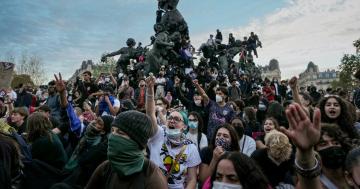 Students in France are engaging in mass protests. Hundreds of them have been arrested and injured by police, and many schools are closed. Annick Metefia joins us from Paris. She is a member of the…


