Anya Parampil’s book tells the story of US hybrid warfare on Venezuela and of the tectonic social and economic shifts reshaping the world today.
“Sanctions,” as imposed by the US, is a sanctimonious word for economic warfare and outright theft, and Venezuela is a textbook case. As Anya Parampil demonstrates in Corporate Coup: Venezuela and the End of US Empire, sanctions were part of a multi-pronged regime change war that included diplomatic aggression, economic terrorism, covert operations, and information warfare.
It also included the bizarre US recognition of an obscure Venezuelan legislator, Juan Guaidó, as the president of Venezuela from January 2019 to January 2023, even as the elected president, Nicolas Maduro, remained in power.
Ridiculous as that was, it worked. By transferring Venezuela’s foreign assets to Guaidó and his “administration,” and by its relentless economic sanctions campaign, the US enabled US and Canadian corporations to suck Venezuelan wealth into their own coffers, where much of it remains to this day. It was a corporate coup but, as Parampil argues in her conclusion, successful only in the near term.
Parampil skillfully weaves the personal story of her frontline reporting through the history of this war, beginning in 2019, when she first walked through the front doors of Venezuela’s Foreign Ministry and saw a “peculiar art installation.” Gradually she realized that it was a sculptural rendering of former Chilean President Salvador Allende’s fractured glasses “left shattered on the floor of his office on September 11, 1973, after US-backed military forces stormed the Presidential Palace in Santiago and overthrew his government.” What could better symbolize the Bolivarian Revolution and the fearsome imperial force it faces still?
Days before she walked through those doors, Juan Guaidó had declared himself the president of Venezuela, “sparking an international political crisis that continues to this day,” even though a Venezuelan pollster demonstrated that “a whopping 81% of Venezuelans did not even know who Guaidó was at the time.”
Venezuelan socialism, US and Canadian corporate vultures
Venezuela embraces the term “socialism,” as Parampil explains, even though the private sector still operates the vast majority of its economy. Its core belief is that the country’s vast natural resource wealth— arguably including the world’s largest oil and gold reserves—belongs to the Venezuelan people. This of course sparks the ire of Western oil and mining companies and the governments that represent them, most of all the US.
Venezuela has a national oil company that owns and manages its oil resources, as did several nations who’ve been toppled by US coups. The government has also claimed its own gold resources, including the Las Cristinas gold mine, arguably the largest unexploited gold mine in the world.
Crystallex, a Canadian mining company, signed an exclusive contract with the government to develop Las Cristinas in 2002, but Venezuela canceled the contract in 2011. Crystallex then asserted that Venezuela owed it $3.16 billion plus interest for expropriating the mine even though it had never been operational.
With the help of Guaidó’s shadow government, Crystallex became the first major player in seizing Venezuela’s most valuable international asset, US-based Citgo Petroleum. Parampil describes a fire sale that ultimately benefited both Crystallex and American oil companies:
“When a court rules that one corporation, such as Crystallex, can seize shares belonging to another, such as Citgo, as a debt payment, the shares are not directly transferred from company to company. Rather, the court sells off a portion of the indebted company’s assets and uses funds raised from the sale to pay the claimant.
“‘They’re auctioned,’ [Venezuelan economist Francisco] Rodríguez explained, referring to the indebted company’s assets.
"In Citgo’s case, this meant the court would oversee the fire sale of roughly $1.2 billion worth of its assets—including gas stations, oil pipelines, oil terminals, and refineries throughout the United States—in order to satisfy Venezuela’s debt to Crystallex. Through that process, oil industry rivals including Shell, British Petroleum, and ExxonMobil would gain a chance to expand their share of the US oil market by swallowing up Citgo’s infrastructure.”
Voilà. Coup complete. Or rather, started. As Parampil recounts, a US court’s decision in favor of Crystallex made way for a host of other corporate vultures to move in on Venezuela’s Citgo assets in the US.
This is, of course, a gross oversimplification of a complex process that I couldn’t have begun to understand without Parampil’s masterful guidance through a byzantine legal and business maze.
Surviving a medieval siege
UN Rapporteur Alfredo de Zayas described the UN sanctions regime on Venezuela as “comparable with medieval sieges of towns with the intention of forcing them to surrender.” Parampil describes how it greatly restricted imports and thereby starved the private sector that the US might have been expected to defend.
The government responded by instituting CLAP, the Comités Locales de Abastecimiento y Producción (Local Committees for Supply and Production), which became “Maduro’s single most effective intervention against US financial war.”
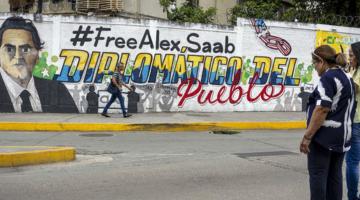
While the sanctions regime had reduced Venezuela’s GDP by 75 percent, its living standards by 72 percent, and increased its mortality rate by 31 percent, the CLAP program delivered regular shipments of government subsidized pantry staples and household products to millions of families nationwide. Its success made it an obsession of the US government, which made repeated attempts to undermine the alternative supply chains it depended on, most notably by arresting and imprisoning Alex Saab, the Colombian-Venezuelan businessman and diplomat who had undertaken the job of creating them. God forbid that a nation should not only claim its own natural resource wealth but also dare to feed its people.
Failed “humanitarian” invasion
Another story line in Corporate Coup is almost as bizarre as the Western recognition of Juan Guaidó. In February 2019, one month after Guaidó inaugurated himself, the US announced that it would force a convoy of “humanitarian aid” into Venezuela from Colombia and began assembling a military presence on the border to oversee its delivery. The narrative it fed the media was that Venezuela was starving its people and even refusing to allow an aid convoy in.
At the time this occurred it was only on the edge of my consciousness because I was focused largely on understanding US aggression in Africa. I did of course note that the US was trying to force “aid” in, and that billionaire Richard Branson was prancing around on the Colombia-Venezuela border making an ass of himself with his 2019 Venezuela Aid Live concert.
Since Branson’s billions aren’t derived from oil, gold, or other natural resources, he seemed to be there simply to assert his right to be a billionaire and challenge an economic model that he imagined might deny him that right.
What I didn’t realize before reading Corporate Coup was that the delirious organizers of this stunt were trying to inspire the Venezuelan troops who amassed on the Venezuelan side of the border to defect and trigger a military uprising that would bring down the Maduro government. Parampil writes:
“Rather than ignite chaos in Venezuela’s streets, the February 23 plot was designed to test the loyalty of the country’s armed forces. By forcing Venezuelan troops to prepare for an invasion, Washington waged a psychological war against the military’s rank and file with the aim of intimidating them into defection. Trump and his advisors did not hide this objective.
“‘To the Venezuelan military high command, now is the time to stand on the side of the Venezuelan people,’ White House National Security Advisor John Bolton tweeted on February 2. ‘It is your right and responsibility to defend the constitution and democracy for Venezuela!’”
Some few defected, but the vast majority of the Venezuelan soldiers stood their ground, and the US operation was a dismal failure. Parampil’s blow-by-blow account of how this all transpired is well worth reading. There’s a sad irony to it now as miles of aid trucks line up on the Egyptian side of the Rafah Crossing, waiting to get into Gaza, and the US continues to oppose a ceasefire that would open the way to letting them in.
Who remembers Juan Guaidó?
The US-backed pretender Juan Guaidó will no doubt be discussed in future academic discourse on the first three decades of 20th century Venezuelan history. If remembered beyond that, he’s likely to be shorthand for a feckless lackey. A “guaidó” could become similar to a “quisling,” shorthand for “traitor” based on the career of Vidkun Quisling, the collaborator who nominally headed Norway’s government during Nazi occupation. Or he may, as Parampil writes, just be a bad, forgettable joke.
In any case, US and Canadian corporate coupsters are still laughing all the way to the bank.
Short term coup, long term loss
As Parampil’s subtitle—Venezuela and the End of Empire—implies, the hybrid warfare against Venezuela worked to enrich Western corporations, but only in the short term. In the long term, they proved the US and its Western allies to be dishonest international partners and inspired nations like Venezuela to establish new trade relationships—including trade not transacted in US dollars—with more trustworthy partners in the new multipolar world.
Parampil’s narrative makes for a fascinating read, not only about Venezuela, but also about the tectonic social and economic shifts reshaping the world as we know it today.
Corporate Coup can be pre-ordered at a 15% discount from OR Books today . It will be available in paperback and electronic form in March.
Ann Garrison is a Black Agenda Report Contributing Editor based in the San Francisco Bay Area. In 2014, she received the Victoire Ingabire Umuhoza Democracy and Peace Prize for her reporting on conflict in the African Great Lakes region. She can be reached at ann(at)anngarrison.com.

 In this week’s segment, we discuss student protests by Black and brown youth in France against austerity measures and race-based inequality in the education system. But we begin with a discussion of…
 Brazil's incumbent president Lula da Silva finished second behind Flavio Bolsonaro in the first round of the presidential election. Because neither man received at least 51% of the vote, a run-off…
 Students in France are engaging in mass protests. Hundreds of them have been arrested and injured by police, and many schools are closed. Annick Metefia joins us from Paris. She is a member of the…
 Ajamu Baraka of the Black Alliance for Peace joins Dimitri Lascaris on BettBeat Media for a conversation about something Western publics have not yet come to terms with — the fact that resistance to…
 Progressive candidates rarely remain so after winning public office. Zohran Mamdani is no exception, but his capitulation to New York zionists angered his supporters, and the people he hoped to…


