by BAR executive editor Glen Ford
In desperation to halt the slide into “non-empire” status, the U.S. makes every government on Earth a potential target for “humanitarian” military intervention. The imposition of chaos is Washington’s default foreign policy as an alternative to “the Chinese handwriting on the wall.”
The U.S. Scorched Earth Policy, Ten Years After Iraq Invasion
by BAR executive editor Glen Ford
“Iraq was much more than an imperial episode; it was supposed to be an epochal game-changer.”
When the United States invaded Iraq on March 17, 2003, the Bush regime hoped to forestall America’s impending economic eclipse through ruthless deployment of its last remaining global advantage: a war machine so huge and technologically advanced, it accounted for half the world’s military spending. The strategic aim of the unprovoked assault, broadly outlined by the Project for the New American Century and telegraphed in numerous Pentagon leaks, was to block the rise of any challenge to U.S. imperial supremacy in the foreseeable future.
Iraq, which the Republican administration believed was ripe for a relatively quick and painless plucking, would serve as a base for U.S. power projection throughout the Arab world and deep into formerly Soviet Central Asia, a region of vast energy reserves that was “still in play” in terms of competition with Russia, China, India and Iran. The U.S. military would thrust itself into the contested region, blocking the natural progression of trade and political relations between eastern and western Eurasia, and unambiguously establishing the United States as the “New Rome” – the permanent arbiter of global affairs. The rise of China would be both slowed and politically quarantined, through a robust U.S. presence.
The larger goal was to prevent America’s long-term economic decline – no secret, even then – from resulting in the loss of global strategic supremacy. The “New Rome” might be in an advanced state of deindustrialization and increasingly uncompetitive in trade, its “soft power” utterly exhausted, but aggressive deployment of its awesome war machine would allow the U.S. to remain the “indispensable nation,” the permanent hegemon.
“The rise of China would be both slowed and politically quarantined, through a robust U.S. presence.”
Iraq was much more than an imperial episode; it was supposed to be an epochal game-changer – the equivalent of George Bush slamming his fist on the global game board, upsetting all the pieces, and then putting them back in ways that ensured U.S. dominance. China, and all the other emerging powers of a world seeking independent routes of development – checked!
As I wrote in BlackCommentator on the evening that Shock and Awe broke over Baghdad:
“We are all assembled, the world's people, awaiting the Pirates' lunge at history. The Bush men have made sure we pay rapt attention to their Big Bang, their epochal Event, after which the nature of things will have changed unalterably to their advantage – they think. The Bush men are certain of our collective response, convinced that once we have witnessed The Mother of All War Shows, humanity will react according to plan, and submit.”
As we predicted, Bush had “reached too far.” His engines of war ultimately failed to “harness Time and cheat the laws of political economy, to leapfrog over the contradictions of their parasitical existence into a new epoch of their own imagining.”
The eventual defeat and withdrawal at the hands of Iraqi irregulars and civil society was catastrophic to U.S. prestige. So much face was lost, it required that the Empire put a new, Black face forward, so as to resume the game under (cosmetically) new circumstances.
A cunning liar emerged from the duopoly pack, a slick young man who claimed to oppose “dumb” wars while pledging undying dedication to U.S. supremacy in the world. And much of the world let its guard down.
“So much face was lost, it required that the Empire put a new, Black face forward.”
Barack Obama would need some smartly-worded wars, because he faced the same historical dilemma as Bush – only now, the imperial rot was far more advanced, and evident to everyone. People had coined the term BRICs, to describe the emerging powerhouses of Brazil, whose development bank would soon surpass the World Bank in size; Russia, newly assertive and still a petro-chemical colossus; India, soon to be the world’s most populous nation; and China, which by some measures became the planet’s biggest economy in 2010, following the global capitalist financial meltdown. (American intelligence services still claim the final economic eclipse of the U.S. will not arrive until around 2030, in the vain hope of delaying a national psychological depression.) Just like Bush, Obama needed to reset the game board.
The defeat in Iraq could not be reversed, so Obama reluctantly honored the terms of Bush’s withdrawal agreement. He “surged” in Afghanistan, to no avail, and now seeks a formula to retain as much killing power in that country as possible after 2014. But Obama’s forced retreats in Iraq and Afghanistan were accompanied by a general declaration of war against the international order, cloaked in the bogus doctrine of humanitarian military intervention. The scope of U.S. aggression has become limitless, bounded only by the geopolitical ambitions of Washington and its ad hoc formations of allies and proxies. Obama has shattered the bedrock of global relations – the sovereignty of nations – without which there can be no international rule of law. Every government on the planet can be made a target, if the U.S. makes the case that the regime is unfit to administer its people.
“Just like Bush, Obama needed to reset the game board.”
Obama’s drone armadas are central to his military posture, and the war on terror rationales inherited from Bush remain useful to Obama’s purposes, at home as well as abroad. However, his principal tool and innovation in the twilight struggle to maintain U.S. hegemony in the era of general American decline, is humanitarian intervention, which justifies any aggression. In effectively jettisoning the rules of war – which the United States was so central to codifying after World War Two – Obama threatens to plunge the world into chaos.
It now appears that the U.S., in desperation to halt the slide into “non-empire” status, has adopted the imposition of chaos as its default foreign policy. No longer competitive in a global playing field, ruled by finance capitalists who create nothing and seek only to monetize other people’s labor and resources, the United States appears to have concluded that extended periods of chaos in crucial areas of the world may be more advantageous than a state of relative peace in which the U.S. is not the dominant actor.
Washington has long favored this strategy in parts of sub-Saharan Africa. It funded Somali warlords to keep that nation in chaos and political incoherence, finally instigating Ethiopia to invade the country in late 2006 to prevent the spread of peace under a popular Islamist government. Since the fall of its long-time strongman, Mobutu, in the Democratic Republic of Congo, U.S. proxies Rwanda and Uganda have imposed a living hell in the country’s eastern regions, a chaos so horrific it has claimed six million lives since 1996, and still counting. Minerals extraction continues amidst the carnage.
“Obama threatens to plunge the world into chaos.”
Then came the advent of the Arab Spring, and the West’s nightmare scenario of true independence and popular rule in the energy centers of the world. Europe and the U.S. responded with overwhelming force, allying with the royalist Arab oil regimes and the international jihadist movement to bring down Muammar Gaddafi’s government in Libya, under a paper-thin humanitarian UN mandate. It was absolutely predictable that chaos would soon spread throughout the northern tier of Africa – what else could possibly occur with the empowerment of jihadists? Simultaneously, the West launched its jihadist war against Syria, igniting two years, so far, of chaos by design in the heart of the Arab world.
This is, in effect, a kind of scorched earth policy, based on the premise that chaos is preferable to international order in situations where a declining U.S. cannot exert effective control. It is a policy that does not blink after two years of mayhem in the tinderbox in which Syria sits – because the alternative, as the U.S. sees it, is the inevitable shrinking of its global domain through the independent interactions of other peoples. Given the alternative, Washington says: let it burn.
The scorched earth strategy suits a retreating army. America still has global reach, which means no region is safe from its dying, imperial convulsions. Although Venezuela provides a huge portion of U.S. oil imports and is situated on a continent that has overwhelmingly rejected the “Washington Consensus,” the period following Hugo Chavez’s passing is fraught with danger of blatant U.S. intervention. The declining empire’s rulers are desperate to erase the Chinese handwriting on the wall. They feel compelled to roll the dice, as Bush did, ten years ago.
BAR executive editor Glen Ford can be contacted at Glen.Ford@BlackAgendaReport.com.

 The U.S. excluded Cuba, Nicaragua and Venezuela from the recent Summit of the Americas held in Los Angeles. While there was widespread condemnation against the U.S., only six heads of state had the…
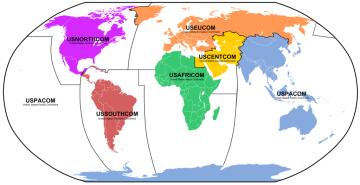 The latest Black Alliance for Peace AFRICOM Watch Bulletin provides analysis of the U.S. Southern Command and includes an interview with Ahjamu Uni, organizer with the All African People's…
 Democrats and republicans alike supported a bil to "counter malign Russian influence in Africa." Such legislation is reminiscent of the worst days of the cold war. Now a member of the Congressional…
 Bakari Sellers is the most prominent supporter of a new PAC dedicated to defeating Congresswoman Rashida Tlaib. The Urban Empowerment PAC has a goal of "electing pro-Israel Black democrats" and…
 A twenty year battle in Israeli courts ended with a decision to evict more than 1,000 Palestinians from Masafer Yatta. Settler attacks on Palestinians escalated even before the ruling, which allows a…


