by Dady Chery
Haiti’s mineral wealth is marked for super-exploitation by a Canadian corporation that has already wreaked havoc in the neighboring Dominican Republic. Mining companies claim the gold and silver reserves were only recently discovered, but “the story could just as well be that the mining executives were biding their time and waiting for a non-nationalistic government to take effect before initiating their projects.” The operation requires construction of a deep-water port in Haiti’s northeast, threatening the country’s marine ecosystems.
Poor Little Haiti to be Fleeced of its Riches
by Dady Chery
“This mining plan will permanently strip the country of much of its mineral, cultural, and ecological wealth.”
Show me a corporate boss who calls Haiti the “poorest country in the western hemisphere,” and I’ll show you a con artist preparing to fleece Haiti. Likewise, show me a western technocrat who bemoans Haiti’s “dramatic deforestation due to charcoal production” and I’ll show a bio-pirate or vandal preparing to wreck Haiti’s remaining cloud-forest and mangrove-forest ecosystems.
It turns out that the real plan for Haiti’s northeastern region — especially the Caracol Bay area — is one that was hatched by Canadian mining corporations, with the U.S and South Korean sweatshop zone being a side project and distraction. If this mining plan is given a green light while Haiti is under foreign occupation, it will permanently strip the country of much of its mineral, cultural, and ecological wealth.
In a recent interview with Canada’s Financial Post, Majescor Resources CEO Dan Hachey was effusive about Michel Martelly’s installment as president because he expects Martelly’s policy of mimicking the Dominican Republic (DR) to be a boon to the mining sector.
Hachey enthusiastically noted that, “thirty years ago, there was no mining sector to speak of in the Dominican Republic…. In that short period of time they’ve seen the development of the Pueblo Viejo Project [of Barrick and Goldcorp's], which is one of the world’s largest gold deposits — and is pretty much a neighbor of ours. They’re going to be coming on with production this year.”
“The real plan for Haiti’s northeastern region is one that was hatched by Canadian mining corporations.”
This glowing picture omits the fact that Barrick and Goldcorp have come under strong popular opposition in the DR (where 20% of the population lacks access to drinking water) for polluting 2,500 cubic meters of water per hour with the vast quantities of cyanide needed to process 24,000 tons of ore a day by opencast (or open pit) mining. This method of mining is banned by the European Union. Activists in the DR have joined forces with a broader group called Observatorio de Conflictos Mineros de America Latina (OCMAL) that has launched a campaign to end this practice in the region.
There is great concern that the DR’s biggest water reservoir, which is close to the mining operations, is continuously at risk of cyanide contamination, since stories of spills and massive fish die offs caused by mining companies are legion. Barrick and Goldcorp have also been accused of dynamiting mountains and destroying Taino Indian archeological sites.
Like the Pueblo Viejo region of the DR currently under exploitation, the area being eyed for mining in Haiti — a 50-square-kilometer property called Somine — is replete with archeological sites and situated along a metal-rich mountain ridge, running from southeast DR to northern Haiti, and now called the Massif du Nord Metallogenic (or Mineralization) Belt.
“The DR’s biggest water reservoir is continuously at risk of cyanide contamination.”
Somine is owned jointly by Haiti’s elite and Majescor, a relatively small company that conducts mineral surveys. The Somine area is surrounded by other mining properties owned jointly by Majescor and larger concerns like Eurasian Minerals and Newmont Mining. Once Majescor’s surveys are complete, it plans to find a big partner, like Barrick or Newmont, to handle the extractive part of the project.
Curiously, the area of Somine was initially surveyed as early as “the 1970s by the UN Development Program, with some very good results [but the project was not pursued, then] there was a feasibility study done by the Germans in 1980, and there was further drilling done in the 1990s by a Canadian junior,” recalled Hachey.
The official story is that an abundance of copper had until recently obscured the fact that the area’s ore is also rich in silver and gold, and this was discovered from Majescor’s recent prospects of Douvray, Blondin and Faille B. However, the story could just as well be that the mining executives were biding their time and waiting for a non-nationalistic government to take effect before initiating their projects.
According to Hachey, April 11 [2012] assays from Blondin found:
March 13 results from Blondin discovered:
February 1 results from Douvray discovered:
-
255 g/t silver over 13.5 meters, including 2,069 g/t silver over 1.5 meters; 0.35% copper over 13.5 meters, including 0.52% copper over 1.5 meters; 0.02 g/t gold over 13.5 meters, including 0.04 g/t gold over 1.5 meters; 277 g/t silver over 13.5 meters, including 1,428 g/t silver over 1.5 meters; 0.18% copper over 13.5 meters, including 0.52% copper over 1.5 meters; 0.04 g/t gold over 13.5 meters, including 0.04 g/t gold over 1.5 meters.
These highly concentrated deposits of copper, silver and gold should reasonably represent a newfound wealth for Haiti at a time of dire need of resources for the country’s reconstruction. But if the DR is to serve as an example, Haiti will not benefit from its minerals. In the DR, Barrick owns 60% of the Pueblo Viejo gold mine and Goldcorp Inc. owns the remaining 40%. To get a sense of the scale of the greed, one need only consider that currently the Pueblo Viejo mine is slated to produce one million ounces of gold per year at a cost of only US$20-50/oz, making it one of the lowest-cost gold mines in the world.
“If the DR is to serve as an example, Haiti will not benefit from its minerals.”
Hachey comments with evident enthusiasm:
“What we’re most excited about is that we found some silver which was never really realized before. It’s the first silver discovery in Haiti.
“Part of the reason why it was never really discovered was that historically there was so much copper prevalent — there’s a lot of outcropping at surface. The people who did the work before did not do much testing, even for gold.
“The geology is a little complex for a copper porphyry, but in a good way. The surprises that we’re getting are all good ones.”
As major draws for a big mining partner to this next phase of the project, Hachey is advertising that, unlike Port-au-Prince, which was destroyed by the earthquake, Cap Haitien is a pleasant place for a Canadian mining executive and his family to come to. In addition he notes that there are plans for “the construction of a deep-water port at Caracol,” only 15 kilometres from Somine and near Cap-Haïtien.
This first official announcement of a deep-water port for Caracol explains in part why there has been no effort to mitigate the ecological effects of the massive free-trade (sweatshop) zone inaugurated in March 2012 in that area: the textile factories’ contributions to the degradation of Caracol Bay should be trivial compared to the damage from opencast gold mining and construction of a deep-water port.
Dady Chery grew up at the heart of an extended working-class family in Port-au-Prince, Haiti. She emigrated to New York when she was fourteen and since then has traveled throughout the world and lived in Europe and several North American cities. She writes in English, French, and her native Créole. She holds a doctorate. She can be contacted at dc(at)dadychery.org.

 Two Black Martyrs' Mothers Confront Black Lives Matter
 Ajamu Baraka, the former Green Party vice presidential candidate and current national organizer for the Black Alliance for Peace – a member of the Black is Back Coalition -- says E
 When capitalism turns vicious in its treatment of white people’s rights, Europeans and Euro-Americans call it fascism, according to Omali Yeshitela, chairman of the Black is Back C
 Samaria Rice, mother of Tamir Rice, the 12 year-old killed by Cleveland cops in 2014, has teamed up with Lisa Simpson, mother of Richard Risher, the 18 year-old gunned down by Los
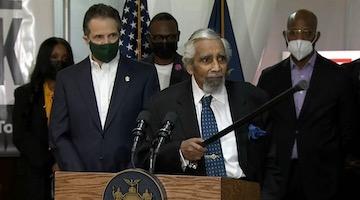 Black politicians shamelessly rallied to Cuomo, ridiculously comparing him to Emmett Till and the Central Park Five, in hopes that he will dispense patronage their way if he remains in of


