by BAR managing editor Bruce A. Dixon
The peaceful strike begun by inmates of several Georgia state prisons continued for a second day on Friday, according to family members of some of the participants. Copyrighted news stories by AP, the Atlanta Journal-Constitution and local TV stations in Macon and Atlanta quote state corrections who say several institutions were placed on lockdown beginning Thursday in anticipation of the inmate protest, on the initiative of wardens of those prisons.
GA Prisoner Strike Continues a Second Day, Corporate Media Mostly Ignores Them, Corrections Officials Decline Comment
by BAR managing editor Bruce A. Dixon
Offices of the wardens at Hay's, Macon State, Telfair, and Augusta state all referred our inquiries to the Department of Corrections public affairs officer, who so far has declined to return our repeated calls.
The prisoner strike in Georgia is unique, sources among inmates and their families say, because it includes not just black prisoners, but Latinos and whites too, a departure from the usual sharp racial divisions that exist behind prison walls. Inmate families and other sources claim that when thousands of prisoners remained in their cells Thursday, authorities responded with violence and intimidation. Tactical officers rampaged through Telfair State Prison destroying inmate personal effects and severely beating at least six prisoners. Inmates in Macon State Prison say authorities cut the prisoners' hot water, and at Telfair the administration shut off heat Thursday when daytime temperatures were in the 30s. Prisoners responded by screening their cells with blankets, keeping prison authorities from performing an accurate count, a crucial aspect of prison operations.
As of Friday, inmates at several prisons say they are committed to continuing the strike. “We are going to ride it,” the inmate press release quotes one, “till the wheels fall off. We want our human rights.”
The peaceful inmate strike is being led from within the prison. Some of those thought to be its leaders have been placed under close confinement.
The nine specific demands made by Georgia's striking prisoners in two press releases pointedly reflect many of the systemic failures of the U.S. regime of mass incarceration, and the utter disconnection of U.S. prisons from any notions of protecting or serving the public interest. Prisoners are demanding, in their own words, decent living conditions, adequate medical care and nutrition, educational and self-improvement opportunities, just parole decisions, just parole decisions, an end to cruel and unusual punishments, and better access to their families.
It's a fact that Georgia prisons skimp on medical care and nutrition behind the walls, and that in Georgia's prisons recreational facilities are non-existent, and there are no educational programs available beyond GED, with the exception of a single program that trains inmates to be Baptist ministers. Inmates know that upon their release they will have no more education than they did when they went in, and will be legally excluded from Pell Grants and most kinds of educational assistance, they and their families potentially locked into a disadvantaged economic status for life.
Despite the single biggest predictor of successful reintegration into society being sustained contact with family and community, Georgia's prison
authorities make visits and family contact needlessly difficult and expensive. Georgia no longer allows families to send funds via US postal money orders to inmates. It requires families to send money through J-Pay, a private company that rakes off nearly ten percent of all transfers. Telephone conversations between Georgia prisoners and their families are also a profit centers for another prison contractor, Global Tel-Link which extracts about $55 a month for a weekly 15 minute phone call from cash-strapped families. It's hard to imagine why the state cannot operate reliable payment and phone systems for inmates and their families with public employees at lower cost, except that this would put contractors, who probably make hefty contributions to local politicians out of business.
Besides being big business, prisons are public policy. The U.S. has less than five percent of the world's population, but accounts for almost a quarter of its prisoners. African Americans are one eighth this nation's population, but make up almost half the locked down. The nation's prison population increased more than 450% in a generation beginning about 1981. It wasn't about crime rates, because those went up, and then back down. It wasn't about rates of drug use, since African Americans have the same rates of drug use as whites and Latinos. Since the 1980s, the nation has undertaken a well-documented policy of mass incarceration, focused primarily though not exclusively on African Americans. The good news is that public policies are ultimately the responsibility of the public to alter, to change or do do away with. America's policy of mass incarceration is overdue for real and sustained public scrutiny. A movement has to be built on both sides of the walls that will demand an end to the prison industry and to the American policy of mass incarceration. That movement will have to be outside the Republican and Democratic parties. Both are responsible for building this system, and both rely on it to sustain their careers. The best Democrats could do on the 100 to 1 crack to powder cocaine disparity this year, with a black president in the White House and thumping majorities in the House and Senate was to reduce it to 18 to 1, and then only by lengthening the sentences for powder cocaine. On this issue, Democrats and Republicans are part of the problem, not the solution.
As this article goes to print Saturday morning, it's not known whether the strike will continue a third day. With prison officials not talking, and corporate media ignoring prisoners not just this week but every day, outlets like Black Agenda Report and the web site upon which you're reading this are among the chief means inmates and their families have of communicating with the public. The prisoners are asking the public to continue to call the Georgia Department of Corrections, and the individual prisons listed below to express concern for the welfare of the prisoners.
Prison is about corruption, power and isolation. You can help break the isolation by calling the wardens' offices at the following prisons. Prisons, naturally , are open Saturdays and Sundays too.
|
Macon State Prison is 478-472-3900.
|
Hays State Prison is at (706) 857-0400
|
|
Telfair State prison is 229-868-7721
|
Baldwin State Prison is at (478) 445- 5218
|
|
Valdosta State Prison is 229-333-7900
|
Smith State Prison is at (912) 654-5000
|
|
The Georgia Department of Corrections is at http://www.dcor.state.ga.us and their phone number is 478-992-5246
|
A Sunday update to this story will be posted at Black Agenda Report, about 9AM EST.
Bruce Dixon is managing editor at Black Agenda Report, and based in Marietta GA. Dixon is a member of the state committee of the GA Green party.

 Regime change is possible but not inevitable. Forces claiming to be leftist and claiming to be revolutionary must actually live up to the true meaning of those words.
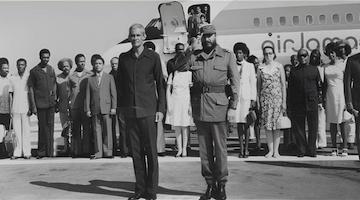 “If you can do that to Cuba because somebody doesn't like the Cuban revolution, then how do I know that you don't do that to me tomorrow?”
 There is no coherent and sustained leftist movement at the very moment that U.S. led global fascism is accelerating.
 Black Agenda Report Editor and Columnist, Ajamu Baraka, recently gave a presentation at the 4th International Conference “Palestine: The Nation’s Central Cause.”
 The US and Israeli war of aggression against Iran continues the ecocide committed against the people of the region.


