A Black Agenda Radio commentary by Glen Ford
The U.S. and Europe produce less and less of what the world wants, and will be eclipsed by Asia by the year 2030, according to America’s own National Intelligence Council. But the NATO allies account for 70 percent of the world’s military budget. The task between now and 2030, is to prevent the decaying powers “from holding the productive forces and nations of the world hostage by force of arms.”
China to be Number One in 2030 – But Who Will be Top Gun?
A Black Agenda Radio commentary by Glen Ford
“’There will not be any hegemonic power,’ on the planet.”
The United States National Intelligence Council, supposedly the best and brightest among America’s strategic analysts, predicts that China will surpass the U.S. already eclipsed
The question that remains unanswered is, What becomes of U.S. imperialism when America and its European allies are no longer the economic top dogs? How can the U.S. claim some kind of grand supervisory role in a world in which it is no longer the major player in the production of the goods and services that humanity wants and needs?
The National Intelligence Council’s report says that, by 2030, “There will not be any hegemonic power,” on the planet, and that “power will shift to networks and coalitions in a multipolar world.” The Council seems to betting on an alliance between the United States and China, which is described as the best-case situation for global security. If that is so, then why is Washington doing its damnedest to encircle and strangle China through proxy wars, gangster diplomacy and saber-rattling of all kinds? With 2030 right around the corner, one would think that it’s past time for the U.S. to making nice with the future center of the world.
“What becomes of U.S. imperialism when America and its European allies are no longer the economic top dogs?”
The report warns that the risk of civil wars and insurgencies will remain high in parts of sub-Saharan Africa, the Middle East and South Asia. That’s a no-brainer, since those are places where the U.S. military is busily bombing people and subverting every government that has not yet joined the American mafia, or that might come to an accommodation with rising economic players like China, India, and Brazil.
Conflicts in Latin America, on the other hand, are expected to decrease as we approach 2030. The real reason, however, for the relative peace that Latin America has enjoyed in recent years is that the hated “Washington Consensus” has been politically defeated in South America. Uncle Sam no longer has the moral, political or economic clout to plunge Latin Americans back into a state of war against themselves, for the benefit of U.S. corporations. The lesson is: with the decline of the United States, peace becomes possible.
But, there’s the catch. With the U.S. and Europe in irreversible economic decline, Washington, London and Paris grow more and more dependent on their militaries. The U.S. and its NATO allies account for 70 percent of the planet’s total military spending. If, as the National Intelligence Council report predicts, the U.S. and Europe are soon to become junior partners in the world economy, then they must also be prevented from holding the productive forces and nations of the world hostage by force of arms. The great project for humanity is to disarm the imperial beast, so that by 2030, or 2050, or however long it takes, the world can tackle the multitudinous crises that colonialism, racism and capitalism have brought upon us.
For Black Agenda Radio, I’m Glen Ford. On the web, go to BlackAgendaReport.com.
BAR executive editor Glen Ford can be contacted at Glen.Ford@BlackAgendaReport.com .

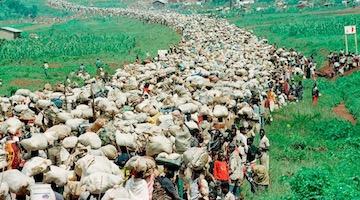 The real story of the Rwandan genocide begins in 1990, when exiled Tutsis from Uganda invaded northern Rwanda, unleashing a deadly campaign that uprooted a million Hutu peasants and set ethnic tens
 Northeast, midwest, southwest, south, down south, up south, out south—south of the Canadian border—Slouched down in his cruiser, slow-rollin’ the ‘hood; Or a-
 The new Democratic administration seems determined to sabotage an agreement to end the “longest war.”
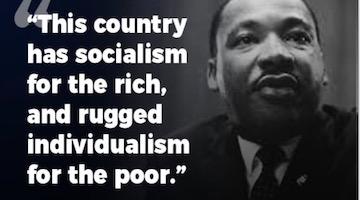 King explicitly linked the value of human dignity to the material conditions necessary to enable people to live a decent life.
 In "On Anarchism and Black Revolution" Peter James Hudson examines the historical roots of critiques of anarchism and its relationship to Black liberation movements.


