A Black Agenda Radio commentary by editor and columnist Jared Ball
The admittedly thrown-together film Black Power Mixtape provides some rare footage of the period, but is otherwise a lightweight. “Other than professor Robin Kelley’s short but powerful comments, the only interviewees representing today’s generation are the slightly more left-than-normal musicians like Talib Kweli, Questlove and Erykah Badu.”
The Black Power Mixtape Remix of Black Power
A Black Agenda Radio commentary by editor and columnist Jared Ball
“Those carrying on the ideological and programmatic work of the Black Power Movement seemingly do not exist.”
It would be difficult to argue that the filmmakers of the recently-released documentary Black Power Mixtape did not intend the irony that came with some concluding comments from singer Erykah Badu. Her point was that Black people had to document and tell their own stories or disappear. That these comments came at the end of a Swedish film about Black Power, a film that both inspires and frightens a Black radical sensibility, made those comments stand out even among the many powerful statements made by those captured in the film. The fact that in 2011 Black people still struggle to tell their own story and, most importantly, to tell the story of the Black radical tradition encumbers this Black Power Mixtape documentary in ways the filmmakers are perhaps ill-prepared to realize.
The film comes at a time when, says Dr. Quito Swan – author of Black Power in Bermuda (2009) – we are in a moment of heightened “commercialization of Black Power” which often “includes a ‘sanitizing’ of revolutionary, anti-capitalist elements of Black Power while alternatively linking the Movement to ‘master narratives’ of ‘Black progress.’ The Black Power Movement (BPM) has in some spaces been softened to a definition more akin to that of Richard Nixon’s than of Stokely Carmichael and in others it has been entombed as ancient history museum artifact as was the case a couple of years ago at the Smithsonian. The message is clear; while the Black Power Movement was too big then and too iconic today to be ignored, it must only be viewed as a relic of history not as a programmatic guide for improving the world today. Praise the movement in its time only. The ideas, strategies and tactics that once challenged the world and inspired millions are of no use in 2011 despite the fact that every single solitary thing those women and men fought to eradicate is still here and worse than ever.
“Those carrying on the ideological and programmatic work of the Black Power Movement seemingly do not exist.”
This is essentially the shortcoming of the film. Even the term “mixtape,” while probably inadvertent, is inappropriately applied. In an email communication with one of the film’s promoters I was told that this term was selected because the filmmakers, while working on a project about 1970s soul music, stumbled upon all of this Black Power footage and that the documentary features contemporary Black American musicians. But the mixtape, in the context of Black American history, has a specific relationship, origin and application – unlike any other – that is also lost in this discussion. The mixtape emerged as what is often described as the Black Power era came to an end. It was rap music’s original mass medium and served during its emergence in the 1970s as it does today as a site of anti-colonial music and journalistic content, a liberated mass medium for still-oppressed communities to express themselves. It is also a contested site in that it today suffers higher degrees of corporate co-optation where major companies use mixtapes to surreptitiously adorn themselves in the robes of the legitimating underground while actually promoting their own musical property.
The value of Black Power Mixtape, particularly in its rare footage of many of the era’s brightest leaders, is far outweighed by what has to be considered the film’s light or lazy research. For instance, why are there no contemporary interviews in the film with the political heirs of the Black Power Movement? The contemporary interviews with Angela Davis focus on her historical role as a Black Power era icon but say little of her current work or the relevance of her analysis in 1975 to 2011. Kwame Ture is similarly left in 1968 despite having lived another 30 years and leaving any number of admirers and members of his organization – still in existence – the All African People’s Revolutionary Party, none of whom are interviewed in the film. In fact, other than professor Robin Kelley’s short but powerful comments, the only interviewees representing today’s generation are the slightly more left-than-normal musicians like Talib Kweli, Questlove and Erykah Badu. Those carrying on the ideological and programmatic work of the Black Power Movement seemingly do not exist.
In the film a young Stokely Carmichael says that the assassination of Dr. King was the state’s “declaration of war against us.” But the question remains, even after a film about Black Power, “who called off that war and when?” The film, in its absence of attention to those still doing Black Power and those still incarcerated for having done Black Power, answers emphatically, that Black Power isn’t here now and apparently isn’t necessary.
For Black Agenda Radio I’m Jared Ball. On the web go to BlackAgendaReport.com.
Dr. Jared A. Ball is an associate professor of communication studies at Morgan State University in Baltimore and is the author of I Mix What I Like! A Mixtape Manifesto (AK Press). He can be found online at: IMIXWHATILIKE.COM.

 Over a year in advance, the Black Misleadership Class has kicked their efforts to corral Black people into the Democratic party, despite the Dems’ apathy toward Black politics or the concerns of…
 The US empire is continuing its psychological warfare campaign by conducting a mass mobilization of resources and waging a propaganda offensive to protect its interests in the Middle East.
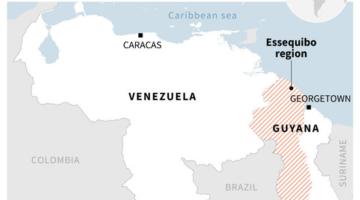 Despite the reality of US intervention causing inhumane conditions in the region, Venezuela’s push for the annexation of Guyana’s Essequibo region prioritizes its own political objectives,…
 Survivors open up about struggles with lingering post-traumatic stress disorder 18 years after the storm
 The high court in Nairobi will issue a ruling on a legal challenge to the deployment of 1,000 Kenyan police forces to Haiti as part of a “multinational force.” The US and UN-backed mission has been…


