by Bruce A. Dixon
"You have a large number of people who never heard of Charlie Houston. But you're going to hear about him. [T]hat man was the engineer of all of it... if you do it legally, Charlie Houston made it possible...." -- Thurgood Marshall
Barack Obama vs. the Legacy of Charles Hamilton Houston
A Black Agenda Radio Commentary by Bruce Dixon
"For masterminding the decades long legal battle to overturn segregation that culminated in the 1954 Brown vs. Board of Education decision, Charles Hamilton Houston became known as "the man who beat Jim Crow".
Barack Obama was the first African American president of the Harvard Law Review. But Harvard Law selected its first black editor more than seventy years earlier in the mid-1920s. That brother was Charles Hamilton Houston. But Houston and Obama have much more in common than their prestigious Harvard Law degrees.
Observing the violence and abuse heaped upon black people while he was an army lieutenant in World War 1, Houston devoted his life to fighting for the legal and human rights of African Americans. He became dean of Howard University Law School, where he trained and mentored a generation of civil rights lawyers including Thurgood Marshall himself. He taught young lawyers that an attorney is either an engineer for social change or a parasite upon society. Houston and Marshall, who later became the first black justice of the Supreme Court crisscrossed the country, especially the South, defending hundreds of poor blacks accused of murder and other crimes, challenging racial injustice and Jim Crow laws in education and public accommodation from sleepy rural courthouses to the Supreme Court. For masterminding the decades long legal battle to overturn segregation that culminated in the 1954 Brown vs. Board of Education decision, Charles Hamilton Houston became known as "the man who beat Jim Crow".
What Charlie Houston and Barack Obama have in common, besides their leadership at the Harvard law Review is their involvement with legalized segregation in American life. While Charles Hamilton Houston spent his entire career fighting to end legal segregation in American life, Barack Obama, in his first 2 years on the Senate Judiciary Committee, by declining to fight, filibuster or meaningfully oppose judicial thugs, neo-segregationists and members of the ultra right wing Federalist Society from appointment to the Supreme Court, may have already undone a large part of Charlie Houston's legacy.
"Obama, in his first 2 years on the Senate Judiciary Committee... may have already undone a large part of Charlie Houston's legacy."
It's popular among American whites these days to declare that they "just don't see race." This is of course an expression of white privilege, since only whites in America have the luxury of such selective blindness. Black and brown people, profiled, pre-judged and and selectively policed, are not permitted to forget who, what and where they are. Since its December 4 oral arguments in a case designed to undo the historic 1954 ruling against legal segregation, the court, its majority decisively tipped by the two right wing judges Obama failed to vigorously oppose, appears poised next year to enact a prohibition against "seeing race" into law, initially in any proposed remedies to unlawful segregation. Inevitably even gathering or sharing of data that might reveal the presence of unlawful segregation or discrimination may be prohibited.
Charlie Houston, died in 1950, a full decade before Senator Obama was born. The legacy of his 3 decades of legal struggle for human rights was the end of Jim Crow. The unraveling of that legacy with no meaningful opposition on the part of the only black senator is the fruit of Barack Obama's first two years on the Judiciary Committee. Charlie Houston is turning over in his grave. We can only imagine what is yet to come.
For Black Agenda Radio, I'm Bruce Dixon.
|
The audio for this Black Agenda Radio commentary is no longer available.
|

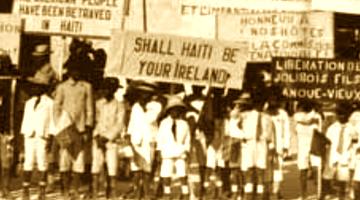 A 1930 essay by Black activist Hermina Dumont Huiswood tells of the bold resistance of the Haitian population to U.S. occupation, and offers hope for the resistance to come in 2024.
 African Stream is an anti-war, anti-imperialist video and text website based in Nairobi, Kenya. Ann Garrison spoke to its founder, Ahmed Kaballo.
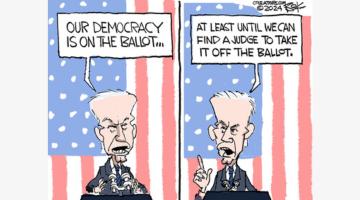 "When bagman Vigor Moribund came to town" is the latest from BAR's Poet-in-Residence.
 Book Forum Editor, Roberto Sirvent, interviews Onyesonwu Chatoyer about her political organizing and work as a writer and editor.
 New York Democrats are fueling the panic over a fictional crime wave to increase surveillance and police presence in NYC.


