Bruce Levine’s “Thaddeus Stevens: Civil War Revolutionary, Fighter for Racial Justice“
Rep Thaddeus Stevens was an unyielding proponent of the nationalization of the large southern plantations and the redistribution of that land to Black people.
“It was clear to Stevens that the North could not win the war against the slave owners without the participation of former slaves.”
The Civil War (1861-65) and the Reconstruction period which followed it is considered to be the second American revolution. The slave owning planter class in the South was defeated, at least for a while. Slave labor was abolished, but came back in other forms after Reconstruction was crushed in 1877.
The promise of the 1776 Declaration of Independence that all men are equal before the law was fulfilled, somewhat, and at least for a while. Pennsylvania Congressman Thaddeus Stevens was the foremost anti-slavery advocate in that struggle, even more so than Abraham Lincoln. Stevens helped to bring about the destruction of slavery and was the leader in the effort during Reconstruction to make the United States a biracial democracy. This wise and eloquent revolutionary has been vilified and rendered rendered obscure since he died 153 years ago. This is so because, as Karl Marx observed, for most of human history the ideology of the ruling class is the ruling ideology. In the case of America, the ruling ideology was racist and reactionary. The distinguished historian Bruce Levine in his just published biography of Stevens “Thaddeus Stevens: Civil War Revolutionary, Fighter for Racial Justice” (308 pages, Simon and Schuster) has secured a place for him alongside his contemporary John Brown in the pantheon of American revolutionary figures. His beautifully written book is a significant contribution in this regard and deserves widespread public recognition.
“Stevens helped to bring about the destruction of slavery and was the leader in the effort during Reconstruction to make the United States a biracial democracy.”
Stevens, like Abraham Lincoln, was a very successful lawyer. He was from Vermont but moved and practiced in Lancaster County in southern Pennsylvania. He served as a congressman from Pennsylvania and was a leading abolitionist beginning in the 1830s.
His political values and morals were shaped by his Vermont upbringing and his mother’s Baptist faith. Unlike New York, Vermont was not dominated by an elite landholding class which presided over estates the size of counties. Vermonters were democratically minded small farmers and small businessmen. Steven‘s mother, a religious Baptist, had the values of the Protestant revolution of 17th century England which overthrew the monarchy there.
The Civil War commenced while Stevens was in Congress. Troops in South Carolina fired on federal Fort Sumter whereupon the southern slave states seceded from the Union declaring themselves a separate country. President Lincoln‘s initial priority in response to this was not to advocate for abolition of slavery but to go to war to keep the Union together.
It was clear to Stevens that the North could not win the war against the slave owners without the participation of former slaves. He pushed Lincoln, who came to realize this and took measures to allow former Black slaves into the Union army. One-eighth of that army was eventually made up of Black men. They made the difference, fiercely fighting for their own freedom and carrying the North to victory.
“It was clear to Stevens that the North could not win the war against the slave owners without the participation of former slaves.”
Stevens believed that in order to have true democracy what was needed was at least a measure of economic democracy. He pushed for the nationalization of the large southern plantations and the redistribution of that land to Black people. This was popularized in the slogan “40 acres and a mule.“
The granting of land to former slaves was actually accomplished in some places, but then reversed with the ending of Reconstruction.
Along with Donald Trump, Andrew Johnson is considered the worst president ever inflicted on the American people. He was Lincoln’s vice-president and ascended to the presidency in 1865 when Lincoln was assassinated. Johnson, a former slave owner from Tennessee, did everything in his power to obstruct Reconstruction.
Stevens led the fight against Johnson. He organized an impeachment trial which failed by one vote. This was a turning point in American history.
“Andrew Johnson is considered the worst president ever inflicted on the American people.”
However incomplete, The Civil War and Reconstruction was a second American revolution. But even if Reconstruction had been successful what now needs to be accomplished to have true equality in the United States is a third American revolution. an anti-capitalist one where the slavery of having to work for wages, pitted against fellow workers, where the wealth of society is in the private hands of the 1% will give way to a society whose wealth is collectively owned and democratically controlled.
Bruce Levine‘s book is remarkably timely given the upsurge of seven 20 million people led by Blacks in the streets in June of last year. It is inspiring and Instructional. Like John Brown, the soul of Thaddeus Stevens goes marching on.
Michael Steven Smith is the co-host of the radio show Law and Disorder and on the Board of the Center for Constitutional Rights.
COMMENTS?
Please join the conversation on Black Agenda Report's Facebook page at http://facebook.com/blackagendareport
Or, you can comment by emailing us at comments@blackagendareport.com




 A one-year-old baby was shot dead by police, but corporate media shield the police and their barbaric actions with a passive voice.
 Gaza proposals obtained by Drop Site show Trump’s board attempting to force a Palestinian surrender that Israel could not achieve in war.
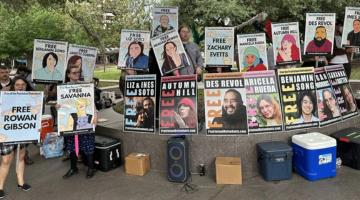 Anti-ICE activists received lengthy prison terms — including a 100-year sentence — in the first major trial of the NSPM-7 era.
 In this week’s segment, we discuss the increase in racist mob violence against Black and brown immigrants in Britain. First, we have a discussion of housing policy in New York, and why low and…
 Many apartments in New York City are protected by rent regulations which determine how much rent can be charged and how much increases, if any, can be.


