BAR Book Forum: Joshua Myers’ Book, “Cedric Robinson: The Time of the Black Radical Tradition”
In this series, we ask acclaimed authors to answer five questions about their book. This week’s featured author is Joshua Myers. Myers is an Associate Professor of Africana Studies in the Department of Afro-American Studies at Howard University. His book is Cedric Robinson: The Time of the Black Radical Tradition.
Roberto Sirvent: How can your book help BAR readers understand the current political and social climate?
Joshua Myers: I think the current political and social climate is the product of something more entrenched than even the categories of “social” and “political” can fully reveal. Cedric Robinson’s work has taught us that what passes as the social and political order is rooted historically and philosophically in conceptual and material processes that necessarily produce this climate, or The Weather, to use Christina Sharpe’s term. Said another way, the crises we see in today’s climate are inherent to the very idea and construction of the social and political systems and the ways that they have been updated or adapted to fit the requirements of capitalism and imperialism over the last several centuries. To render human life and movement through market logics is to produce a crisis and a climate that makes the entire planet vulnerable—even as billionaires attempt to spread these logics throughout the universe. In my book, I try to arrive at something of an understanding of how Cedric Robinson wrote about these larger questions, so we can see that the climate at any given point (i.e. “today), is not simply a temporary blip in an otherwise perfectible system and way of being in the world. We will have to think with the social and the political, but only in order to think a world beyond them.
What do you hope activists and community organizers will take away from reading your book?
The urgency of organizing, it seems, never ceases. There is always something. We must ensure that we are always prepared to allow those elements of resistance to shape who and what we organize for. In the book, I write about Cedric Robinson’s life, which began as an organizer, and it was that organizing that directly led to the theoretical work that he would accomplish as a scholar. Though I believe that the distinctions drawn between theory and praxis reflect a Western philosophical conception that has done harm, I also believe that too often we repeat or reify that notion when it comes to thinking Black radicalism. Robinson’s life can help us break out of that if we listen closely. The organizing never stopped. Neither did the thinking. The urgency of organizing can never justify the absence of thinking through who we must be as part of an expansive notion of the Black Radical tradition. Ultimately, Robinson was after—and we must continue to be after— a kind of excavation of human consciousness as the most important form of resisting the forces of racial capitalism and the various evils it spawned. If we can know more about who we were in relationship to what the structures of oppression imagine us to be, we can know more about who we must be now, and what we must be now. For that question is what animates the spirit of movement and resistance.
We know readers will learn a lot from your book, but what do you hope readers will un-learn? In other words, is there a particular ideology you’re hoping to dismantle?
Given the prominence of Cedric Robinson’s name in the past five or six years, I hope that readers will un-learn that he was far more than one or two chapters of his most well-known book, Black Marxism. I hope that readers will un-learn that one’s embrace of his work must forever and always hinge on their acceptance of the premise of those one or two chapters. Because Black Marxism itself comes out of a context that is important to understand. At the same time, that work is both more than that context and that work is more than just that book. Once we get beyond the singularity of Robinson as theorist of racial capitalism or Robinson as coiner of this or that term, we can actually embrace the spirit of the thing animating his work. It is not a theoretical intervention that drew me to his work, it was a relation to our people’s lives and struggles. Black life is full and in the pages of Robinson’s work we sense and feel that fullness. This may be a hard sell for many, but that’s what I wanted to accomplish in this text. It would have been easy to write a treatise challenging all the misconceptions—for there are many—and I fall into that trap at certain points in the text. But behind every misconception is a conception. And if we would only get at that…
Who are the intellectual heroes that inspire your work?
Well, Cedric Robinson, of course. In the end, Cedric Robinson, the person became more important for me to understand, because his sense of generosity and openness is reflected in the spiritual embrace of Black radicalism that is present in the work. So I could not really feel my way through the writing without that presence in my mind and heart. The writing in fact flowed more easily when I relinquished the academic form and posture of representation and evidence and just gave myself the freedom to be open to what I heard him saying. If we are not doing this in Black Studies, we end up missing a lot. So that inspiration is there. And because it is there, the work does not always center him. He would not have centered himself. In fact, the whole notion of centering anything becomes fraught. But what is foremost is the tradition. I think of the 2006 Nas record, “Carry on Tradition,” where he writes in the hook “when you rep what we rep/then carry on tradition.” It’s a perfect reading of the task of knowing what we are and whose we are and what to do. We are only the carriers. An important and essential job, but not more important than the thing being carried.
In what way does your book help us imagine new worlds?
The anti-Blackness we fight against every day is the world as is. It is the world as it was constructed over the past several centuries. It is the feature, not a bug. No matter how many times we repeat this, it does not seem to always register to those who think that certain modes of repair or revolution are in effect attacking the feature, when in their conceptions they cannot. So, enter Cedric Robinson. His work is really about those alternative conceptions—alternative to Western thought and alternatives within Western thought—that explode the master narratives that gave salience to the category of “ideology.” It is in those alternative conceptions where human consciousness resides. It is in those alternative conceptions where the true imagination of a new world will reside. Any program for true revolutionary change must then reside there. And for Black folk, it must presage what Robinson called “the oneness” which animated every struggle we have participated in; every iteration of the Black Radical tradition has been about becoming one, knowing that without each other we are incomplete. Without each other, the new world we might imagine is incomplete. My book is an attempt to think through some of that imagining with Robinson as guide.
Roberto Sirvent is editor of the Black Agenda Report Book Forum.



 The recent report by the U.S. fascist state attacking Cuba and its allies serves as a glaring call for urgent and strategic unity among the broadest sectors of the U.S. left, and all people of…
 Nicaraguan President Daniel Ortega stated that when the country's next elections take place, none who promoted a violent anti-government insurrection in 2018 will be allowed to stand for office.…
 "Israel and Washington use Ceuta and Melilla to attack Spain for naming the genocide in Gaza. The enclaves are colonial relics. But the powers now raising the issue have no concern for African or…
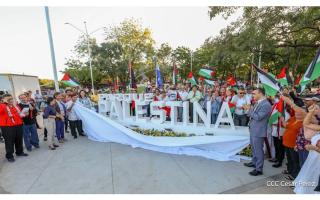 Against the backdrop of Israel’s renewed attacks on Palestine, the World Court is set to hold public hearings in September on Nicaragua’s legal proceedings against Germany for aiding and abetting…
 In this week’s segment, we talk to Kshama Sawant, a socialist congressional candidate in Washington state, but we begin with a discussion of the Trump administration’s red scare and state repressio


