by Mark P. Fancher
Ever since NATO’s 2011 regime change in Libya, the U.S. military command, AFRICOM, has had free rein in most of the continent. Boko Haram “terrorism” provides an excuse to intervene, but AFRICOM’s real aim is to secure U.S. control of African economic resources. “It took only the suggestion of potential oil reserves to inspire a U.S. military plan for the success of the oil exploration efforts of the Nigerian government” in the Lake Chad region.
The AFRICOM Snake Slithers into the Lake Chad Basin
by Mark P. Fancher
“Why is AFRICOM meddling in the region when it is neither a home-grown African army nor an organization that specializes in providing the type of humanitarian assistance the Lake Chad Basin needs?”
In April, “Unified Focus 2017,” a special training exercise created by U.S. Africa Command (AFRICOM), will mobilize representatives of various military forces to plan for the protection of the Lake Chad Basin. This region is where national boundaries for Nigeria, Chad and Niger meet. A senior Cameroonian military official explained: “It’s a multinational effort led by the United States to fight terrorism, especially against Boko Haram.”
The participation of Cameroon, Benin, Chad, Niger, and Nigeria in this military exercise is -- in a very confused, misguided way -- logical. But why, in all of its arrogant glory is the United States leading this? While we’re at it, what could possibly motivate the United Kingdom, the Netherlands and Italy to also be involved?
For decades, Africa’s freedom fighters have demanded independence and self-determination for the continent. Yet, there has been a stubborn tradition of western meddling and interference manifested most clearly in the final days of 1884 when representatives of European countries met in Berlin. In much the same way birthday cake is served, these colonizers carved out and distributed among themselves big pieces of African territory. Yet again in 2017, western countries are meeting to make plans for Africa, but this time the focus is on the discrete region of the Lake Chad Basin.
Terrorism has been a problem for the Lake Chad Basin, and the issue has not escaped the attention of the United Nations. U.N. officials say multi-national counterinsurgency efforts have made gains against Boko Haram, but the group remains a threat to civilians in the region. It is noteworthy however that notwithstanding the military strategy to be developed by AFRICOM, the U.N. has concluded armed forces will not solve the Lake Chad Basin’s problems.
A U.N. official explained: “A military approach will not bring an end to Boko Haram.” He said the terrorist group’s activities occur in areas where there is extreme poverty, income and social inequality, and the absence of stable government. Another U.N. official said: “Now is the time to act decisively to expand humanitarian assistance and protection as well as basic services, and thus lay the groundwork for early recovery and reconstruction.”
“The U.N. has concluded armed forces will not solve the Lake Chad Basin’s problems.”
AFRICOM has paid lip service to these U.N. experts and others by acknowledging: “The effort to counter Boko Haram’s extremism is not a military only fight. Military has the first part, the security solution, but there are many other organizations involved in the effort.” This begs the question of why AFRICOM, which is first and foremost a military command, is meddling in that region when it is neither a home-grown African army nor an organization that specializes in providing the type of humanitarian assistance the Lake Chad Basin needs? The answer is found in one word- oil.
When the subject is West African oil, it is the Niger Delta, and not the Lake Chad Basin that usually comes to mind. But the Niger Delta has been the scene of unending controversy and conflict. The interest in an alternative oil supply led the Nigerian government and others connected with the oil industry to take a hard look at the Lake Chad Basin. Although the Lake Chad Basin has been the focus of irregular and inconsistent oil exploration for the past three decades, the Nigerian government in particular is motivated to begin more focused efforts.
A Nigerian oil industry publication explains that the new exploration: “…is aimed at building up the nation’s depleting proven oil reserves…” It also notes the country’s plan to increase its oil reserves to 40 billion barrels by 2020. “Besides building up the country’s oil reserve, another reason for the push for oil discovery in the Chad Basin is discoveries made in neighboring countries in basins with similar structural settings with Nigeria.”
An Economic Confidential commentary notes: “If the area does in fact hold accessible reserves, however, the find must be considered within the context of the country’s political and security dynamics...” The article goes on to say: “…any company involved in extraction will face considerable security threats. The vast infrastructure networks on which oil and gas industries are dependent provide attractive targets for militants, and are virtually impossible to secure entirely.” Enter AFRICOM. It took only the suggestion of potential oil reserves to inspire a U.S. military plan for the success of the oil exploration efforts of the Nigerian government. Thanks to AFRICOM, when oil is located by the Nigerians, western oil companies will be right there to get in on the action – or maybe even take total control.
Western imperialists have an established tradition of meeting to decide the fate of Africa. AFRICOM’s meddling and intervention highlight the fact that long overdue are the meetings by Africans to decide not only to purge imperialists from Africa, but to also decide the particulars of when and by what means that will happen.
Mark P. Fancher is an attorney who writes frequently about the U.S. military presence in Africa. He can be contacted at mfancher@comcast.net.

 The 55th anniversary of the Newark, New Jersey rebellion, how the child welfare system damages Black children and families, and how the United Nations creates suffering in Haiti.
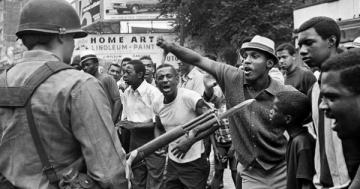 On July 12, 1967, a five-day long rebellion took place in Newark, New Jersey. We speak to Larry Hamm, President of the Newark based Peoples Organization for Progress, which is commemorating the…
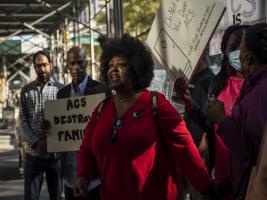 Joyce McMillan is the founder of JMacForFamilies, which works to abolish the current punitive child welfare system and to strengthen the systems of supports that keep families and communities…
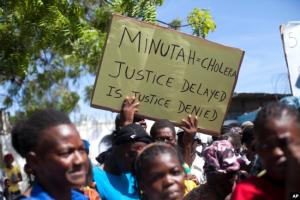 The United Nations Security Council is discussing whether to extend or to end its mandate over Haiti. The vote was delayed as requested by China, a permanent member of the Security Council. Far from…
 Danny Haiphong and Margaret Kimberley discuss recent BAR articles, Protesting for Jayland Walker and


