The lexicon of abolition has taken a reformist turn and has been seized by liberal-left commentators, writers, and a certain activist class to suggest that the capitalist state model can be convinced to “abolish” its domestic decentralized army that maintains its very power over the masses of people.
Originally published by Community Movement Builders.
In deciding to suggest abolition can be achieved by an attack on the institutions of the state while leaving the state in place creates a cognitive dissonance on why the police were created in the first place. The lexicon of abolition has taken a reformist turn and has been seized by liberal-left commentators, writers, and a certain activist class to suggest that the capitalist state model can be convinced to “abolish” its domestic decentralized army that maintains its very power over the masses of people, who, at different historic times, has shown its willingness when collectively angered to fight back against both state and capitalist institutions. Short of the national guard, and the Federal Bureau of Investigation, it is local policing that enforces the law, i.e., the rule of the capitalist class through the political system that answers to its needs.
The idea behind radical abolition as a revolutionary ideology aimed at the capitalist state as an institution has been mainstreamed as an expression of challenging the institutions that the capitalist state created for its survival. This new understanding of left abolition leaves out the actual function of the police in the hands of the state and the capitalist elite. The role of police as the front-line soldiers in controlling the masses, warehousing surplus labor, controlling the movement of Black people and the protection of private property is downgraded in conversations about abolition. What is left is an attempt to garner liberal sympathies on the “abuses” of the police and criminal justice system that attributes police killings, mass arrest, incarceration, and harassment as an excess as opposed to a purpose.
Reform activists are putting forth the idea that the police as an institution can’t be reformed, which is correct, but that the state capitalist system will see the light of this idea and move to abolish the police, which is not only incorrect but a dangerous assumption on what the state’s role is vis-à-vis Black people and other working-class and poor people. Having an overarching focus on reforming state institutions, while the state that created the structure remains untouched, is another “Alinksy” style single-issue organizing campaign strategy that removes race, class, and politics in an attempt to win reform without substance. Here, reform that the state will never and can’t accept if it is to maintain its rule over the general populace.
In this idealistic scenario, we look at the “abolition” of the chattel enslavement of Africans as a model of what successful abolition looks like. We ignore the replacement of slave labor with wage labor and sharecropping; the purposeful caveat carved out in the 13th amendment that led to black codes and prison convict leasing. The continued control over a once captive population through terror, cross burnings, lynching and Jim Crow laws. This all meant that the state was not about abolition or reform, but a shifting of how both a system of economic and physical control would be maintained. The “evolution” of slave patrols into police systems was a natural way to keep those systems going while liberals got to uplift the banner of abolition and reform while also maintaining their dominant position in society.
Today’s liberal class (which now includes larger amounts of Black people, people of color, women, and LGBTQ communities) of activists, writers, and commentators have now joined this struggle of maintaining a level of class elevation while seemingly calling for change that the capitalist state will either ignore or create its own replacement narrative to continue to empower the police. We have seen that during times of upheaval; city governments in liberal cities have increased pay for the police and have provided plenty of overtime to move resistance efforts off the street. When the pressure has subsided, the response has been to openly support the police by creating narratives of police victimization and a need for them based on crime statistics increasing. From this, the calling for higher police budgets for the police, although no correlation has ever existed between more police and a change in so-called crimes statistics. But, as we know, none is needed.
Where city governing institutions in semi-liberal city administrations take on the idealistic goal of “defunding” or “abolition” what we will get is a new state institution with a different name that serves the same purpose of control over the population. This allows for a left-liberal class to claim a victory and additional funding by not pointing out that it is not the police that needs abolishing but the very capitalist class and state that control and resource the police and the liberal class that bargains on the margin. This positioning further strengthens the state institutions because it centers them in the battle for reform and as the arbitrator of how to proceed forward. Without the pressure of creating autonomous zones or liberated territory that creates dual power while challenging institutions, the state will continue to have a monopoly on how and who gets to implement reform, real or imagined.
Without expanded understanding and or strategy, even in reformist campaigns that clearly understands and speaks to the role of the police as a military arm of a corrupt capitalist state as opposed to a “crime-fighting force” that has lost its way, little progress toward a stated goal of abolition will be made. The US capitalist state created the police to serve the purpose of keeping control over the masses of people. That same state depends on this force for its very existence. It will never have the compulsion to abolish itself out of existence.
Community Movement Builders (CMB) is a member-based collective of Black people dedicated to being a force for creating sustainable self-determining communities through cooperative economic advancement and collective community organizing. Our mission is rooted in Black love and equity. Grassroots Thinking is our newsletter/community blog about our work and movement activity.

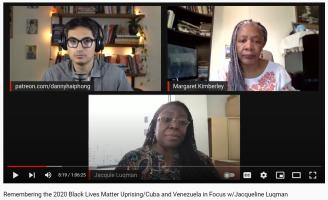 Journalist and activist Jacqueline Luqman joins the Left Lens to discuss the two year anniversary of the BLM uprisings and her recent trips to Cuba and Venezuela.
 The UK sends asylum seekers to Rwanda, the number of police killings in the U.S. continue unabated, and the Democratic Republic of Congo is threatened by U.S. client states and comprador, neo-…
 The United Kingdom is paying the Rwandan government $150 million to accept asylum seekers. The UK is accelerating deportations and denial of legal rights to Global South immigrants. Fiona of the…
 Police killings continue at a rate of more than 1,000 per year in the U.S., with 2022 numbers outpacing those of 2021. Sam Simyangwe of Mapping Police Violence provides analysis of the death toll and…
 The Democratic Republic of Congo lives under threat of attack from neighboring U.S. client states Rwanda and Uganda. Its neo-colonial leadership acts on the direction of Washington and Europe.…


