Solidarity with Palestine tests morality, but solidarity with Venezuela tests politics. The recent U.S. intervention demands a radical left moving from moral outrage to a material confrontation with its own state.
Palestine is the moral heart of global anti-colonial politics. It exposes the brutality of settler colonialism in its most naked form: land theft, ethnic cleansing, military occupation, and white supremacist domination. For many on the left, solidarity with Palestine has become a defining ethical commitment. But while Palestine functions as a moral litmus test for individuals and organizations across the political terrain from left to right, Venezuela is a structural and political one.
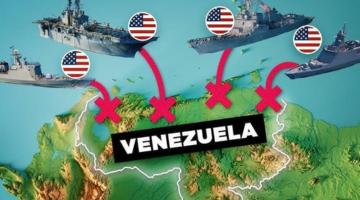
Recent events in Venezuela have dramatically escalated the stakes of anti-imperialist politics in a way that cannot be ignored. On January 3, 2026, the United States launched a large-scale military operation with the objective of kidnapping Venezuelan President Nicolás Maduro and his wife and transporting them back to the United States to face federal charges. This marks a decisive escalation in the forms of subversion and interventionist tactics that have characterized U.S. interventions in recent decades.
It also became a game-changer for radical politics inside the empire. The turn toward overt military force and the forcible removal of a sitting head of state signals a return to the raw practice of colonial domination — a form of power not seen so explicitly since the 2004 removal of Haitian President Jean-Bertrand Aristide by the George W. Bush administration.
The Empire has dropped the mask.
The question now is whether the left will continue to speak in the language of “liberal critique” and “class collaboration,” or whether it will finally confront bipartisan-supported imperial power in its most direct and unapologetic form.
Venezuela is the issue where anti-imperialism stops being a slogan and becomes a confrontation with one’s own state. It is therefore also the issue where U.S.-based radicals should unapologetically affirm Venezuela’s right to self-determination and openly oppose the U.S. imperial project in Venezuela. If they are not prepared to do this, it demonstrates unequivocally that their radicalism was never serious — that it was always symbolic and selective, which made it ultimately safe for the empire.
The Venezuela situation also reveals another now-normalized feature of “left” politics: the divergence between a left that is formally anti-imperialist and a liberal/left that remains fundamentally U.S.-centric and social imperialist. When this current turns to international events — especially cases of U.S. intervention — its position is shaped less by opposition to imperialism than by its assessment of the internal character of the targeted state. The legitimacy of intervention is thus implicitly judged according to whether the society under attack conforms to what amounts to Western “liberal” expectations and not the conditions and imperatives of revolutionary social transformation.
In practice, the actually existing efforts at socialist-oriented economic, social, and political development are almost always deemed inadequate, flawed, or authoritarian. This judgment then becomes the pretext for withholding solidarity. The predictable result is that these “left” forces find themselves aligned with U.S. imperialism in both analysis and effect, even as they insist that their position is informed by a “left” critique.
This is not a minor theoretical error but a political failure. It subordinates the principle of self-determination to ideological gatekeeping, and it replaces solidarity with conditional approval. In doing so, it converts anti-imperialism into a posture rather than a commitment — a language that can coexist comfortably with empire so long as empire speaks in the idiom of liberal democratic reformism and white saviorism!
Examples of this approach have emerged since the kidnapping of Maduro and his wife where sections of the collaborative left adopt the language and assumptions of U.S. policy makers about Venezuela — condemning Nicolás Maduro’s personality, legitimacy, or policies — but then attempt to separate those “left” condemnations from the brutal consequences of imperial intervention.
The first example is the familiar move: “I oppose U.S. intervention, but Maduro is an authoritarian who brought this on himself.” This framing accepts Washington’s narrative that Venezuela’s crisis is primarily the product of internal leadership failure rather than external economic warfare, sanctions, and destabilization. By centering Maduro’s alleged illegitimacy, this position reproduces the moral logic that makes intervention appear reasonable, even if the speaker claims to oppose the intervention itself. This position turns anti-imperialism into a procedural objection rather than a principled one — objecting to methods while accepting the white supremacist, colonialist premise that the U.S. has the authority to judge and discipline other societies.
The second example is the appeal to “human rights” as a neutral justification: “The U.S. shouldn’t intervene militarily, but something must be done about human rights abuses in Venezuela.” This treats human rights discourse as politically innocent, ignoring its long history as an imperial instrument used selectively against disobedient states and never against compliant ones. This framing erases the massive human rights violations produced by sanctions, economic strangulation, and political isolation — forms of violence that are invisible precisely because they are bureaucratic.
In both cases, the liberal/left position preserves U.S. moral authority while disavowing U.S. violence. This is not a contradiction but a function: it allows empire to operate with legitimacy. By accepting imperial categories and merely disputing their execution, the liberal/left becomes not an opponent of empire but one of its most useful managers.
The kidnapping of President Maduro is not simply another foreign-policy episode but a textbook case of imperial domination. In the present international context of imperial lawlessness — characterized by a form of global fascism led by the United States — it signals that these methods will be used again to attack and assert control over other sovereign nations.
Venezuela thus remains the linchpin for an authentic radical left precisely because it tests whether anti-imperialism is a principle or merely a fashionable posture. This moment demands that those committed to justice confront not only the moral obscenity of settler colonialism in Palestine but also the raw mechanisms of material power deployed abroad and domestically by their own state. Opposing empire only when it is directed at states that meet the Western left’s criteria for deserving solidarity will always fail, because such “perfect” states do not exist in reality. This logic explains how the U.S. “left” can normalize anti-anti-imperialism while continuing to present itself as radical.
“Actually existing,” concrete national projects of social transformation will always be imperfect. If the standard for solidarity is grounded in fantasies of Bernsteinian peaceful “democratic” transitions in a neocolonial context or even more idealist visions in core imperialist societies like the U.S., in which state power is seized on Friday and society becomes stateless and self-managed by local peoples’ assemblies by Monday, then no real struggle will ever qualify. These expectations function less as political standards than as mechanisms for disqualification.
The birth of new societies and their development within a disintegrating global capitalist order — and in the face of an international bourgeoisie committed to violent state terrorism and subversion to maintain Western white supremacist imperial power — constitute the objective conditions that shape the politics of those societies and should inform anti-imperialist politics in the metropoles.
Only by naming and opposing the full spectrum of imperial violence — from financial warfare to overt military conquest — can a radical left aspire to be consistent and consequential in the objective conditions we find ourselves in.
Venezuela’s struggle today lays bare the essential question: Do we oppose oppression only as distant abstractions, or do we confront empire at its most aggressive and normalized expressions?
Opposing empire in Venezuela is critical because the Venezuelan experiment at national survival with the lessons it has learned was beginning to expose the fact that even with “maximum pressure,” the possibility of an alternative political and economic trajectory outside neoliberal capitalism and U.S. hemispheric dominance was possible.
Venezuela’s ability to sell its oil, even at a diminished level after years of sanctions that resulted in its inability to reinvest in critical infrastructure, represented a critical win for its people and for all states that possessed critical resources. Its successful attempts to trade oil outside the dollar system — including in Chinese currency or digital alternatives — are significant not mainly because they threaten U.S. energy security, but because they undermine U.S. financial and geopolitical control. The real concern is the precedent: that a major resource-holding state can defy U.S. authority, weaken dollar-based systems, and still survive. The issue is thus about maintaining hegemony, not just securing fuel.
Palestine reveals the moral horror of settler-colonial domination, while Venezuela reveals the operational logic of contemporary empire abroad and in its’ domestic politics. If radical politics cannot confront that logic at its source — in the policies of the U.S. state itself — then it risks becoming a politics of outrage without consequence. Venezuela is the linchpin not because it is more important than Palestine, but because it tests whether the left is willing to oppose empire where it is most normalized, most respectable, and for some, most difficult to name.
For many U.S. radicals, this will be very difficult because the price might be too high. Unequivocal support for Venezuelan self-determination means defending a state targeted by your own ruling class, being accused of supporting “authoritarianism,” a charge that functions as an ideological weapon to discipline dissent that will result in losing access to mainstream legitimacy.
This is precisely why Venezuela is the site where left politics becomes dangerous, subversive and its practitioners materially punished — which is exactly why it is the real test of radicalism.
The charge of repression coming from a state in the grip of neofascist consolidation and a liberal/left represented by “progressives” such as Bernie Sanders and Zohran Mamdani – who will not only condemn the Bolivarian process but the revolutionary people and process of Cuba – illustrates perfectly the rightist convergence of the fascist state and the social democratic managerial “left.”
Venezuela’s Bolivarian project cannot be explained by the simplistic focus on supposed internal dysfunction and authoritarianism but by its geopolitical disobedience — the refusal to submit to the U.S. assertion of the Monroe Doctrine and the global neoliberal order. For the imperialist white supremacist policymakers, that refusal had to be punished through economic suffocation and political destabilization.
Yet, Venezuela’s ability to survive, to demonstrate that it could exist outside of the structures dominated by international capitalist financial institutions, ironically posed an existential threat to U.S. hegemony not only because it was uniquely dangerous, but because it could be contagious.
Ajamu Baraka is an editor and contributing columnist for the Black Agenda Report. He is the Director of the North-South Project for People(s)-Centered Human Rights and serves on the Executive Committee of the U.S. Peace Council and leadership body of the U.S.-based United National Anti-War Coalition (UNAC).

 “Between October 2 and October 8, 1937, between 15,000 and 40,000 Haitians and Black Dominicans were slaughtered by Dominican troops…”
 Ethiopia and Eritrea are on the brink of a war that could further destabilize the Red Sea, disrupt oil tanker traffic, and drive gas prices even higher.
 The UN's renewal of the Gang Suppression Force mandate is part of a wider hemispheric project to reassert military control across the Americas. Caribbean leaders cannot claim to support a Zone of…
 The Islamic Revolutionary Guard Corps (IRGC) has issued a letter addressed to the American people, outlining its views on recent developments and Iran-U.S. relations.
 The Trump administration's new sanctions on Cuba, are part of a dual strategy to create unendurable hardship while simultaneously making Cuba financially dependent on the United States.


