by Mark P. Fancher
Ethiopia’s authoritarian regime, dominated by elites of the Tigrayan ethnic group, faces growing protest by the Oromo and Amhara people, who together make up the majority of the population. Even the U.S. admits that the regime is a serious violator of human rights, yet the U.S. is Ethiopia’s main military ally. Given the glaring contradictions, it is fair to ask: “Will U.S. troops be called into Ethiopia to do battle with civilian protesters?”
Will U.S. Troops Become the Ethiopian Government’s Thugs?
by Mark P. Fancher
“We are all Oromo.”
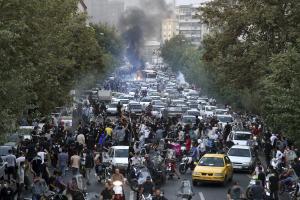
The government of Ethiopia recently declared a state of emergency in response to a wave of massive protests by that country’s Oromo people. For decades the Oromo have been the targets of government oppression and political repression even though they represent more than a third of Ethiopia’s population. The frequency and intensity of Oromo resistance has increased in recent months, and it was highlighted by a cross-armed gesture made during the Olympics by Feyisa Lilesa, an Oromo who ran the marathon for Ethiopia. (Holding the arms above the head to form an “x” is a gesture of Oromo resistance.)
The most recent crisis follows accusations that Ethiopian security forces fired bullets and teargas into a crowd of an estimated two million Oromo gathered for a holy festival. The Ethiopian government says there were 55 deaths, but activists claim more than 500 people died in the resulting stampede. In addition, by at least one account the government’s recent confiscation of Oromo farmland for purposes of commercial development for foreign businesses sparked protests around the country.
Perhaps of even greater concern to the government is emerging solidarity between the Oromo and Ethiopia’s Amhara people. The current Ethiopian government, dominated by elites of the Tigray people, has encouraged hostility between the Oromo and the Amhara in order to preserve government hegemony. However, the government has reacted violently to the protests of both the Oromo and the Amhara, and the two groups have begun to make common cause. At rallies, Amhara activists have proclaimed: “I am not Oromo but I stand with my Oromo brothers.” “We are all Oromo.”
“The government has reacted violently to the protests of both the Oromo and the Amhara, and the two groups have begun to make common cause.”
Lurking in the shadows of the upheaval is the United States of America. Ethiopia is among the top ten African recipients of U.S. military financing, notwithstanding complaints that the Ethiopian government has used this support to violate human rights. Even the U.S. State Department has complained about “restrictions on freedom of expression…restrictions on freedom of association, including through arrests; politically motivated trials, and harassment and intimidation of opposition members and journalists.” Nevertheless, in March the U.S. and Ethiopia signed a new security partnership agreement. While the U.S. apparently believes this relationship is necessary because of the supposed role Ethiopia can play in combating terrorism in the region, evolving U.S. military operations in the Horn of Africa make Ethiopia a place to watch carefully in coming months.
Of particular concern is the fact that “Task Force Hurricane,” a U.S. military unit that will work out of Camp Lemonnier in Djibouti, was recently launched. This unit is designed to carry out the mission of the East African Response Force (EARF) which, because of the attack on the U.S. embassy in Libya, is focused heavily on protecting diplomatic personnel. An EARF company commander explained: “The EARF is a rifle infantry company that is on standby for a short notification to deploy rapidly in response to a crisis in a permissive environment.” One of the unit’s private first class soldiers was more plain-spoken. He said: “…if anything was to ever go down, we need to be prepared, we need to be ready to go. The purpose of the EARF is that we are supposed to be ready if we ever get called to go to an embassy or if anything ever goes down, we are ready to fight.”
“Ethiopia is among the top ten African recipients of U.S. military financing.”
What does all of this mean if at any time protesters are perceived to be threats to foreign embassies or U.S. citizens? Already the U.S. embassy has blamed the death of a post-doctoral biology researcher from the University of California-Davis on protesters who allegedly threw stones at her vehicle while she was in Ethiopia for a meeting. Protesters in Ethiopia have also been blamed for damaging a Turkish textile firm’s factory and a Turkish owned cable plant. When commenting on the state of emergency, Ethiopia’s prime minister said: “We want to put an end to the damage that is being carried out against infrastructure projects, health centers, administration and justice buildings.” Will U.S. troops be called into Ethiopia to do battle with civilian protesters?
At the time of the signing of the new security partnership agreement with the U.S., Ethiopian Defense Minister Siraj Fegessa said: “I look forward to continuing the close cooperation of our two defense forces. I have no doubts that we will turn that into a truly successful endeavor.” Speaking for the U.S., AFRICOM’s Commander David Rodriguez said: “Support between the Ethiopians and the U.S. will continue to be broad ranging, and will include equipment, training, advisory support, information sharing, and logistics support.” While visiting Ethiopia last year, President Obama called Ethiopia an “outstanding partner” in the fight against terrorists.
The protests against the Ethiopian government are likely to continue, and there is potential for revolution. The U.S. may ultimately face the hard choice of deciding whether its friendship with the Ethiopian government is worth sending U.S. troops into a country in turmoil to suppress civilians who fight for the most basic human rights.
Mark P. Fancher is an attorney who writes frequently about the U.S. military presence in Africa. He can be contacted at mfancher@comcast.net.

 The grassroots resistance against data centers is about more than zoning and community benefit agreements. It is the latest front in America’s war against the people over land, sovereignty, and who…
 To understand the violence of contemporary immigration enforcement, one must trace its lineage directly to the antebellum slave patrols — a system founded on racial terror and complete state control.
 The arson attacks that engulfed the protected forests of he Andean-Patagonia region serve as a reminder that Western conservation models, which dispossess Indigenous peoples of their lands, are…
 When political energy is channeled into opposing an individual, that energy is diverted from the work of building the popular power needed to challenge the empire he represents.
 The Cold War-era "strategy of tension" has evolved into a modern system of hybrid warfare targeting sovereign nations that challenge Western hegemony.


