VIDEO
here
SHARMINI PERIES, EXEC. PRODUCER, TRNN : Welcome to The Real News Network. I'm Sharmini Peries coming to you from Baltimore, where protests are continuing after yet another death in police custody. Freddie Gray, a 25-year-old African-American Baltimore resident died a week after his arrest. Officials have launched a criminal probe into his death, but Maryland's police bill of rights stipulates that only police can investigate police. The Gray family has called for a federal civil rights investigation into the killing because they said they fear that the police are covering up his death.
Ongoing killings and brutality against African-Americans has the black community organizing and raising many questions of who controls law enforcement in this country. Now joining us to discuss this is Glen Ford. Glen has just returned from Black Is Back Coalition's national conference on black community control of police in St. Louis.
Thank you so much for joining us, Glen.
GLEN FORD, EXECUTIVE EDITOR, BLACKAGENDAREPORT.COM : Thank you for the opportunity.
PERIES : So Glen, I hope you've come back with a major solution to this problem.
FORD : Well, black community control of police is the--excuse me, the democratic solution to the problem. The problem that black people have with the police is, black people don't have power and the police are not accountable to them. So black community control of the police is the logical solution, and that's what that conference in St. Louis was about this weekend.
When you talk about Ferguson, you're really talking about a greater black St. Louis population. Ferguson's one of those small towns that now have large black populations as a spillover from very, very black north St. Louis, which is where the conference was held. The conference had the deep involvement and heard the searing testimony from many, many mothers and fathers and sisters and brothers of the victims of police oppression in black America, not just from St. Louis, but from all across the country. All of them saw the logic, and endorsed the logic of black community control of the police.
One of the reasons I think this was such a successful conference is that elements of the Black Is Back Coalition, which is comprised of lots of groups, elements of the Coalition back in January convened a black people's grand jury in Ferguson, which brought a people's indictment against Officer Darren Wilson for murder in the death of Michael Brown. And of course, that is part of the general demand for black community control of police. It's not just that this police army of occupation makes life miserable for black folks, it's the whole U.S. criminal justice system, which includes prosecutors and the courts. And we have to devise ways to sever ourselves from that hostile matrix and complex of power to the extent that we can.
The central message of the conference was that the problem, as we said, is a problem of power. That is, black people are not killed in such horrific numbers by the police because the police are badly trained. They're not killed because police don't have body cameras or other technical fixes. They kill because black people have no power in their own communities, or those communities are run by people who are accountable to folks outside of the communities. So this conference, and I'm sure that when it's replicated across the country, as it will be--this conference firmly, was adamant, that when people come up with these diversionary proposals, these pseudo-solutions to the problem--and that includes just hiring more black cops. And of course it includes stuff like amorphous sensitivity training. The response has to be that black folks demand control of the police that are in their community.
There was a working group within the Coalition that drew up sample legislation that could be used to, for resolutions by local city councils to demand black community control. And there are parts of that resolution that geographically delineate what, where the black community is. You can't just say black community control without saying what are the boundaries there. So that's the kind of thinking and working that's already underway. There are petitions that have been formed nationally demanding black community control of the police.
It was, it was certainly by acclimation, accepted that there should be universal cop watching. That is, everybody ought to be watching and videotaping the cops, making a record of their behavior. After all, that is how the black panther party for self-defense began back in 1966 in Oakland, California. They were a cop watch. And they identified the police as an army of occupation in the black community, and it was true then, and it's true now. And black folks are responding, finally, to that reality.
PERIES : Now Glen, describe for us more what that looks like in terms of a model for policing, controlling the police.
FORD: Well, it could have many different ways of coming into being. The conference was very, very careful not to try to make some kind of cookie-cutter approach to black community control of police. And there's a basic reason that you cannot do that. None of this comes about through the proceduralisms of our bourgeois, go to the polls every two or four years to vote democracy. We're talking about a confrontation with the state as it now exists.
And everybody who's an activist understands that the openings that need to be made involve the seizure of power by people on the ground. The creation of crises that are so difficult, so painful for the rulers to bear that they will agree to proposals that would have been unthinkable before. And so the nature of these crises as they develop, crises that are inevitable because as you said at the beginning of this story, the police like clockwork just keep on doing their murderous job, that by definition these conditions in various localities will be different at different times and different places, and there will be different openings.
Some crises will be more prone to spontaneous violence than others. In other places organized groups of people working quite out in the open in large numbers can help create the creative crisis that forces the rulers to respond to a righteous demand for black community control of police. There's no formula for this. But what we do know is that the black community has been radicalized in a fantastically short period of time. I mean, it's not a year since August 9th, when Michael Brown was shot down in Ferguson. We have not gone through a whole summer season under this new mentality and attitude in the black community. This radicalization.
So we don't know how things are going to develop, but we do know that when these situations present themselves and people seize the time, those of us who are organized need to be ready to talk about what the solutions should be. And the solution is power. Power to control the police. Or replace and displace the police in our communities.
PERIES : Glen, as always, thank you so much for joining us, just back from the Black Is Back Coalition. Thank you, Glen.
FORD: Thank you.
PERIES: And thank you for joining us on The Real News Network.

 Ethiopians and Eritreans from all over Northern California rallied in San Francisco for peace and for the sovereignty and self-determination of their home countries.
 “The principles of anarchism appear to be growing in some corners of the Black community,” due largely to the work and thought of former Black Panther Lorenzo Kom’boa Ervin.
 Now, I wasn’t Yuri Kochiyama amidst toppled chairs, gun smoke scented chaos, cradling Malcolm’s heavy head on the Audubon Ballroom
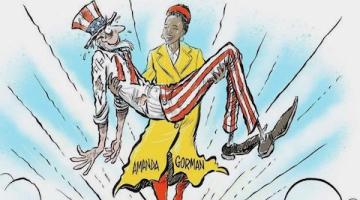 All too often we witness petit-bourgeois African women willingly taking positions of leadership, power, and influence within the political and military infrastructure of the United States.
 As a space for democratic deliberation and decision-making, the jury box still has the potential to shift the criminal legal system – but first we must change who is able to serve on a j


