The Louisiana v. Callais Supreme Court decision has given state legislatures the green light to break up Black and Native voting districts.
Originally published in Struggle La Lucha.
Selma, March 7, 1965. The Supreme Court just finished burying what they marched for.
On April 29, the U.S. Supreme Court gave state legislatures a green light to break up Black and Native voting districts — an attack on Black self-determination, Native sovereignty and basic democratic rights.
The 6-3 ruling in Louisiana v. Callais gutted what remained of Section 2 of the Voting Rights Act of 1965. It struck down Louisiana’s second majority-Black congressional district and opened the door for similar attacks across the country.
Lawmakers can now break up Black and Native voting districts, then say it was not racism — it was just a plan to give Republicans more seats.
The decision landed while public attention was fixed on the U.S. war on Iran, soaring gas prices and preparations for May Day. That timing mattered. War and crisis pushed one of the most sweeping attacks on basic democratic rights since the end of Reconstruction out of the center of public attention. Coming on the eve of May Day, the ruling showed the class character of the attack: It struck at Black political representation, Native sovereignty and the right of oppressed peoples to determine their own political future, while the workers’ movement was preparing to march against war, austerity, racism and repression.
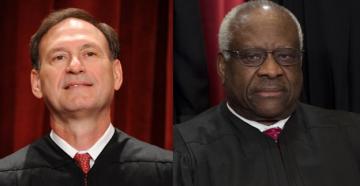
Writing for the conservative majority, Justice Samuel Alito held that Louisiana’s effort to ensure fair representation for Black residents — who make up one-third of the state’s population — was unconstitutional “race-based discrimination.”
Justice Elena Kagan, dissenting, called the ruling the “latest chapter in the majority’s now-completed demolition of the Voting Rights Act.”
She is correct. But the attack did not begin in 2026, and it cannot be understood as a legal matter alone.
1877 again
This is not the first time Black democratic rights have been traded away in a ruling-class crisis.
In the Compromise of 1877, Northern capital and the Southern ruling class struck a counter-revolutionary deal that ended Reconstruction. Control of the South was returned to the old slaveholding order and its successors — the planters, merchants, politicians and railroad magnates who ruled the “redeemed” South. In practice, “home rule” meant white-supremacist rule over the Black masses of the South, enforced by a reign of terror.
Black people in the South paid the price. Federal protection was withdrawn. Reconstruction governments were destroyed. The Southern ruling class imposed Jim Crow: a system of white-supremacist rule over Black people, enforced through disfranchisement, terror, poverty wages and segregation, and used to keep the whole working class divided.
The 1965 Voting Rights Act was won through mass struggle. Black-led movements across the South, joined by supporters across the country, marched, organized and built local movements under the threat of jail, beatings and murder. Black people forced the ruling class to concede basic democratic rights: the right to vote, to be represented and to assert their right to self-determination. Today, the Supreme Court is turning the ruling-class attack on those rights into law. The Louisiana ruling marks a new stage in that attack.
Cover fire
The April 29 ruling did not arrive in a vacuum. The United States is waging a losing war on Iran. Oil prices have surged. Food costs are rising. The government is paying more to borrow money to keep the war machine running.
In the middle of that crisis, the Court struck at basic democratic rights.
From Louisiana to North Carolina, Florida to Mississippi, at least 15 House districts are now at risk. Losing even a handful could produce the largest drop in Black representation in Congress since the end of Reconstruction.
This is how democratic rights are taken back. The ruling class does not need a secret plan. It needs a crisis and the power to use it. While war and economic pressure dominate public attention, the Court and state legislatures move to weaken Black, Native, Latine, Asian, Arab, immigrant and working-class communities before they can answer with organized force.
A map that scatters Black voters in Memphis across rural conservative districts, or eliminates three of Florida’s four Black-held congressional seats, produces exactly that.
State officials moved immediately.
Louisiana Gov. Jeff Landry moved first. He used the Supreme Court ruling to declare an “election emergency” and suspend the May 16 congressional primary after voting had already begun. Ballots already cast were thrown out. The Court had struck down Louisiana’s second majority-Black congressional district; Landry moved to eliminate it.
Alabama moved next. Attorney General Steve Marshall asked the Supreme Court to lift the orders that blocked Alabama from using its old congressional map. That map had been stopped because it broke up Black representation in a state where Black residents make up more than one-quarter of the population. Marshall cited the Louisiana ruling and demanded quick action in three cases.
Tennessee Gov. Bill Lee called lawmakers back to Nashville to redraw the state’s congressional map. The target is Memphis — the state’s only majority-Black district.
Florida moved at the same speed. On April 29, lawmakers approved a DeSantis-backed map just two days after he unveiled it. The map could move Florida’s House delegation from 20-8 Republican to 24-4. It reshapes Democratic areas around Orlando, Tampa-St. Petersburg and South Florida, and effectively eliminates one nearly majority-Black district.
Native sovereignty under attack
The attack on voting rights also reaches Native nations, where political representation is tied directly to sovereignty.
The Court has changed the rules to protect the politicians drawing maps that break up Native communities. Native voters can show that a map splits their communities and denies their sovereignty. The Court ruling says that’s okay.
For tribal nations, political voice affects infrastructure, health care, environmental protection, collectively held land and treaty rights. When Native voters are split among several conservative rural districts, their collective voting strength is destroyed.
Native sovereignty also shapes fights over land, water, pipelines and mining — exactly where corporations and the war economy press hardest. Breaking up Native communities serves the same class interests as breaking up Black representation in Memphis, Louisiana or Florida.
The ruling also shows what “colorblind” constitutionalism does. It takes the political map produced by slavery, Jim Crow, Native dispossession and centuries of exclusion, then declares that map neutral. The result preserves racist inequality while pretending race has been removed from the question.



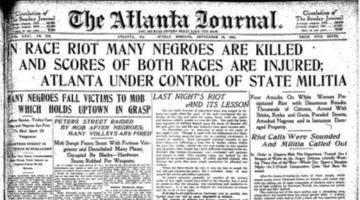 The Atlanta Journal-Constitution never stopped printing racist lies—it just upgraded its fonts.
 Francesca Albanese’s new UN report doesn’t just document genocide, it indicts the corporate machine profiting from Palestinian blood.
 In this week’s segment, we discuss how the UK government protects Israel through terrorism statute lawfare, and media manipulation. But first, Donald Trump announced an early end to Temporary…
 The Trump administration recently announced the end of Temporary Protective Status (TPS) for 500,000 Haitians currently living in the United States. The end of TPS would end their ability to…
 Roger McKenzie is the international editor of the UK-based Morning Star, the only English-language socialist daily newspaper in the world. He joins us from Oxford to discuss how the UK supports…


