The US has a 10-Year Plan to pacify and occupy Haiti using tactics that try to hide its imperial motives. Last week, it was deleted from the website of the US Embassy in Haiti.
On March 23, 2023, the United States State Department posted a summary of its ten-year strategy for Haiti on the website of the US embassy in Haiti. One year since, the summary has been deleted. With a bit of sleuthing, the summary, and the 45-page report it summarizes, can be found elsewhere in the warren of webpages of the State Department. Yet its removal from the Haiti embassy website is bound to raise some questions concerning the United States’s Haiti policy, especially as that policy appears to have imploded through a combination of US diplomatic bungling, international outrage, and, most importantly Haitian defiance.
“The U.S. Strategy to Prevent Conflict and Promote Stability 10-Year Strategic Plan for Haiti,” as it is called, is part of the U.S.’s new, global approach to foreign policy. This policy is outlined in the U.S. Strategy to Prevent Conflict and Promote Stability (SPCPS), and was legally codified in the bipartisan Global Fragility Act of 2019 (GFA) (Div. J, Title V, P.L. 116-94). At the basis of the Global Fragility Act is an approach that transitions from reactive US military intervention in so-called “conflict zones,” to long-term US investments designed to address the underlying causes of conflict and the “fragility” of those states and regions important to US military and economic security. The Act proposes a ten-year inter-agency commitment to Haiti, Libya, Mozambique, Papua New Guinea, and Coastal West Africa (Benin, Côte d’Ivoire, Ghana, Guinea, and Togo) — all seen as “fragile” states. The Global Fragility Act does not mention that its real purpose is also to counteract the growing global influence of the People's Republic of China and the Russian Federation.
Haiti was identified as a “priority country” for advancing the US master-plan due to its “strategic relevance and proximity to the United States.” The US embassy in Haiti was at the forefront of a consultation process that included the Department of State, the Department of the Treasury, the Department of Defense, and the U.S. Agency for International Development, as well as more than 230 people from different elements and classes of Haitian society. The resulting report looks like it was written by an ambitious, aspiring white midwestern college student during their summer Beltway internship: it is crafted in the cliched, technocratic language of neoliberal consultants and NGO workers, and its conclusions claim to be “data-driven,” produced with “stakeholders.” There is no mention, of course, of imperialism or racism, and zero historical context. In effect, this report could have been culled after watching a 3-minute CNN segment on Haiti. It comes as no surprise, then, that “escalating gang violence and political turmoil” is deduced as the root cause of Haiti’s crisis, while “lack of safety and security, economic inequality, and weak governance” are the issues to be focused on. A long-term, “phased” approach to these issues is proposed, but how “sustainable impact and fundamental institutional change” will be implemented, is not clear. Naturally, “the U.S. government will encourage local direction and ownership of all efforts envisioned under this plan” and “locally driven solutions” will be prioritized.
Of course, one cannot but note the fundamental contradiction here: how can you prioritize “locally driven solutions” when the plan and strategy are imposed from abroad (and when the plan itself was not translated into Kreyol)? The plan depicts Haiti (and all classes of Haitian society) as situated on an even political playing field wherein both local and “international” players have equal weight and power. Moreover, while the word “gang” is mentioned thirty-two times in the longer, forty-five page report, “elites” are mentioned but four times — and usually only in relation to “gangs”-- and neither The Core Group, nor the United Nations, nor BINUH, nor MINUSTAH, merit a single mention. (“Cholera,” it should be said, is mentioned once, but it is not linked to the United Nations, the entity that brought it to the country, killing thousands of people). Also conspicuously missing in the plan is any reference to the United States (and France and Canada) as the prime factor behind Haiti’s current and ongoing imperial crisis.
Yet perhaps all of this does not matter. All the consultations and data-crunching have come to naught as US racism and arrogance towards Haiti have tripped over the State Department’s incompetence and insouciance, leading to a bungled, diplomatic disaster that has exposed the cynical, bad faith posture of the US – and revealed the real internal fragility of the Global Fragility Act. And in tried if not necessarily true fashion the US appears to be resorting to its default policy approach to Haiti: force, violence, and military intervention – phased approaches and long-term strategy be damned.
Nevertheless, for your edification, and to preserve this document for the archives of US imperialism, we reprint below the summary of the “The U.S. Strategy to Prevent Conflict and Promote Stability 10-Year Strategic Plan for Haiti.”
The U.S. Strategy to Prevent Conflict and Promote Stability 10-Year Strategic Plan for Haiti
U.S Department of State, March 24, 2023
Summary
The United States is committed to helping Haiti become a safer, more stable, and democratic country, reflecting the deep people-to-people ties between our countries. Haiti faces a uniquely challenging moment in its history — in July 2021, President Jovenel Moïse was assassinated. Since early September 2022, a dramatic deterioration in security has paralyzed the country. Criminal gangs– many backed by corrupt political or economic actors– took control of vital strategic installations, including the Port International de Port-au-Prince and the country’s main fuel terminal (Varreux) for two months. The blockage of the fuel terminal has brought critical services such as water distribution and sanitation, garbage collection, electricity, and health centers to a virtual stand-still.
This acute situation is further exacerbated by Haiti’s extreme vulnerability to environmental shocks. International diplomatic and assistance efforts have achieved mixed results, and their impact has been the subject of scrutiny and debate. Gender-based violence (GBV) and severe gender inequality threaten to undermine stability in Haiti, and women and girls suffer disproportionately from climate change, violence, lack of rule of law, and food insecurity in the country.
In April 2022, President Biden announced the U.S. government would focus on Haiti as a priority country for advancing the U.S. Strategy to Prevent Conflict and Promote Stability (SPCPS). Haiti’s selection was based on its strategic relevance and proximity to the United States and the need for a more coordinated long-term approach to address drivers of instability in the country. The security situation in Haiti continues to significantly deteriorate, which only underscores the urgency to take a long-term approach to buttress and integrate U.S. diplomacy, development, and security-sector engagement in Haiti. This plan provides a framework and sequenced approach for U.S. efforts, which can be scaled and sequenced based upon political and security openings in the country.
This plan was developed through an embassy-led interagency process. Thorough consultations with over 230 individuals representing Haitian government and civil society, multilateral and bilateral organizations, the private sector, academia, Haitian diaspora, and experts and practitioners shaped the plan, as did broader U.S. interagency policy deliberations on Haiti outlining a long-term strategic vision for Global Fragility Act (GFA) efforts in country. This working group will continue as a coordination mechanism during its implementation. The plan supports and will inform all U.S. government diplomatic and foreign assistance strategies for Haiti, including the U.S. Department of State Integrated Country Strategy and the 2020-2024 USAID/Haiti Strategic Framework.
The plan seeks to orient and align U.S. efforts over time toward a long-term goal: that Haiti’s citizens and government advance a shared vision and a permissive environment for long-term stability. This goal envisions that government institutions become more capable and responsive to the basic needs of Haitians, and at the same time, Haitians develop sufficiently increased trust in public institutions to participate in Haiti’s civic and political processes.
Under this plan, United States will marshal diplomatic engagement and assistance over time to support two overarching objectives:
- Objective 1: Advancing responsive and accountable governance and security.
- Objective 2: Supporting an engaged and prosperous citizenry.
The plan envisions a phased approach, prioritizing security and justice sector efforts at the outset in light of Haiti’s current context. During this first phase, U.S. government efforts will engage and leverage partners among Haitian civil society and the Haitian National Police (HNP) to inform and implement programming to strengthen citizen security and the rule of law, while ensuring the protection and promotion of human rights and accountability. Initial efforts will focus on key high-crime and high-violence neighborhoods and key transportation and economic hubs.
Following the targeting of security and justice needs under Phase I, Phase II will begin addressing root causes of instability, building on justice sector reform while addressing civic engagement and economic opportunity. Phase III will help expand Haitian-owned systems to have sustainable impact and fundamental institutional change. Phasing will enable the U.S. government to adapt to changing circumstances on the ground, including capitalizing on targets of opportunity.
The plan places a strong emphasis on partnering with Haitian leaders and stakeholders. To ensure greater sustainability and impact, the U.S. government will encourage local direction and ownership of all efforts envisioned under this plan. Cognizant of the ongoing challenge of engaging with the government amid the current crisis, the United States will seek and engage reform-minded leaders at both national and local levels. This plan outlines a local partnership approach to engage as wide a representation of stakeholders as possible, ensuring that Haitians are protagonists in shaping and implementing their country’s development path. It also includes a strategic communication plan to ensure U.S. government-funded efforts are effectively amplified throughout the country.
This plan acknowledges that despite best intentions and having invested significant resources to date, U.S.-led and other international diplomatic and assistance efforts in Haiti have not always achieved their aims or resulted in inclusive, equitable outcomes. In line with SPCPS’s goals, the U.S. government is committed to promoting innovative and evidence-based approaches. The plan will respond to and incorporate lessons learned from decades of interventions in Haiti and elsewhere: that lasting results require whole-of-government collaboration, a more holistic, systems approach to address Haiti’s drivers of instability and a planning horizon that extends beyond traditional funding cycles. In addition to working with Haitian government actors where possible, the U.S. government will deepen engagement with Haitian civil society, including religious groups and NGOs, as well as other international donors, Haitian diaspora organizations, and multilateral organizations to advance this plan.
Specifically, the U.S. government is committed to advancing the following areas of innovation through this plan:
- Applying a phased and targeted approach: Taking a long-term, holistic view, that seizes upon political will and opportunities for partnership.
- Focusing on progress over programs: Emphasizing a forward-thinking rather than reactive mindset that prioritizes sustainable outcomes in priority areas.
- Seeking innovation while scaling success: Identifying innovative as well as proven, evidence-based initiatives that can be scaled.
- Spurring an increased level of internal U.S. government coordination: Ensuring that U.S. government efforts across departments and agencies are well-aligned and optimized along a shared strategy.
- Prioritizing locally driven solutions: The plan ensures that local partnership and coordination undergird all elements of the strategy, ensuring greater sustainability and impact of U.S. efforts.
- Fostering intentional international coordination: The plan outlines a strategy for international coordination to promote donor alignment, guard against duplication, and maximize impact.
The plan explicitly acknowledges and seeks to address many risks inherent to the approach which, unmitigated, could hinder achievement of the objectives. This includes the overall political and security situation in Haiti. U.S. government efforts are intended to be able to adapt to the changing environment on the ground. Where opportunity exists for greater impact, the U.S. government will scale up support, and where efforts are less successful, will scale back or terminate programming or alter approaches. Rigorous monitoring, evaluation, and learning (MEL) will be central to the success of this plan. We will ensure we learn lessons from prior efforts in Haiti and feed these into program and policy development, both in the design phase and through real-time adaptation


 Three years into Israel's genocide in Gaza, the consequences of a decision driven by siege, settlement expansion, and assaults on Al-Aqsa are still unfolding.
 In this week’s segment we hear about the right-wing politics of the anti-migrant movement in South Africa, ANC failures, and upcoming elections in that country. But we begin with the first and only…
 Chris Smalls discusses his memoir, "When the Revolution Comes: A Fight for the Future of the Working Class," published by Penguin Random House. He is the first and only union leader to successfully…
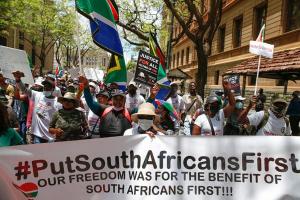 Our guest is Nairobi based political writer and strategist Clinton Nzala. He joins us to provide an update and an analysis of the South African anti-migrant March and March movement, which is…
 The Hague Group’s goal is to “. . . take coordinated legal and diplomatic measures against Israel’s violations of international law.” But international law was never a reality.


