One of the greatest fictions of democracy is that people oppressed by their own government can place their faith in the electoral process.
“The United States may be a lot more like Haiti than it cares to admit.”
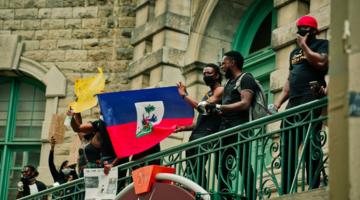
News of the arrest and subsequent deportation of five armed US citizens in Haiti last week has come to dominate the news cycle in recent days. This is a distraction from the real story. The US public should be paying attention instead to our government’s highly asymmetrical response to protests in Haiti and Venezuela. The inference that the people of Venezuela are democracy seekers, while those in Haiti are democracy destroyers, exposes the US’s favorite political institution itself as a lie.
President Trump was recently championed by Fox News when he expressed support in the name of the Venezuelan people for the immediate removal of Maduro. The Venezuelan president was elected to a second term in May 2018, but his opponents claimed that electoral corruption disqualified the results.
In contrast, despite similar accusations of unfair elections in Haiti, the U.S., as member of Core Group, has urged “respect” for the process that brought Moïse to the presidency:
“II would be a grave error to state that simply because there were elections in Haiti, the country has a representative democracy.”
"Reiterating the fact that in a democracy change must come through the ballot box, and not through violence, the Core Group urges the executive and legislative branches of power to collaborate for the electoral law and the 2018-2019 budget law to be adopted and promulgated as soon as possible. It is only through these actions that the elections scheduled by the Constitution for October 2019, can be held in a free, fair and transparent manner…."
The Core Group’s statement betrays the false assumption that in one writer’s estimation, “the words ‘election’ and ‘democracy’ have become synonymous.” As in the case of Venezuela, it would be a grave error to state that simply because there were elections in Haiti, the country has a representative democracy.
According to a report from the Institute for Justice and Democracy in Haiti, the 2016 elections that brought Moïse to power were “organized by an interim government that lacked constitutional legitimacy,” and because so many Haitians have been historically excluded from voting, much of the populace has lost faith in elections, in general.
The United States is no stranger to such democratic disillusionment. The famous poet Langston Hughes once opined, “I swear to the Lord, I still can't see, Why Democracy means, Everybody but me.”
The kinds of claims of voter suppression that have been reported in Haiti and Venezuela have historically been characteristic of elections in the United States, too.
“Much of the populace has lost faith in elections, in general.”
Electoral laws in the US were, in fact, created to exclude. At the founding of the country, anyone not male and who lacked property ownership was prevented from voting. Black men in the United States did not gain the right to vote until the fifteenth amendment in 1870. Women could not universally vote until 1920. Even with these developments, intimidation at the polls, along with various exclusionary local and state laws in the southern US, maintained black voter suppression. The Voting Rights Act, which attempted to once and for all mandate universal suffrage in the United States, was not passed until 1965. That black voter turn-out immediately ballooned after the law’s passage merely confirmed that African Americans had been prevented from participating in the “democratic” process for the majority of US history.
Even today, while many US politicians proclaim the country to be the longest standing democracy in the world, our elections are plagued with irregularities and inequalities, from fraud, to gerrymandering, to discriminatory ID laws, to judicial interference, to disqualification of large members of the populace as a result of mass incarceration, and most recently, to alleged foreign interference.
Thus, the United States may be a lot more like Haiti than it cares to admit.
“Trump’s election resulted from ‘a loophole in the United States electoral system.’”
Indeed, after President Trump reportedly referred to Haiti as one of the “shithole countries,” the US-based Haitian Studies Association pointed out the similarities between Haitian and US politics in the statement it issued to remind the public that Trump’s presidency is “of questionable legitimacy.” Trump’s election resulted from “a loophole in the United States electoral system," the statement reads, "and probable intervention by a foreign nation, a situation with which Haitians are familiar.”
The myriad ways the US voting system neither reflects the will nor addresses the needs of the majority of the US public has even led some to proclaim that “America is not a democracy.” Perhaps, the real problem though is not America but democracy itself.
Many people in the US are experiencing a life under “democracy” in which they are threatened by the precisely the same kinds of problems as so-called developing nations like Haiti. These include crumbling infrastructures, pollution by industrial toxins and human waste, fatal exclusion from access to medical care, forms of poverty that are making them vulnerable to homelessness and addiction, and legendary gun violence.
It is high time for people in the US to begin to seriously question whether democracy is in service of the people or only of the people in power. For, one of the greatest fictions of democracy is that people oppressed by their own government can place their faith in the electoral process to make their lives better. Anyone who views democracy as having produced freedom and equality for all in the United States, is likely someone being protected by such a flawed political institution, and not someone whom it is excluding and even destroying.
Marlene L. Daut is Associate Professor of African Diaspora Studies in the Carter G. Woodson Institute for African American and African Studies and the Program in American Studies at the University of Virginia. She specializes in early Caribbean, 19th-century African American, and early modern French colonial literary and historical studies. Her first book, Tropics of Haiti: Race and the Literary History of the Haitian Revolution in the Atlantic World, 1789-1865, was published in 2015 by Liverpool University Press' Series in the Study of International Slavery. Her second book, Baron de Vastey and the Origins of Black Atlantic Humanism, was published in fall 2017 from Palgrave Macmillan’s series in the New Urban Atlantic.
COMMENTS?
Please join the conversation on Black Agenda Report's Facebook page at http://facebook.com/blackagendareport
Or, you can comment by emailing us at comments@blackagendareport.com



 The 1976 bombing of Cubana Flight 455 was part of a six-decade U.S.-orchestrated campaign of destabilization against Cuba, which has now escalated into a genocidal siege aimed at starving the Cuban…
 While Trump pardoned an actual drug lord president, he keeps a kidnapped Venezuelan president, Nicolas Maduro, and his wife, First Combatant Celia Flores, in a mold-infested Brooklyn jail on false…
 Jeffrey Isaac Jarquin was deported from the U.S. by ICE and upon arrival in Managua was sent to prison by Nicaraguan authorities. Corporate media has decried the detention of a “torture victim” and “…
 In this week’s segment, we discuss student protests by Black and brown youth in France against austerity measures and race-based inequality in the education system. But we begin with a discussion of…
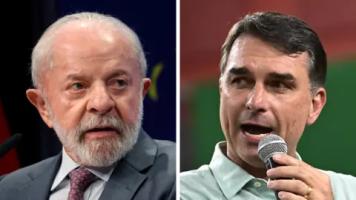 Brazil's incumbent president Lula da Silva finished second behind Flavio Bolsonaro in the first round of the presidential election. Because neither man received at least 51% of the vote, a run-off…


