President Maduro holding up a map of Venezuela and the Essequibo (Photo: Presidential Press | X: @PrensaPresidencial)
Brazil’s Lula, along with leaders from CELAC and CARICOM, will facilitate talks between Caracas and Georgetown to promote peace in the region.
Originally published in venezuelanalysis.com.
Caracas, December 11, 2023 (venezuelanalysis.com) – Venezuelan President Nicolás Maduro will meet with Guyana’s President Irfaan Ali on December 14 to address the ongoing Essequibo controversy amidst increased tensions and threats of military deployment.
The meeting will be hosted by the Prime Minister of St. Vincent and the Grenadines, Ralph Gonsalves, who sent a letter Saturday to Maduro and Ali urging them to “de-escalate the conflict and institute an appropriate dialogue.”
In his letter, Gonsalves said that both Guyana and Venezuela had agreed to talk with mediation from Brazil’s Luiz Inácio Lula da Silva, a United Nations (UN) representative and the leaderships of the Community of Latin American and Caribbean States (CELAC) and the Caribbean Community (CARICOM), of which St. Vincent and the Grenadines and Dominica hold the respective pro tempore presidencies.
“Both of you are on public record for committing to the Caribbean as a Zone of Peace and the maintenance of international law,” Gonsalves reminded the Venezuelan and Guyanese heads of state, adding that “time is of the essence” and that much was “at stake.”
Venezuelan Foreign Affairs Minister Yván Gil thanked the Caribbean leaders for their efforts to promote a dialogue between Caracas and Georgetown. In a communique on Saturday, Caracas also reiterated its commitment to solving the Essequibo dispute adhering to the 1966 Guyana Agreement and maintaining the region “free of foreign interference.”
On Monday morning, Gil and Communications Minister Freddy Ñáñez held a breakfast with reporters in the Foreign Ministry headquarters in Caracas to discuss the ongoing territorial dispute.
“The holding of the upcoming summit is a victory for Venezuela’s commitment to dialogue,” Gil told those present. He went on to stress Venezuela’s commitment to the 1966 Geneva Agreement. “It is the only valid instrument to resolve the controversy.”
For its part, the Guyanese government notified that President Ali had agreed to meet with Maduro but “will not deviate from and will strictly adhere to the ICJ [International Court of Justice] process in the resolution of the border controversy.”
A communique issued Saturday added that Guyana would continue to engage with bilateral partners “on defense cooperation pacts, as well as the ongoing range of political, social and economic arrangements” involving the Essequibo resources.
Recently, the Guyanese Defense Forces (GDF) engaged with the US Southern Command (SouthCom) and other military partners to conduct operations in the Essequibo area alleging the need for self-defense after accusing Caracas of “annexation” plans. In response, the Venezuelan government denounced the threat of a foreign military presence in the region. President Maduro created a defense zone for the Essequibo while maintaining its commitment to dialogue.
According to the US embassy in Guyana, on December 7 the US Southcom conducted “flight operations” alongside the GDF. Previously, the Caribbean nation had hosted the Tradewinds multinational military exercise with the US SouthCom and welcomed US State Secretary Antony Blinken.
Guyana strengthened ties with Washington after US oil giant ExxonMobil discovered 11 billion barrels of high-quality crude in the Essequibo’s undelimited territorial waters in 2015. Since then, Guyanese governments have proceeded with bidding processes for oil exploration, which Caracas has rejected as violations of the unresolved border lines.
In March 2023, General Laura Richardson, Commander of US Southern Command, told the US Senate Armed Services Committee that Guyana was a “very willing partner” and called to expand US presence in the country, emphasizing its strategic location next to Venezuela.
“That is a very willing partner, Guyana, the fastest-growing economy in the world right now because of the light, sweet crude that was discovered off their shores […] our embassy there needs to be a little bit bigger to help them channel and guide them with all these new additional resources,” said Richardson.
Venezuela has likewise accused Guyana of serving the interests of ExxonMobil while analysts say the small nation is trapped in a very unfavorable deal that grants the Texas-based company 75 percent of oil revenue while exempting it from taxes. The 2016 agreement prohibits Guyana from modifying or terminating the contract without Exxon’s consent.
A June 2023 Intercept investigation likewise documented the close ties between Georgetown and the oil corporation, signaling strong influence in Guyanese policies and a massive propaganda campaign in favor of the company’s presence in the country.
Amidst increased tensions, the Maduro government held a referendum on December 3, in which Venezuelans approved the creation of a new state called Guayana Esequiba, rejected the ICJ’s jurisdiction to rule on the border issue and refused the 1899 arbitration award that granted the Essequibo to the United Kingdom, Guyana’s former colonizer. The popular vote also supported the 1966 Geneva Agreement as the only instrument to solve the controversy.
Following the vote, President Maduro proposed legislation to advance the addition of Guayana Esequiba as Venezuela’s 24th state, ordered the creation of several civil and military institutions for the disputed Essequibo region, and approved granting oil, gas and mining licenses while demanding companies dealing with Guyana to leave the Essequibo area.
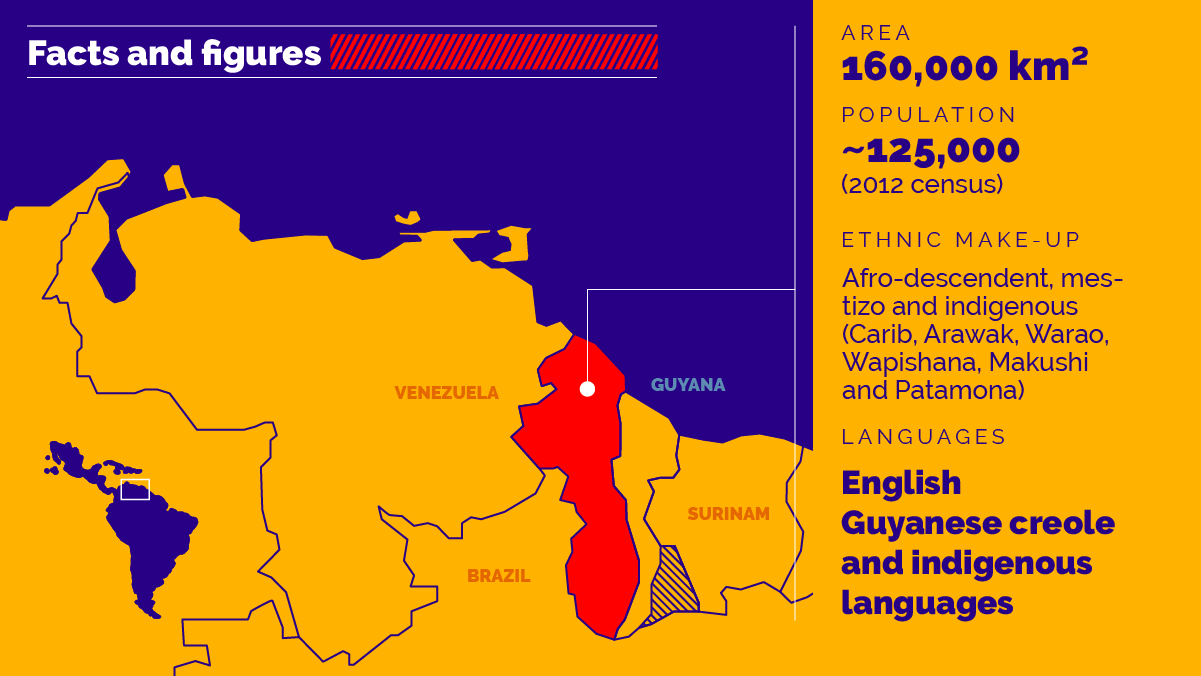
The Essequibo dispute timeline
The two neighboring South American countries’ dispute over the 160,000 square kilometer Essequibo Strip dates back to the 19th century. Venezuela has consistently maintained that the resource-rich territory had been part of the country since gaining independence from Spain in the early 1800s.
For its part, Guyana —a former Dutch and British colony until 1966— says the border issue was settled by a Paris Arbitration Panel in 1899 that granted the Essequibo to the United Kingdom. Caracas, however, says the ruling was a “fraud” due to the lack of Venezuelan representation as well as alleged evidence of collusion between the judges. At the time, Venezuela was purportedly represented by the United States.
In light of the continuous border issues, in February 1966 the United Kingdom reached an agreement with Venezuela, known as the Geneva Agreement, which commits the countries to work out a mutually satisfactory solution through direct dialogue. Guyana took over the UK’s role after gaining independence months later. Since then, Guyanese governments have repeatedly refused to engage in negotiations with Caracas by arguing that the Venezuelan part has not proven the fraudulent nature of the 1899 ruling in court.
During the Hugo Chávez government (1999-2013), the controversy receded as the two nations forged closer ties, including an oil-for-rice cooperation agreement through the PetroCaribe program, which ended in November 2015 following ExxonMobil’s crude discoveries in the Essequibo waters. PetroCaribe was paralyzed in 2018 as Venezuela’s economic crisis worsened under US sanctions.
With oil resources entering the equation, in March 2018 then-Guyana President David Granger requested that the International Court of Justice end the Essequibo controversy by upholding the 1899 ruling. Caracas is currently challenging the court’s jurisdiction while defending the 1966 accord as the only binding instrument to solve the border issue.
Andreína Chávez Alava is a writer for Venezuelanalysis, an independent website produced by journalists and researchers who are dedicated to producing news and analysis about the current political situation in Venezuela.

 Schools across the U.S. have altered policies and even landscapes in an attempt to make a repeat of last spring’s Palestine protests impossible. The result is a far-reaching war on free expression…
 Israel once again is attempting to circumvent international law by appealing to the U.S.
 60 years ago, the Mississippi Freedom Democrats took a stand at the Democratic National Convention, bodily challenging the racist party and the violent voter repression of Black people. Years…
 We are joined by Jasiri Fahali Kiyamaa, an organizer of Curbfest, an event advocating for political prisoners. New York City's Curbfest will take place on Saturday, September 7, 2024 in Brooklyn.
 In 2020 our late comrade Glen Ford spoke at a Black is Back Coalition video conference on political prisoners. In these excerpts of his remarks, he discussed the need to understand the political…


